
People with coeliac disease who also keep an eye on carbohydrates
You need a strictly gluten-free product and also want to assess the carbohydrates, sugars, fibre and size of your usual portion.


If you have coeliac disease, first choose breakfast cereal clearly labelled gluten-free. This is especially important with oats, as they may be cross-contaminated, according to the Dutch Coeliac Association. Then compare carbohydrates, sugars and fibre per 100 g and for the portion you eat. Gluten-free granola can vary considerably from unsweetened gluten-free rolled oats or muesli.
You need a strictly gluten-free product and also want to assess the carbohydrates, sugars, fibre and size of your usual portion.
You want to know whether an oat product is clearly labelled gluten-free. According to the Dutch Coeliac Association, oats may come into contact with gluten during growing or processing.
You’re looking for a crunchy gluten-free option, but want to compare the sugars and carbohydrates per portion. Granola is a different product category from standard flakes.
If you have coeliac disease, check the gluten-free labelling first. Only then compare the nutritional information of products that meet this requirement.
| What to look for | What to check when buying | Who it matters most to |
|---|---|---|
| Gluten-free status | Look for clear gluten-free labelling. For oats, the Dutch Coeliac Association recommends the Crossed Grain symbol; check the ingredients and allergen information too. | If I have coeliac disease, I want to be sure that an oat product is clearly labelled as suitable too. Around 39% of consumers give this check their highest priority. |
| Carbohydrates and ingredients | Compare carbohydrates, of which sugars, and fibre per 100 g; also work out these values for your portion. Diabetes Fonds highlights unsweetened, high-fibre breakfast cereals as something to consider. | When I’m watching the carbohydrates in my breakfast, I don’t want to rely on a sugar claim alone. For around 38% of consumers, this nutritional consideration comes first. |
| Portion size and allergens | Check the nutritional information for the amount you eat and read the allergen information, especially for granola containing peanuts or nuts. | I want a crunchy breakfast I can enjoy in a suitable portion, without overlooking an allergen that matters to me. This consideration comes first for around 23% of consumers. |
The nutritional content varies from product to product. According to Jumbo’s product information, Free Of Gluten Crunchy Granola Nuts-Honey contains 21 g of sugars per 100 g, compared with 1.9 g per 100 g for Holie’s Gluten Free Granola Buckwheat & Nuts.
As well as sugars, compare the total carbohydrates and the portion you actually eat.
Oats may come into contact with gluten. Fibre content doesn’t tell you whether a product is gluten-free either: according to Jumbo’s product information, Brinta Wholegrain Cereal Breakfast contains wheat, while Kellogg’s lists wheat bran and barley malt extract in All-Bran Fibre Plus.
If you have coeliac disease, choose a product that is clearly labelled gluten-free. Check the ingredients and allergens on every new pack.
A low sugar value doesn’t tell you how many total carbohydrates are in your portion. Granola containing nuts may also be unsuitable if you have a nut allergy.
Compare the nutritional information per 100 g and per portion, and check the allergens before choosing a variety.
Product ranges can change, and product information may be updated. This is especially important if gluten-free labelling or an allergen affects your choice.
Check the current pack for gluten-free labelling, ingredients, allergens and nutritional information.
AH Glutenvrij Granola is a good example for anyone looking for granola that is clearly labelled gluten-free.
Gluten Free Granola Buckwheat & Nuts is a gluten-free buckwheat and nut granola; the nutritional values apply to this specific variety.
Crunchy Granola Nuts-Honey is an example of crunchy gluten-free granola whose nutritional value is worth checking separately.
If you need to eat strictly gluten-free, the ingredients list is what matters for Brinta Wholegrain Cereal Breakfast.
Check Kellogg’s breakfast cereals variety by variety, rather than relying on a fibre claim or the brand name.
The range includes different types of granola. Being listed in the granola category doesn’t, by itself, mean that every variety is gluten-free.
ALDI includes gluten-free muesli and porridge oats in its breakfast cereal range.
When gluten-free ranges change, the current pack matters more than an older listing in the range.
This is a crunchy granola option for anyone who wants to check the portion size and allergens as well as the gluten-free labelling. Granola isn’t a substitute for comparing standard flakes, rolled oats and muesli.
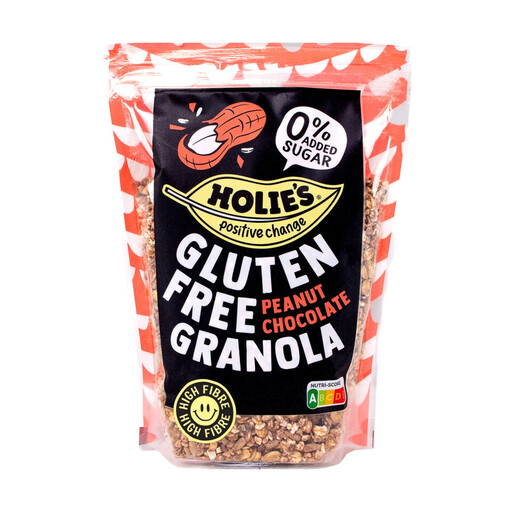 Image unavailable
An option if you’re looking for crunchy gluten-free granola and want to assess the nutritional information for your own portion.
330 g pack. According to the product information, this Peanut Chocolate variety contains peanuts; if you have allergies, check the other allergens on the current pack too.
No. Being gluten-free says nothing about the amount of carbohydrates, sugars or fibre. According to Jumbo’s product information, two gluten-free granolas, Holie’s Buckwheat & Nuts and Free Of Gluten Nuts-Honey, contain 1.9 g and 21 g of sugars per 100 g respectively. Also compare the total carbohydrates in the portion you eat.
Choose oats that are clearly labelled gluten-free. The Dutch Coeliac Association recommends the Crossed Grain symbol; otherwise, look for a gluten-free logo or statement, as oats may come into contact with gluten. A small number of people with coeliac disease also react to pure oats; if you have symptoms, speak to a doctor or specialist dietitian.
Compare carbohydrates, of which sugars, and fibre per 100 g and for the amount you eat. Also check whether added sugars are listed. Diabetes Fonds recommends wholegrain breakfast cereals with no added sugar as a starting point when putting together breakfast.
Check the current pack before using the product too. Ingredients and allergen information can change, so this final check is important if you have coeliac disease or a food allergy.