
People with coeliac disease who want bread late at night
You’re looking for a product labelled gluten-free and want to avoid it coming into contact with crumbs from ordinary bread during storage or preparation.


If you have coeliac disease, choose bread or rolls clearly labelled gluten-free and avoid contact with crumbs from ordinary bread. Sliced bread is handy for a late-night snack when you want to eat straight away; check how rolls need to be prepared, while a bread mix needs to be baked first. If you’re looking for an alternative to wholemeal bread, compare the fibre content too, and check whether the ingredients include iodised salt or baker’s salt.
You’re looking for a product labelled gluten-free and want to avoid it coming into contact with crumbs from ordinary bread during storage or preparation.
You want to assess gluten-free options on more than just colour or taste, and compare their fibre content and whether they list iodised salt or baker’s salt.
Your choice depends on how much time you have: eat a slice straight away or prepare a roll first. Either way, the gluten-free label is key.
| What to consider | What should you check? | Who is this most important for? |
|---|---|---|
| Gluten-free status and cross-contamination | Read the gluten-free label and allergen information on the packaging. Keep the bread and utensils free from ordinary bread crumbs. | With coeliac disease, I want to be able to grab some bread for a quick evening snack without it coming into contact with ordinary crumbs. Around 42% of consumers give this reassurance top priority. |
| Fibre and salt used | Compare fibre per 100 g or per portion, and check the ingredients to see whether iodised salt or baker’s salt has been used. | If I’m replacing my usual wholemeal bread, I want to be able to compare the nutritional information of the alternatives. For around 33% of consumers, this nutritional profile matters most. |
| Preparation and portion size | Check the portion size, preparation instructions and storage guidance after opening. | Late at night, I want to know whether I can eat a slice straight away or need to prepare a roll first. Convenience comes first for around 25% of consumers. |
Spelt is a type of wheat and contains gluten. A dark colour or visible seeds don’t mean that bread is suitable for people with coeliac disease either.
Check for an explicit gluten-free label and the up-to-date allergen information, rather than relying on the product name alone.
Gluten-free bread can come into contact with gluten-containing crumbs at home, for example on a chopping board or in a shared toaster.
Store it separately and use clean utensils and a separate toaster.
Gluten-free bread that’s dark or contains seeds doesn’t automatically have the same fibre content as your usual wholemeal bread. The Voedingscentrum also says that bakers aren’t required to use baker’s salt.
Compare the fibre in the nutritional information and check whether each product lists iodised salt or baker’s salt in its ingredients.
Albert Heijn’s gluten-free range includes packaged seeded bread, rolls and snack products.
Schär’s gluten-free bread ranges include Meisterbäcker loaves, ciabatta and baguettini.
Consenza’s range includes fresh gluten-free loaves, bread rolls, bake-at-home products and frozen options.
These products offer two different options: Gv Baguette Mini if you’re looking for a small bread format, and a Schär bread mix if you’d rather bake bread yourself in advance. For both products, check the gluten-free label on the current packaging, and find out how the baguettes need to be prepared.
 Image unavailable
A small bread option to consider if you’re planning a late-night snack. The product name states that there are 7 pieces; check the packaging to see whether the rolls need baking or you need to make the dough first, and read the gluten-free label and allergen information.
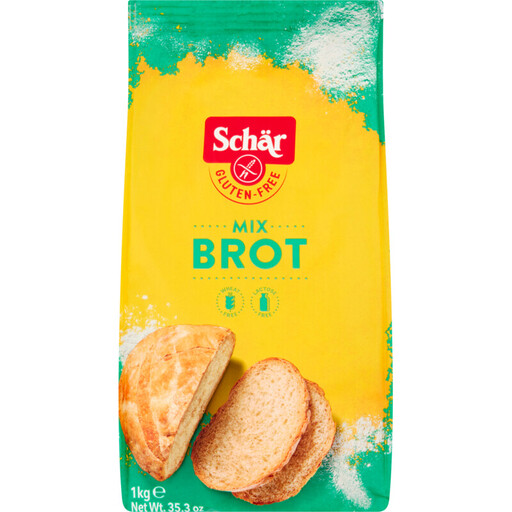 Image unavailable
For anyone who wants to bake bread in advance, rather than enjoy a ready-to-eat late-night snack. The product name states that the pack contains 1 kg of mix; check the preparation instructions, gluten-free label, ingredients and nutritional information on the packaging.
Not as a substitute for bread labelled gluten-free. Spelt is a type of wheat; with dark or seeded bread, check the packaging rather than relying on the name.
Under Commission Implementing Regulation (EU) No 828/2014, a food intended for the final consumer may be labelled ‘gluten-free’ if it contains no more than 20 mg of gluten per kg. The label doesn’t remove the need to avoid contact with gluten-containing crumbs during preparation.
Compare the fibre per 100 g or per portion, and check which type of salt is listed in the ingredients. The Voedingscentrum says that bakers don’t have to use baker’s salt, so don’t rely on the bread’s name alone if you want to know whether it contains iodised salt.
Use a separate toaster and clean utensils, and store gluten-free bread separately from ordinary bread. When adding toppings, watch out for crumbs on the worktop and on knives too.