
Travellers with coeliac disease
For breakfast, lunch or a picnic, you need bread that is clearly labelled gluten-free. Away from your own kitchen, preventing cross-contamination also takes care, as the Dutch Coeliac Society highlights.


If you have coeliac disease, choose bread labelled ‘gluten-free’ or bearing the Crossed Grain symbol for your summer holiday; the word ‘wholemeal’ does not make ordinary bread suitable. Then compare the fibre content, allergens and storage instructions on each pack, and avoid contact with gluten-containing crumbs when sharing meals.
For breakfast, lunch or a picnic, you need bread that is clearly labelled gluten-free. Away from your own kitchen, preventing cross-contamination also takes care, as the Dutch Coeliac Society highlights.
If you’re replacing ordinary wholemeal bread, compare the ingredients, fibre per 100 g and serving size of each gluten-free product. A gluten-free label doesn’t tell you how much fibre the bread contains.
The storage temperature, how long the bread keeps once opened and the space available will determine whether it’s practical to use during your journey and at your accommodation.
If you have coeliac disease, first check that the bread is labelled gluten-free and consider how you can use it without cross-contamination. Then compare what suits your trip and which nutritional details matter to you.
| What to consider | What to check when buying | Who it matters to |
|---|---|---|
| Gluten-free labelling and cross-contamination | Check the gluten-free label or Crossed Grain symbol on the pack. Consider whether you can keep the bread, fillings and kitchen utensils separate. | When I eat away from my own kitchen with coeliac disease, I want to avoid my bread coming into contact with gluten-containing crumbs; for around 42% of consumers, this safety concern would come first. |
| Storage and transport | Read the storage instructions for before and after opening, and check whether you’ll need a freezer for a frozen product. | While travelling and at my accommodation, I want to be able to store the bread as instructed; around 33% of consumers would see this as their main consideration when choosing. |
| Fibre and ingredients | Compare fibre per 100 g and read the ingredients and allergen information for the exact variant. | When I replace ordinary wholemeal bread, I want to know which grain ingredients and how much fibre the gluten-free option contains; for around 25% of consumers, that would be the main question. |
These words don’t indicate whether a product is suitable for a gluten-free diet. According to the Netherlands Nutrition Centre, you can identify gluten-free products by the ‘gluten-free’ label or the Crossed Grain symbol.
Check the label on the exact pack before comparing fibre content or types of bread.
The Dutch Coeliac Society warns that gluten-free bread can still come into contact with gluten through crumbs, shared utensils or fillings.
Store the bread separately and use clean hands, a clean knife and separate fillings when preparing and serving it.
The Garbo variant described by Jumbo must be stored at −18 °C or colder and must not be refrozen once thawed.
Choose this kind of product only if you can meet the storage instructions during transport and at your accommodation. Otherwise, check the instructions for a packaged alternative.
A gluten-free label on its own tells you nothing about the fibre content or whether the bread contains iodine. The Netherlands Food and Consumer Product Safety Authority explains that iodine may be added to bread through baker’s salt; that doesn’t mean every gluten-free loaf contains it.
Compare the nutritional information and ingredients on the pack. If you’re replacing ordinary bread regularly and have questions about your diet, discuss them with a dietitian.
A gluten-free bread variant with wholegrain buckwheat flour, as described by Albert Heijn.
Albert Heijn and Jumbo list various gluten-free Schär breads, including Classic, Mehrkorn and Vital.
Albert Heijn’s range includes light and dark multiseed varieties, as well as other types of bread.
Jumbo lists 500 g gluten-free brown and white loaves in this range.
A dark, gluten-free wholemeal sourdough loaf described by Jumbo as suitable for freezer storage.
These products offer two different starting points: a Gv Baguette Mini variant and a Schär bread mix. Check exactly what the first contains and how to prepare it; the mix means making your own bread during your stay.
 Image unavailable
If you’re considering mini baguettes for your trip, check whether this variant contains bread rolls or a mix, and how it needs to be prepared.
If you have coeliac disease, read the gluten-free label on the pack and avoid cross-contamination during preparation. If you have additional allergies, also check the information about soya and possible traces of lupin and mustard.
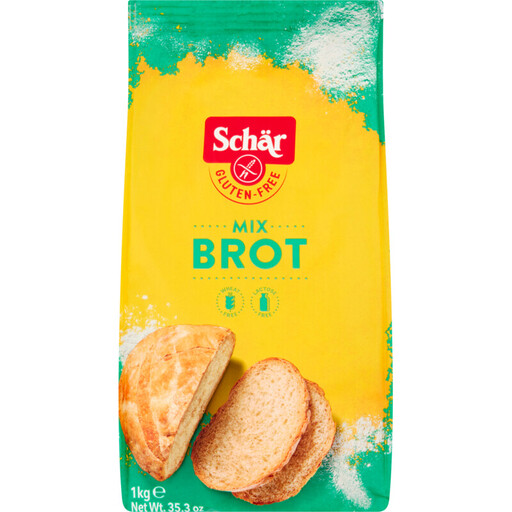 Image unavailable
This 1 kg bread mix is only suitable for a stay where you can make bread; it isn’t ready-to-eat bread for your holiday.
Before using it, check the gluten-free label and allergen information on the pack. If you have coeliac disease, use clean utensils and a clean work surface to avoid cross-contamination.
Under Commission Implementing Regulation (EU) No 828/2014, the label ‘gluten-free’ may be used if the food contains no more than 20 mg of gluten per kg when sold to the final consumer. This EU rule also applies in the Netherlands; ‘wholemeal’, ‘brown’ and ‘spelt’ are not substitutes for this label.
No, the symbol isn’t required to identify bread with an permitted gluten-free label. The Netherlands Nutrition Centre lists both the words ‘gluten-free’ and the Crossed Grain symbol as ways to identify it on the packaging.
Keep gluten-free bread separate and use clean hands, clean utensils and separate fillings. The Dutch Coeliac Society warns that crumbs and shared utensils can also cause cross-contamination.
That isn’t determined by the bread category. The Netherlands Food and Consumer Product Safety Authority explains that iodine compounds may be present in bread and bread substitutes through baker’s salt, up to a maximum of 65 mg of iodine per kg of salt. Check the ingredients of the specific bread or ask the manufacturer if this matters to your choice.
No, choose based on the exact pack, not just a category listing. Before you leave, check availability and, when buying, read the gluten-free label, ingredients, allergens and storage instructions for your chosen variant.