
Looking for gluten-free wholemeal ingredients
You have coeliac disease and want to know which wholemeal ingredients the bread contains, as well as seeing that it is labelled gluten-free. Check both points on the current packaging.


If you have coeliac disease, first choose bread whose current packaging explicitly states that it is gluten-free: ‘wholemeal’, ‘dark’ or ‘seeded’ on their own don’t tell you whether it’s gluten-free. Then compare the wholemeal ingredients and fibre per 100 g, depending on what matters to you, and check the allergens and ingredients of the exact product too.
You have coeliac disease and want to know which wholemeal ingredients the bread contains, as well as seeing that it is labelled gluten-free. Check both points on the current packaging.
You compare gluten-free breads by their fibre content per 100 g. A seeded loaf may be worth considering, but the name alone doesn’t confirm that it’s wholemeal.
Once you’ve bought it, you’ll also need a way to store gluten-free bread separately and prepare it without crumbs from other bread. The Netherlands Nutrition Centre and the Dutch Coeliac Society highlight the importance of keeping it separate.
For bread suitable for coeliac disease, an explicit gluten-free label is essential. Only then compare the wholemeal ingredients, fibre content and practicality of products that meet this requirement.
| What to look for | What should you check? | Who is this most important for? |
|---|---|---|
| Gluten-free label | Look for an explicit gluten-free label on the current packaging; don’t rely on words such as ‘wholemeal’ or ‘spelt’ alone. | When I buy bread for someone with coeliac disease, I want to make sure it’s gluten-free before considering anything else. Around 36% of consumers would say this is their main purchasing priority. |
| Fibre and wholemeal ingredients | Compare fibre on the same basis, per 100 g, and check which wholemeal ingredients are actually listed. | I want to be able to choose between identifiable wholemeal ingredients and a higher fibre content, without assuming that seeded means wholemeal. For around 29% of consumers, this would be the most important consideration after checking that the bread is gluten-free. |
| Availability and storage | Check the current range and read the use-by date and storage instructions for the product you choose. | If I don’t buy bread often, the packaging needs to suit how I store and use it at home. That would be the deciding practical consideration for around 21% of consumers. |
| Iodised salt | Check the ingredients list for iodised salt or baker’s salt; don’t assume every loaf has the same ingredients. | If I don’t eat much bread, I want to know whether the loaf I’ve chosen contains iodised salt. An estimated 14% of consumers would see this as their main additional consideration. |
‘Wholemeal’ describes the parts of the grain used, not the absence of gluten. According to the Netherlands Nutrition Centre, wheat, rye, barley and spelt are among the grains that contain gluten.
First check the gluten-free label on the packaging. Only then assess the wholemeal ingredients and fibre content.
The Netherlands Nutrition Centre warns that even a stray bread crumb can matter if you have coeliac disease. So even after taking care when buying it, it’s still important to store and prepare gluten-free bread separately.
Keep gluten-free bread well wrapped and separate, and use clean or separate chopping boards, knives and equipment.
Whether a product contains iodised salt varies. The type of bread or the shop it comes from is no substitute for checking the ingredients list.
Check the current packaging for iodised salt or baker’s salt. If you have questions about your own diet, speak to a specialist dietitian.
PLUS says that product ingredients, nutritional values and allergy information can change. Bread that was once listed online may also no longer be available.
Check the current packaging every time you buy, especially the gluten-free label, ingredients and allergens.
These names can help you find products to compare. Always check the gluten-free label and ingredients for each bread and its current packaging.
Albert Heijn lists bread products in its own AH Gluten-Free range.
PLUS lists its own gluten-free seeded bread and gluten-free bread products from Schär.
Schär is a gluten-free brand with various bread products listed by shops including PLUS and Dirk.
Dirk lists gluten-free bread products from Schär in its online range.
ALDI lists gluten-free bread rolls in its bakery range.
Lidl has a page for its gluten-free range.
This is a mix for making your own gluten-free bread, not a ready-made wholemeal loaf. Check the ingredients and nutritional information separately for the bread you plan to bake.
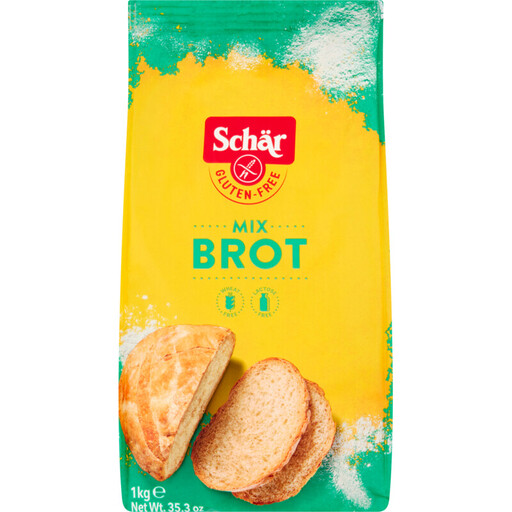 Image unavailable
If you want to bake your own gluten-free bread, this is a bread mix, not a ready-made loaf.
Check the current packaging for allergens, including soya, and for information about possible cross-contamination. Don’t compare the nutritional values of the mix directly with those of prepared bread. The name also doesn’t confirm that the finished bread will be wholemeal.
No. Ordinary wholemeal bread made from gluten-containing grains such as wheat, rye or spelt isn’t gluten-free. For bread suitable for coeliac disease, look for an explicit gluten-free label on the current packaging. Only then check whether it contains wholemeal ingredients.
Keep it well wrapped and separate, and use clean or separate hands, worktops, knives and other equipment when preparing it. This is especially important if other people in your household also eat gluten-containing bread.
No. The colour and the word ‘seeded’ don’t tell you which ingredients are wholemeal. Check the ingredients list and compare fibre on the same basis, for example per 100 g. If you have coeliac disease, always check the gluten-free label too.
No. Don’t assume that every gluten-free bread is made with iodised salt or baker’s salt. Check the ingredients list for the product you choose. If you have questions about your overall iodine intake, speak to a specialist dietitian.