What should you look for when choosing?
Start with your child’s dietary needs: check the gluten-free label, then consider the portion, other allergens and the rules where the biscuit will be eaten.
| What to consider |
What to check when buying |
Who should pay particular attention? |
| Gluten-free suitability |
Look for ‘gluten-free’ or the Crossed Grain symbol on the current packaging. If your child has coeliac disease, also prevent contact with food that contains gluten. |
If my child has coeliac disease, I don’t want to rely on the product name alone. For around 42% of consumers, a reliable gluten-free choice is the top priority. |
| Portion and snack time |
Compare the stated serving size and nutritional information, including sugars and salt. A stated serving isn’t automatically a suitable portion for a toddler. |
I want to be able to give my child a small biscuit without it replacing their usual snacks; around 33% of consumers give this consideration top priority. |
| Other allergens and taking food with you |
Read the current ingredients and allergen information, and ask the nursery or school about its rules for snacks brought from home. |
If my child has other food allergies or needs a snack for nursery, I also need to know what else it contains and what I’m allowed to bring. Around 25% of consumers give this particular consideration most weight. |
Brands and shops to consider
A brand name or shop category doesn’t determine whether a particular biscuit is suitable for your toddler’s diet and allergies. Always assess the individual product and its current packaging.
Albert Heijn / AH Glutenvrij
Albert Heijn has a gluten-free biscuits category, which includes products sold under the AH Glutenvrij name.
- For AH Glutenvrij Koekjes amandel, Albert Heijn states that it is made in a completely gluten-free environment.
- This information applies to that specific product. Check the current packaging for other allergens too; ‘gluten-free’ doesn’t automatically mean ‘wheat-free’ if your child has a wheat allergy.
Jumbo / Jumbo Lekker Vrij
Jumbo has a category for gluten-free biscuits and snacks, including products from Jumbo Lekker Vrij.
- The category is a useful starting point for comparing the labels on different biscuits.
- A product’s inclusion in this category doesn’t tell you whether it’s suitable for a specific allergy or as a daily snack for a toddler.
Schär
Schär offers gluten-free biscuits, including Digestive and Butterkeks.
- Schär states that a serving of Digestive is 10 g, which gives you a useful reference when considering portion size.
- According to Schär’s product information, Digestive may contain lupin and egg. If your child has either of these allergies, check the current packaging.
Lotus Biscoff
Lotus Biscoff Original is a regular speculoos biscuit, not a gluten-free alternative.
- The ingredients information from Lotus Bakeries makes it clear which variety is meant.
- According to Lotus Bakeries, Lotus Biscoff Original contains wheat flour and gluten, so it isn’t suitable if your child needs to eat gluten-free.
Lidl
Lidl promotes a temporary range of additional gluten-free products.
- For a specific product, you can check the gluten-free label and allergen information on the packaging.
- Don’t plan a snack for nursery or school around a specific product without first checking the current range and packaging.
Biscuits on Joybuy
This biscuit may be worth considering if you’re looking for a gluten-free option for an occasional treat. To check whether it’s suitable for a child with coeliac disease or other allergies, you’ll need to look at the current packaging.
 No image available
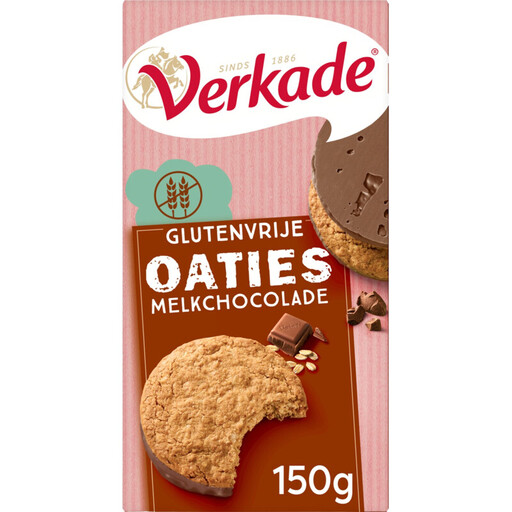
Verkade Gv Oaties Milk Chocolate 150 g
For an occasional biscuit treat: check that the gluten-free label on the current packaging is suitable for your child’s diet, especially if they have coeliac disease.
Pack size: 150 g. Read the allergen information and check whether oats are suitable for your child. Decide how much to give based on the biscuit and the current nutritional information, not the pack weight.
View on Joybuy
Frequently asked questions
How can I identify a gluten-free biscuit for a child with coeliac disease?
Look for ‘gluten-free’ or the Crossed Grain symbol on the current packaging, and read the ingredients and allergen information too. The Voedingscentrum recommends these labels as a way to identify suitable products. You should also prevent the biscuit from coming into contact with food that contains gluten.
Are gluten-free biscuits also free from milk, egg or nuts?
No, the gluten-free label doesn’t tell you anything about these other allergens. Check the current packaging against your child’s allergies. The ingredients and allergens listed vary between biscuits from Schär and AH Glutenvrij.
Is a gluten-free biscuit suitable as a daily snack for a toddler?
According to the Voedingscentrum, biscuits are better suited to an occasional treat than an everyday snack. For regular snacks, the Voedingscentrum recommends options such as vegetables, fruit, wholemeal bread and a wholegrain cracker. If your child follows a gluten-free diet, check that bread or crackers are suitable too.
Does every child need to eat gluten-free biscuits?
No. According to the Voedingscentrum, children don’t need to follow a gluten-free diet unless they have a condition that requires it. If your child has a wheat allergy, check separately for wheat: a gluten-free label alone isn’t enough to confirm that a product is suitable.


