If your child has coeliac disease, choose a biscuit labelled ‘gluten-free’ and check the current packaging for any other relevant allergens. According to the Dutch Coeliac Association, this label means the product contains less than 20 mg of gluten per kg. For everyday snacks, the Netherlands Nutrition Centre recommends fruit, vegetables or a little wholemeal bread, but any alternative must also be suitably gluten-free if your child has coeliac disease. Keep biscuits for a small, occasional treat.
Who is this relevant to?
Parents of a toddler with coeliac disease
You’re looking for a biscuit with a clear gluten-free label, and want to check whether any other allergens are relevant to your child. The Dutch Coeliac Association explains what ‘gluten-free’ means; for allergen information, the Netherlands Food and Consumer Product Safety Authority advises checking the label.
Parents who give their child biscuits now and then
You want a small treat for snack time without making biscuits an everyday choice. For toddlers’ usual snacks, the Netherlands Nutrition Centre recommends mainly fruit, vegetables or a little wholemeal bread.
Parents packing a snack to take out
You want the school or childcare provider to be able to check the allergens on the packaging. Before packing the snack, also ask what the specific setting’s policy is on food brought from home.
What should you look for when choosing?
If your child has coeliac disease, start by checking for a gluten-free label and reading the current packaging. Then decide whether to offer a biscuit, how much to serve and whether the snack will be taken out with you.
| What to consider |
What to check when buying |
Who is this most important for? |
| Gluten-free suitability |
Look for the ‘gluten-free’ label and read the ingredients and allergen information on the current packaging. According to the Dutch Coeliac Association, the label means the product contains less than 20 mg of gluten per kg. |
If my toddler has coeliac disease, I first want to know whether the biscuit is suitable for a gluten-free diet. For around 34% of consumers, this suitability comes first. |
| Snack time and portion size |
Compare the portion size and nutritional information; serve biscuits in small amounts and only occasionally. For toddlers’ usual snacks, the Netherlands Nutrition Centre recommends fruit, vegetables and a little wholemeal bread. |
On an ordinary snack day, I don’t want to automatically give my child a whole pack of biscuits. Around 33% of consumers prioritise their choice of snack and portion size. |
| Current label and range |
Check the allergen information for the product you’ve chosen, and see which products are actually available to buy. Albert Heijn and Jumbo list gluten-free biscuits in their ranges. |
When I buy again, the specific pack must suit the allergens that matter to my child. Around 20% of consumers prioritise finding and checking a suitable product. |
| School or childcare |
Ask about the specific setting’s policy on allergens and food brought from home; if needed, send the original packaging with the label clearly visible. |
If the snack is going with my child, I want to know whether the childcare provider will accept it and can check the allergens. For around 13% of consumers, this is their main concern. |
Common mistakes
-
Taking ‘gluten-free’ to mean it’s recommended as an everyday snack
The label tells you about gluten, not how often to give your child a biscuit. For toddlers’ usual snacks, the Netherlands Nutrition Centre recommends mainly fruit, vegetables or a little wholemeal bread.
Save a gluten-free biscuit for a small, occasional treat. If your child has coeliac disease, also check that any other snack is suitably gluten-free.
-
Automatically giving your child the whole pack
Packaging aimed at children doesn’t determine how much you should give your toddler.
Check how many biscuits are in the pack and decide on a small portion before snack time.
-
Assuming an ordinary children’s biscuit is gluten-free
Lotus Bakeries lists wheat and rye as ingredients in Lotus Dinosaurus. A child-friendly format doesn’t change the ingredients.
If your child has coeliac disease, choose a product with a clear gluten-free label and read the current ingredients list.
-
Relying on an online product photo alone
For your final decision, check the ingredients and allergens on the packaging you have in front of you.
Read the label again if you buy a different variety or give your child the same biscuit again at a later date.
Brands to consider
Albert Heijn / AH Glutenvrij
Albert Heijn’s gluten-free biscuit range includes AH Glutenvrij Double cookies, as well as biscuits from other brands.
- You can compare different types of gluten-free biscuits side by side.
- Check the ingredients, other allergens and portion size for each pack you choose.
Jumbo Lekker Vrij
This range includes gluten-free speculaas biscuits and milk chocolate digestives.
- There’s more than one type of biscuit in the range to compare.
- Check the current nutritional information and allergens for each type. Gluten-free biscuits aren’t automatically an everyday snack for toddlers.
Heerlijck Banket bij ALDI
ALDI describes Heerlijck Banket Coconut Macaroons as a pack of six gluten-free biscuits.
- The product description explicitly states that these coconut macaroons are gluten-free.
- Choose a small portion and check the allergens on the packaging.
Lidl
Lidl offers a gluten-free range alongside its standard range.
- The range is a good starting point if you’re looking for gluten-free products.
- Check which biscuits are available and read the label on the pack you choose.
Lotus Biscoff / Lotus Dinosaurus
For Lotus Dinosaurus, Lotus Bakeries lists wheat and rye as ingredients. This means the biscuit isn’t a gluten-free option for someone with coeliac disease; it doesn’t mean that every Lotus product has the same ingredients.
- The ingredient information helps you rule out this particular biscuit when gluten-free is essential.
- Assess any other variety separately using its current packaging, rather than relying on the brand name or child-friendly appearance.
A biscuit from Joybuy
This biscuit may suit you if you’re looking for an occasional treat labelled gluten-free. Before giving it to your child, check the current allergen information and choose a small portion.
 No image available
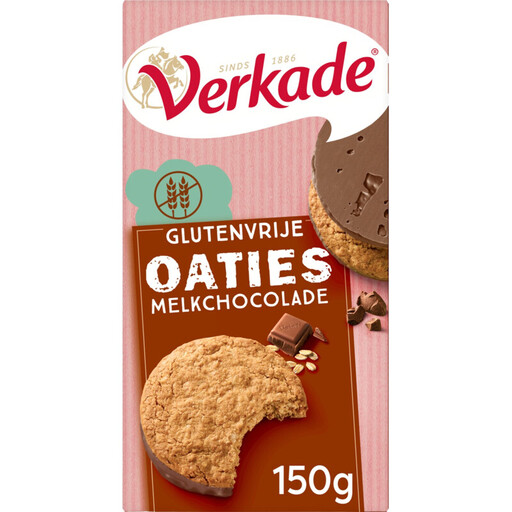
Verkade Gv Oaties milk chocolate, 150 g
Described as gluten-free, this biscuit may suit an occasional snack if you’re specifically looking for a biscuit for a toddler with coeliac disease.
Check the current packaging for milk, soya, oats and possible traces of nuts that are relevant to your child. Also check whether oats are suitable for them.
View at Joybuy
Frequently asked questions
What does ‘gluten-free’ mean on a biscuit pack?
According to the Dutch Coeliac Association, the label means the product contains less than 20 mg of gluten per kg. Also read the ingredients and check for other allergens on the current packaging.
Is a gluten-free biscuit suitable as an everyday snack for a toddler?
Not as a standard choice every day. For toddlers, the Netherlands Nutrition Centre recommends fruit, vegetables or a little wholemeal bread as snacks; if your child has coeliac disease, any alternative you choose must also be suitably gluten-free.
Should I read the label again when I buy the same biscuit?
Yes, check the pack you’re actually using. Look again at the gluten-free label, ingredients and any allergens that matter to your child.
Can I send a gluten-free biscuit to school or childcare without checking first?
First ask what the specific school or childcare provider allows. A gluten-free label doesn’t replace their policy on food brought from home; if needed, send the original packaging so the allergen information is easy to read.


