
Festival-goers with coeliac disease
You want to take a clearly labelled gluten-free snack with you and avoid contact with ordinary biscuit crumbs. Coeliac UK points out that even a small amount of gluten can matter if you have coeliac disease.


For a street festival, choose biscuits in an unopened pack that is clearly labelled gluten-free, and check the current label just before you leave. If you have coeliac disease, you’ll also need to take care to avoid contact with ordinary biscuit crumbs. If you need to avoid other ingredients too, check the allergen information for the specific variety.
You want to take a clearly labelled gluten-free snack with you and avoid contact with ordinary biscuit crumbs. Coeliac UK points out that even a small amount of gluten can matter if you have coeliac disease.
As well as checking that the biscuits are labelled gluten-free, you check the ingredients and allergens in your chosen variety. Gluten-free biscuits may also contain milk, soya or nuts, for example.
You’re looking for a pack with enough biscuits to share, and you’ll keep them separate from ordinary snacks and loose crumbs throughout the festival.
First, check the gluten-free labelling and any other allergens. Then choose a pack that’s suitable for taking with you or sharing, and only then decide which type of biscuit you’d like.
| What to consider | What to check | Who it matters to |
|---|---|---|
| Gluten and cross-contamination | Check the gluten-free label on the pack and keep the biscuits away from ordinary biscuit crumbs. | If I have coeliac disease, I also want to avoid my biscuits coming into contact with gluten while I’m out. Around 36% of consumers put this reassurance first. |
| Taking them with you and sharing | Compare the pack size and packaging type. Choose a pack you can take with you sealed and keep separate from other food. | For a day at a festival, I want to be able to take biscuits with me or share them without putting them next to ordinary snacks. For around 29% of consumers, this practical consideration is the deciding factor. |
| Other allergens | As well as the gluten-free label, read the full ingredients and allergen information, including any warnings about possible traces. | If I also need to avoid milk, soya or nuts, the word ‘gluten-free’ on its own isn’t enough. Around 21% of consumers put this additional check first. |
| Flavour and type of biscuit | Once you’ve checked the label, choose from the available varieties, such as spiced biscuits, digestives or chocolate biscuits. | Once I’ve found a pack that suits my dietary needs, I want to take a type of biscuit I enjoy. Around 14% of consumers say this is their top consideration. |
A brand name or familiar flavour doesn’t tell you whether a specific variety of biscuits is gluten-free. Coeliac UK notes that gluten can also be found in less obvious products.
Check the gluten-free label on the pack you’re actually buying. Don’t assume it’s the same as another flavour or a pack you bought before.
Coeliac UK warns that even a stray bread crumb can cause symptoms if you have coeliac disease. That’s why it’s important to avoid contact with ordinary snacks after you’ve bought the biscuits too.
Keep the pack sealed until you’re ready to eat, store the biscuits separately and use clean plates and utensils when sharing them.
Gluten-free biscuits may still contain ingredients you need to avoid. For example, Jumbo lists milk, oats and soya in its gluten-free chocolate digestives, with a warning that they may contain nuts.
For your chosen variety, check both the allergens it contains and any warnings about possible traces. Don’t assume lactose-free means free from milk ingredients.
Ingredients and allergen information can change. Albert Heijn therefore recommends checking the information on the packaging before eating the product.
Use a product page to browse your options, but check the gluten-free label and allergen information again on the pack you’re taking with you.
Albert Heijn lists several gluten-free biscuits under its own label, including almond biscuits in a 45 g pack.
Under this own-label range, Jumbo lists gluten-free varieties of biscuits including spiced biscuits, stroopwafels and digestives.
Jumbo describes Céréal chocolate biscuits as gluten-free and lactose-free.
Albert Heijn lists several gluten-free Schär biscuit varieties, including madeleines, digestives and Butterkeks.
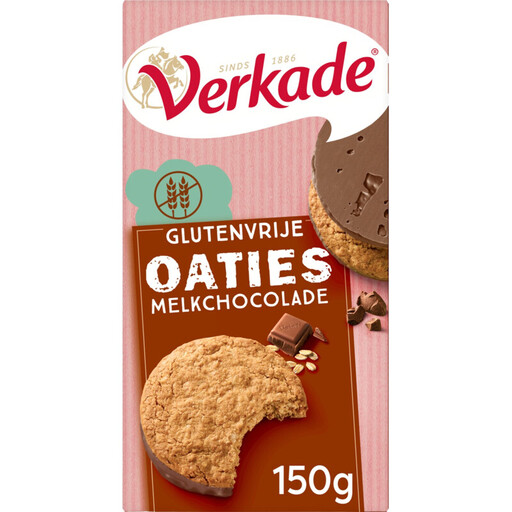
These packaged oat biscuits with milk chocolate are an option to take with you. Before eating them, check the gluten-free label and allergen information on the current packaging.
 No image available
These packaged biscuits are an option to take with you if the current packaging carries the gluten-free label you’re looking for.
Pack size: 150 g; milk chocolate variety.
The product information flags oats as something to consider for some people with coeliac disease, lists milk and soya, and notes that the biscuits may contain nuts. Read the label before choosing this variety.
Under Commission Implementing Regulation (EU) No 828/2014, the term ‘gluten-free’ may be used if the gluten content of the food sold to the final consumer is no more than 20 mg/kg. Check the label on the specific biscuits you’re buying.
No. The absence of an obvious wheat ingredient isn’t enough. Check for a gluten-free label on the packaging and avoid contact with ordinary biscuit crumbs. Coeliac UK says that even a small amount of gluten can cause symptoms if you have coeliac disease.
Yes, check the packaging again. Albert Heijn says that ingredients, nutritional values and allergen information can change, even if you already know the product.
No. Gluten-free doesn’t tell you anything about those other properties. For example, Jumbo lists soya and possible traces of nuts in its gluten-free Céréal chocolate biscuits, which are also described as lactose-free. Always read the full allergen information for the variety you’ve chosen.