
Commuters with coeliac disease
You want to take a gluten-free option with you for mornings when you’re short on time. As well as checking the label, consider whether you can eat the biscuit without any preparation.


If you have coeliac disease, first choose a biscuit or Dutch breakfast cake whose current packaging says ‘gluten-free’. Then compare the allergen and nutritional information, as well as how much preparation is involved: you can take an individually wrapped biscuit with you straight away, while an unsliced breakfast cake needs to be portioned in advance.
You want to take a gluten-free option with you for mornings when you’re short on time. As well as checking the label, consider whether you can eat the biscuit without any preparation.
You might consider a biscuit or Dutch breakfast cake when there isn’t time for a leisurely breakfast. In that case, the portion size and nutritional information can help you decide what else to have with it.
As well as gluten, you need to check ingredients such as milk, egg, nuts, soya or lupin. The words ‘gluten-free’ alone don’t tell you whether these are present.
If you have coeliac disease, start by checking the current gluten-free claim, then consider which packaging and portion best suit your morning. Also read the allergen and nutritional information for the exact product variant.
| What to consider | What to check when buying | Who should pay particular attention? |
|---|---|---|
| Gluten-free claim | Check the current packaging for the exact product variant; don’t rely on a search filter or brand name alone. Under Commission Implementing Regulation (EU) No 828/2014, a food sold to consumers may be labelled ‘gluten-free’ if it contains no more than 20 mg/kg of gluten. | If I have coeliac disease, I want to be able to confirm that my choice is labelled gluten-free before I leave. This is the most important consideration for around 36% of consumers. |
| Ready to take with you | Check whether you can eat the biscuit straight away or need to cut and pack portions in advance. Jumbo lists a 60 g filled biscuit; Albert Heijn describes Peijnenburg’s gluten-free breakfast cake as unsliced. | On a busy morning, I don’t want to have to slice breakfast cake first. Being able to take it with me straight away is the top priority for around 29% of consumers. |
| Breakfast and portion size | Compare the nutritional information per 100 g and per portion, then decide what else you’d like to eat. Albert Heijn lists Peijnenburg’s unsliced breakfast cake as a 285 g pack containing nine 30 g portions. | If a biscuit is going to be my quick breakfast, I want to know how much I’m eating and what else I’ll have with it. This is the first consideration for around 21% of consumers. |
| Other allergens | Read the ingredients and allergen warnings for the exact product variant. According to Jumbo, Jumbo Gevulde Koek Gluten Vrij contains almonds, eggs, lupin, milk and soya, and may contain sesame. | If I’m avoiding other allergens too, a gluten-free label isn’t enough to help me choose. These additional ingredients are the top priority for around 14% of consumers. |
A brand name doesn’t tell you whether the exact product variant is gluten-free. The ingredients listed by Makro for Lotus Biscoff Speculoos Topping include wheat flour; don’t assume that this applies to every other variant.
For any biscuit, check its own packaging for the ‘gluten-free’ claim.
Ingredients and allergen information can change. That’s why a product page is no substitute for checking the label on the pack you buy.
Before eating it, check the current packaging, including the ingredients and allergen information.
A gluten-free filled biscuit may contain other allergens. For its Gevulde Koek Gluten Vrij, Jumbo lists almonds, eggs, lupin, milk and soya, among other ingredients.
If you have additional allergies, make a separate choice based on the allergen information.
The gluten-free claim tells you nothing about the amount of sugar, fat, fibre or protein in a portion.
Check the nutritional information per portion and per 100 g, then decide which other breakfast foods would go well with it.
Albert Heijn offers gluten-free oat biscuits and filled biscuits, among other products, alongside products from other brands.
Jumbo has a gluten-free range that includes biscuits and breakfast products.
Lotus Biscoff is a speculoos brand, but the brand name itself is not a gluten-free claim.
Lidl talks about its gluten-free products, but availability can vary.
Aldi has a general biscuit range; if you have coeliac disease, you need to check the gluten-free claim on each product.
This oat biscuit is one option to consider if you’re looking for something to take with you. Before eating it, check the current gluten-free claim, allergens and packaging; the product name doesn’t tell you whether the biscuits are individually wrapped.
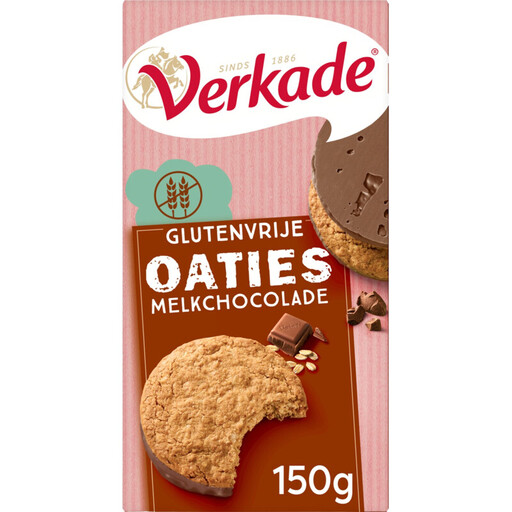 Image unavailable
A biscuit to consider if you want something to take with you; check whether the packaging and portion sizes suit your morning.
The product name lists a 150 g pack. Before eating, check the current gluten-free claim, ingredients and allergen information on the packaging.
No. Look for ‘gluten-free’ on the current packaging of the specific product. Commission Implementing Regulation (EU) No 828/2014 sets requirements for this claim, as well as additional conditions for oats in products sold as gluten-free.
No. Jumbo lists almonds, eggs, lupin, milk and soya in Jumbo Gevulde Koek Gluten Vrij, and says it may contain sesame. If you have additional allergies, always check the information on the current packaging.
Because ingredients and allergen information can change. Albert Heijn therefore recommends checking the packaging before eating the product, even if you’ve bought it before.
A biscuit can be a quick breakfast option, but the gluten-free claim doesn’t tell you what nutrients you’ll be getting. Compare the nutritional information per portion and per 100 g, then decide whether you’d like to have anything else with it.