
People with coeliac disease who snack late
You’re looking for a biscuit with an explicit gluten-free label and want to check the other allergens on the current packaging before eating it.


If you have coeliac disease and fancy a biscuit late in the evening, first choose a pack that is explicitly labelled ‘gluten-free’. According to the Netherlands Food and Consumer Product Safety Authority, a product making this claim may contain no more than 20 mg/kg of gluten. Then check the current ingredients and allergen information, and choose a portion size that suits how much you want to eat. Don’t assume that ‘gluten-free’ also means free from other allergens.
You’re looking for a biscuit with an explicit gluten-free label and want to check the other allergens on the current packaging before eating it.
You’d like to choose an oat biscuit, but first check whether the product is labelled gluten-free and whether oats and any other allergens are suitable for you.
You don’t want to open more biscuits than you plan to eat late in the evening. The number of portions, the amount per portion and how to store the biscuits after opening are practical things to consider.
Start with the gluten-free label on the pack. Then compare the other allergens, portion size and current availability, based on what matters most to you.
| What to consider | What to check when buying | Who it matters most to |
|---|---|---|
| Gluten-free label | Look for ‘gluten-free’ on the current packaging; if you have coeliac disease, don’t judge suitability by the flavour or ingredient name alone. | If I have coeliac disease, I want to see clearly that my biscuit is labelled gluten-free before I eat it. This check comes first for around 36% of consumers. |
| Other allergens | Read the ingredients and allergen information, including for oat biscuits and varieties containing chocolate. | As well as gluten, I may need to avoid ingredients such as oats, nuts, milk or soya. This additional check is the top priority for around 29% of consumers. |
| Portion size | Compare the number of portions, the amount per portion and how to store the pack after opening. | For a late-night snack, I want to be able to have an amount that suits my plans for the evening. Portion size is the deciding factor for around 21% of consumers. |
| Availability | Just before buying, check that your chosen variety is available and that the pack shown matches the product you’ll receive. | I want to know that I can actually buy my chosen biscuit, rather than relying on an outdated listing. This is the most important consideration for around 14% of consumers. |
A gluten-free biscuit may still contain oats, milk, egg, soya, lupin or nuts. This distinction matters if you need to avoid ingredients other than gluten.
Read the ingredients and allergen information on the current packaging, not just the front of the pack.
The presence of oats alone doesn’t mean a biscuit carries a ‘gluten-free’ label. If you have coeliac disease, your personal tolerance of oats may also be a consideration.
Check the gluten-free label on the specific product and consider whether oats are suitable for you.
A product range page doesn’t necessarily show which variety is available when you buy. Ingredients and allergen information can change too.
Check current availability and read the packaging of the product you’re buying.
If your chosen variety isn’t available, finding another explicitly gluten-free option may take extra time or mean a trip to another shop.
Jumbo lists a range of gluten-free Schär biscuits, including speculoos and Choco Chip Cookies.
Albert Heijn’s own-brand range includes various biscuits, including oat and almond biscuits.
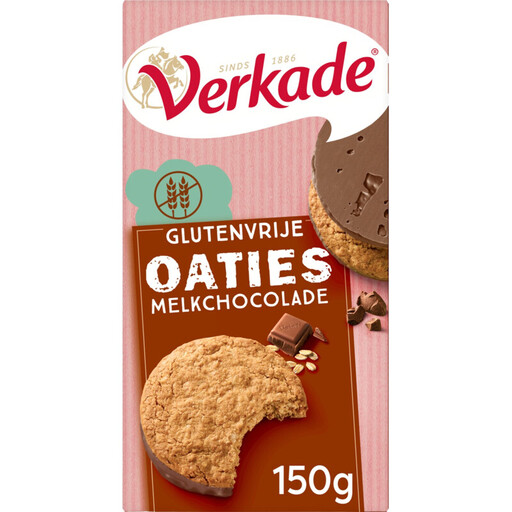
Verkade Gv Oaties Milk Chocolate is a listed variety made with gluten-free oats and milk chocolate.
ALDI describes Heerlijck Banket Coconut Rings as a pack of six ring biscuits weighing 360 g.
This milk chocolate oat biscuit is an option if you’re looking for a variety explicitly labelled gluten-free and oats are suitable for you. Check the portion size and allergens against the current packaging.
 No image available
If you fancy an oat biscuit as a late-night snack, this is an option if you can tolerate oats. The product description says this variety is gluten-free; it contains milk, oats and soya, and may contain nuts. Check the ingredients and allergen information on the current packaging before eating it.
According to the Netherlands Food and Consumer Product Safety Authority, a product labelled ‘gluten-free’ may contain no more than 20 mg/kg of gluten. If you have coeliac disease, check that the chosen biscuit carries this label on its current packaging.
No. ‘Gluten-free’ doesn’t mean that the product is free from milk, egg, soya or nuts. If you have another allergy, read the ingredients and allergen information for the specific variety; gluten-free oat biscuits, for example, may also contain hazelnuts.
First check whether the biscuit itself is labelled gluten-free, and take your personal tolerance of oats into account. The product description for Verkade Gv Oaties says that a small number of people with coeliac disease may be sensitive to the oat protein avenin.
Ingredients and allergen information can change, even for a biscuit you’ve bought before. Albert Heijn also points this out in its product information, so read the packaging of the product you actually have in front of you.