
People with coeliac disease who exercise
You’re looking for a biscuit to have after exercise and want to check that it’s gluten-free before buying. The Dutch Coeliac Society highlights the importance of checking the label.


If you have coeliac disease, first choose a biscuit labelled ‘gluten-free’, then check the current ingredients and allergen information on the packaging; ‘wheat-free’ does not mean the same thing. If you’d like to eat the biscuit as part of your post-workout recovery nutrition, check the nutritional values per portion and decide whether you’d also like a suitable source of protein.
You’re looking for a biscuit to have after exercise and want to check that it’s gluten-free before buying. The Dutch Coeliac Society highlights the importance of checking the label.
You want to know how a biscuit fits in alongside other food after training. A 2015 article in Current Sports Medicine Reports described the different roles of carbohydrates and protein in recovery after endurance exercise.
You’re comparing types of biscuits and pack sizes, and want to check which products are available at a shop before you set off. Albert Heijn and Jumbo offer a range of gluten-free options.
If you have coeliac disease, first check that the product is labelled gluten-free and look out for any other allergens. Then consider the nutritional value of the portion you plan to eat and whether the pack is a convenient size to take with you.
| What to consider | What to check when buying | Who it matters to |
|---|---|---|
| Gluten-free labelling | Look for ‘gluten-free’ on the packaging, and check the ingredients, allergen information and any warnings too. Under Commission Implementing Regulation (EU) No 828/2014, ‘gluten-free’ may only be used for food sold with a gluten content of no more than 20 mg per kg. | If I have coeliac disease, I want to know first whether the biscuit fits my gluten-free diet before choosing a flavour; around 42% of consumers put this question first. |
| Nutritional value of the snack | Compare the carbohydrates and protein per portion, and consider what else you’ll eat after training. | After training, I want to decide whether a biscuit works as a snack on its own or whether I should have a source of protein alongside it. Around 33% of consumers put this consideration first. |
| Pack size and availability | Think about how many biscuits you want to take with you and check the shop’s current range. | If I want something to eat on the go after exercise, I’m looking for a pack that’s easy to carry and actually available to buy; convenience is the top priority for around 25% of consumers. |
A gluten-free label tells you nothing about other allergens. According to the product information, Verkade GV Oaties Melkchocolade contains milk, oats and soya, and may contain nuts.
Read the full allergen information on the current packaging, even if you’ve bought the biscuit before.
Carbohydrates and protein play different roles in recovery after endurance exercise, as described in Current Sports Medicine Reports in 2015. The gluten-free label doesn’t tell you how much of either you’ll get in a portion.
Check the nutritional values per portion and decide whether you’d like to have a source of protein alongside the biscuit that suits your diet and any allergies.
A gluten-free product listed by a shop may not be available every time you visit.
Check the current range before you set off and, if needed, choose an alternative product or another shop in advance.
If availability varies, you may need to make an extra trip to another shop.
Jumbo and Albert Heijn stock a range of gluten-free biscuits from Schär, including Digestive Landtaler and Butterkeks.
Albert Heijn’s own-brand range includes speculaas and various cookies.
This gluten-free range from Jumbo includes digestives with milk chocolate and speculaas.
Verkade GV Oaties Melkchocolade is described as a gluten-free biscuit. Nutritional values per 100 g and allergen information are available for this variety.
This biscuit is labelled gluten-free and can be considered as part of a post-workout snack. If you have coeliac disease or other allergies, always check the current packaging. Also check the nutritional value of the portion you plan to eat as part of your snack.
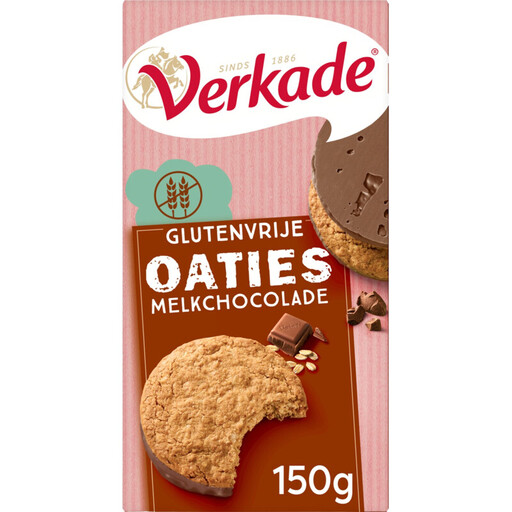 Image unavailable
A biscuit described as gluten-free, to consider as part of a post-workout snack.
The product information states that it contains 53.5 g of carbohydrates and 6.5 g of protein per 100 g. These are not values for the portion you eat.
Contains milk, oats and soya, and may contain nuts. Check the current packaging for ingredients and allergen information.
Under Commission Implementing Regulation (EU) No 828/2014, food sold to consumers may be labelled ‘gluten-free’ if it contains no more than 20 mg of gluten per kg. Also check the current packaging for any other allergens that are relevant to you.
No, ‘wheat-free’ is not the same as ‘gluten-free’. If you have coeliac disease, look for the gluten-free label and check the packaging. The Dutch Coeliac Society also recommends looking for the Crossed Grain symbol.
A biscuit doesn’t have to be your whole snack. If you want to tailor your food to support recovery after exercise, check how much carbohydrate and protein your portion provides and whether you’d like a suitable source of protein alongside it.
Check the information on the current packaging before eating the product. Albert Heijn warns that ingredients, nutritional values and allergen information can change, even for products you already know.
No, don’t assume a limited-time selection will always be available. Check the shop’s current in-store or online range before setting off to buy a specific product.