Who is this choice relevant to?

Parents of children with coeliac disease

If you’re looking for a biscuit for a school day, check the gluten-free label on the current packaging and agree with the school how food and treats will be handled. The Dutch Coeliac Association highlights the importance of making these arrangements with the school.

Parents looking for a lunchbox-sized portion

A small pack or an individually wrapped portion can be useful when a child takes their own biscuit to school. Check that the packaging works with the arrangements for sharing food and eating together.

Shoppers who need to consider more than gluten

If there are additional dietary restrictions involving, for example, milk, eggs, soya, nuts or oats, the gluten-free label alone isn’t enough. Check the ingredients and allergen information for the exact biscuit.

What should you look for when choosing?

Start with the gluten-free label and the child’s individual dietary requirements. Then compare the packaging and any other allergens: a handy portion for school won’t help if the biscuit itself isn’t suitable.

What to considerWhat to check when buyingWho it matters to
Gluten-free label Read the current packaging and look for an explicit gluten-free label. The Dutch Coeliac Association defines gluten-free as containing less than 20 mg of gluten per kg of product. If my child has coeliac disease, I don’t want to rely on a biscuit’s appearance to decide whether it can go to school. For around 42% of consumers, having confidence that a product is gluten-free comes first.
Portion for school Compare individually wrapped portions or the weight of a small pack, and check with the school about sending food in. A portion of their own makes it easier to send a biscuit separately for shared mealtimes. Around 33% of consumers put this practical consideration first.
Other allergens and oats Check both the listed allergens and any potential traces, and make sure oats fit the individual dietary requirements. If I also need to consider milk, eggs, soya, nuts or oats, gluten-free alone doesn’t tell me enough to make a choice. For around 25% of consumers, these additional dietary restrictions matter most.

Common mistakes

  • Judging a standard spritz biscuit by its appearance

    You can’t tell whether a biscuit is gluten-free by its shape or buttery flavour. A standard biscuit isn’t automatically a suitable alternative for someone with coeliac disease.

    Check the label on the specific product, rather than choosing based only on a brand name or the absence of the word wheat.

  • Confusing gluten-free with free from other allergens

    Gluten-free biscuits can still contain milk, eggs, soya, nuts or oats. The relevant ingredients vary from product to product.

    Check the ‘contains’ and ‘may contain’ information against the child’s dietary and allergy requirements.

  • Sending in a shared pack without agreeing it with the school

    For treats and shared mealtimes, it needs to be clear which food is for the child and how it will be kept separate.

    Agree with the school in advance how the child’s own biscuit or portion should be sent in, and how special occasions will be handled. The Dutch Coeliac Association recommends coordinating with parents about school meals.

  • Assuming every gluten-free oat biscuit is suitable

    According to the Dutch Coeliac Association, most people with coeliac disease tolerate pure gluten-free oats, but this isn’t true for everyone. An oat biscuit may also contain other allergens.

    Check the gluten-free label and the ingredients of the oat biscuit, and take into account any individual requirements around oats.

Brands to consider

AH Glutenvrij

Among Albert Heijn’s range of gluten-free biscuits, you could look at smaller packs if you’re after a biscuit for a school lunchbox.

  • AH Glutenvrij Koekjes amandel comes in a 45 g pack. Albert Heijn describes the product as being made in a completely gluten-free environment.
  • This biscuit contains almonds, eggs and soya. As it is made with gluten-free wheat starch, wheat is also listed as an allergen; check this separately if you have a wheat allergy, and read the current packaging.

Schär

Schär offers gluten-free biscuits and madeleines, among other products, if you’re considering a different type of biscuit from a spritz.

  • Jumbo lists Schär Butterkeks as 4 × 41 g, with pre-packed portions that can be sent in separately.
  • Butterkeks contains milk and eggs, and may contain lupin and soya. The gluten-free Madeleines, in an 8 × 30 g pack, contain eggs and may contain nuts.

Céréal

Céréal’s chocolate biscuits are worth considering if you need a product that is both gluten-free and lactose-free.

  • Jumbo’s product information describes the 150 g chocolate biscuits as gluten-free and lactose-free.
  • They contain soya and may contain, among other things, eggs, milk, nuts, sesame and lupin. Check the current allergen information before sending them in.

Verkade

Verkade GV Oaties is an oat biscuit with milk chocolate for anyone looking for a different flavour and texture from a biscuit.

  • Joybuy’s product information describes GV Oaties as made with gluten-free oats; the pack contains 150 g.
  • The biscuit contains oats, milk and soya, and may contain nuts. The product information also warns that a small number of people with coeliac disease may be sensitive to oat protein.

Biscuit alternative on Joybuy

This oat biscuit with milk chocolate is labelled gluten-free and is an alternative to compare if you’re looking for something other than a spritz biscuit for the school lunchbox. Check that oats and the listed allergens are suitable for the child, and that you can send in an appropriate portion.
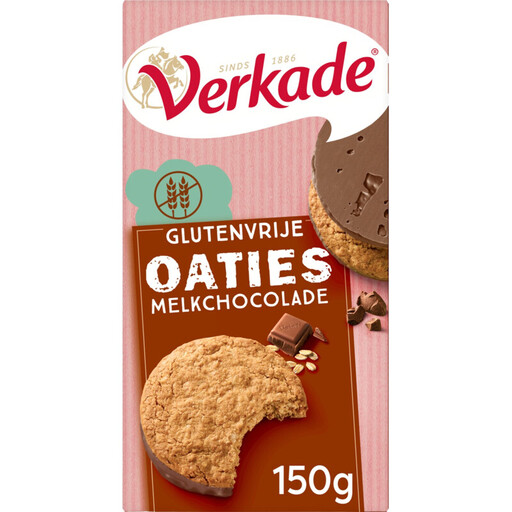
Verkade GV Oaties Milk Chocolate, 150 g pack

Verkade GV Oaties Milk Chocolate 150 g

An oat biscuit with milk chocolate for anyone looking for a gluten-free alternative to a spritz biscuit who can eat oats.

The pack contains 150 g. The biscuit contains oats, milk and soya, and may contain nuts. Before sending it to school, check the current packaging, any individual requirements around oats, and whether you can send in a suitable portion.

View on Joybuy

Frequently asked questions

Is wheat-free the same as gluten-free?

No. Gluten can also come from rye and barley, among other grains. If a child has coeliac disease, don’t choose a product based only on the words ‘wheat-free’. Check for a gluten-free label and read the current ingredients and allergen information.

Can a biscuit containing wheat starch still be gluten-free?

Yes, if the product meets the requirements for being labelled gluten-free. For example, Albert Heijn lists gluten-free wheat starch in AH Glutenvrij Koekjes amandel. This doesn’t automatically make the biscuit suitable for someone with a separate wheat allergy.

What should you agree with the school about a gluten-free biscuit?

Agree how the child will bring their own food and what will happen with treats, school meals and other special occasions. The Dutch Coeliac Association recommends that parents and the school discuss this in advance; also check the school’s own policy.

Is a gluten-free oat biscuit suitable for everyone with coeliac disease?

No, you can’t assume it will suit everyone. According to the Dutch Coeliac Association, most people with coeliac disease tolerate pure gluten-free oats, but not everyone does. Check the gluten-free label and take into account any individual requirements around oats and other allergens.
