What should you look for when choosing?
Start with the label on the specific biscuit and how you’ll pack it. Then consider other allergens, your child’s preferences and a portion that’s practical to take along.
| What to consider |
What to check when buying |
Who is this most important for? |
| Gluten-free label and crumbs |
Look for ‘gluten-free’ or an appropriate certification on the specific product. Keep the biscuit separate from bread containing gluten and ordinary biscuits. |
When I’m packing for a child with coeliac disease, I want a clearly labelled biscuit that won’t come into contact with gluten crumbs while it’s on the go. Around 50% of consumers prioritise this gluten-free choice. |
| Other allergens |
Read the ingredients and allergen information on the current packaging; if necessary, ask about the school or childcare setting’s rules. |
If my child also has another food allergy, I can’t rely on the word ‘gluten-free’ alone. For around 30% of consumers, these additional allergens are the first thing to consider. |
| Biscuit type and portion size |
Compare the type of biscuit and pack size of products that meet the required labelling criteria. |
If my child wants a familiar type of biscuit and the portion needs to be easy to take along, I’ll choose an option that’s practical. Around 20% of consumers prioritise this preference and portion size. |
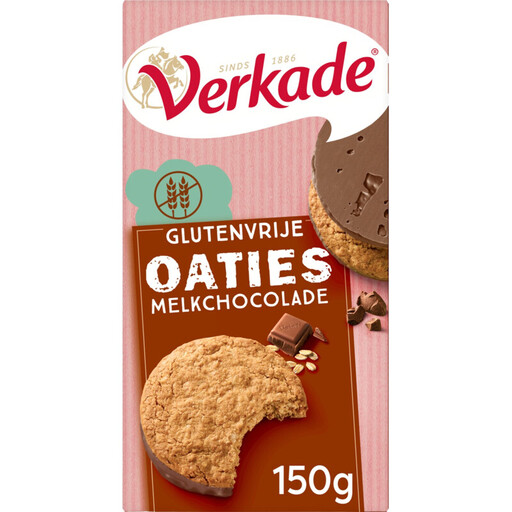
Gluten-free oat biscuit on Joybuy
This option is an oat biscuit with milk chocolate for an after-school snack. Check that your child tolerates gluten-free oats, and that the other allergens and packaging suit the way you’re packing it and the school’s rules.
 No image available
Verkade Gv Oaties Milk Chocolate 150 g
An after-school biscuit for a child who tolerates gluten-free oats and would enjoy an oat biscuit with milk chocolate.
The pack contains 150 g. The product contains oats, milk and soya, and may contain nuts; check the current packaging for all relevant allergens.
Keep the biscuit away from gluten crumbs. Check the packaging itself if you need individually wrapped portions.
View on Joybuy
Frequently asked questions
When can a biscuit be labelled ‘gluten-free’?
Under Commission Implementing Regulation (EU) No 828/2014, this claim may be used when the food, as sold to the final consumer, contains no more than 20 mg/kg of gluten. For a child with coeliac disease, look for the label on the specific biscuit, rather than relying only on the fact that wheat isn’t listed as a main ingredient.
Is a gluten-free oat biscuit always suitable for someone with coeliac disease?
No. Check both the gluten-free label and whether the individual can tolerate oats. The Dutch Coeliac Society highlights the risk of ordinary oats being contaminated with gluten-containing grains, and notes that some people with coeliac disease also react to pure oats.
Should I pack a gluten-free biscuit separately?
Yes. If your child has coeliac disease, keep it separate when you’re also packing ordinary bread or biscuits containing gluten. The Dutch Coeliac Society advises avoiding cross-contamination, so leave the biscuit sealed if possible or use a clean, separate, sealed compartment.
Why should I check for allergens other than gluten?
A gluten-free biscuit may still contain ingredients your child is allergic to. Voedingscentrum explains that common allergens must be listed in the ingredients information, so read the current packaging and check the rules at the school or childcare setting too.


