
Vandaag of morgen in huis

Kwaliteit gegarandeerd

Welkomstaanbiedingen ontgrendelen: GRATIS bezorging | Tot 80% korting | Gratis 30 dagen JoyPlus-proefperiode
Download de app
Choosing a new cup or set of drinking glasses seems simple. Yet product pages are often packed with terms such as insulating, durable, handmade or dishwasher-safe, while important information about capacity, care and material is missing. As a result, you may buy an attractive cup that does not fit in your kitchen cupboard, gets damaged quickly or turns out to be impractical for your favourite drink.
As a Joybuy Product Recommendation Officer, I therefore focus mainly on verifiable details: material, capacity, quantity, care instructions and the intended use described for each product.
A 150 ml espresso cup is suitable for a small coffee, but not for a large latte. A 480 ml coffee cup, on the other hand, may be too large for a standard coffee machine or a small tray. So do not just look at the appearance; check the capacity in millilitres as well.
For everyday use, drinking glasses of around 300 to 350 ml are often practical for water, soft drinks and juice. If you mainly drink tea or large coffees, a ceramic mug or tea glass of 400 ml or more may be a better choice.
Not every cup is suitable for the dishwasher. For some products, this applies only to the lid or the top rack. Other glasses must be washed by hand. For example, the Secret de Gourmet Glass Set of 6 Tumblers is explicitly described as not dishwasher-safe.
Also check whether a ceramic mug is suitable for use in the microwave. According to the product information, the YumiPLUS blue trapezoid-shaped mug is suitable for both microwave and dishwasher use. That does not mean that every glazed mug has the same properties.
Double-walled glass cups have a layer of air between two glass walls. According to the product description, this can help keep hot drinks warm for longer and cold drinks cool for longer. The outer section also generally feels less hot than single-walled glass. However, the actual length of time depends on the starting temperature, the surroundings and the amount of drink.
A vacuum-insulated thermal cup is a different product category. It is designed for use on the go and usually has a lid. So consider whether you are looking for an open glass mug for home or a sealable thermal cup for your bag, bike or car.
Always check the full product description. A product name may, for example, mention a “glass mug”, while the product information specifies additional materials or a particular use.
Think in advance about the drink you usually pour:
Also pay attention to the diameter and height. A tall glass mug may not fit beneath every coffee machine. A wide ceramic mug, meanwhile, can take up a lot of space in a kitchen cupboard.
A set of six drinking glasses is practical for a household or entertaining guests, while a single ceramic mug is a better choice if you are looking for one item or putting together a gift. Also check the weight: a set of glasses is convenient, but can be relatively heavy to store or move.
For dishwasher-safe cups, check whether the claim applies to the entire product. With double-walled glass cups, it is sensible to handle sudden changes in temperature with care. It is best not to continue using damaged glasses or mugs with cracks or chips.
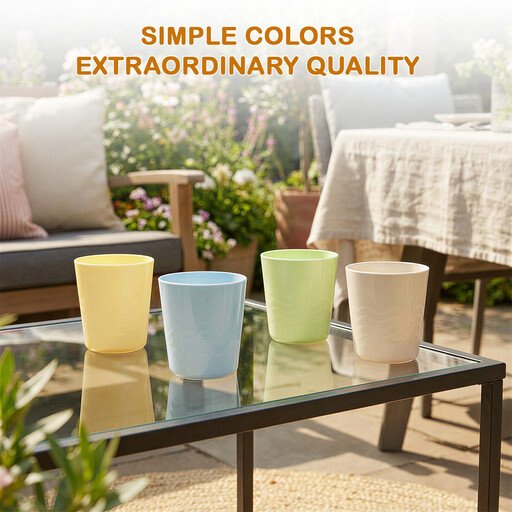
Why this suits the profile: Four lightweight 300 ml PP plastic cups for water, juice and everyday use at home.
The capacity and quantity are clearly stated, so you will not accidentally order a single cup.
Set of 4; PP plastic; 300 ml per cup.
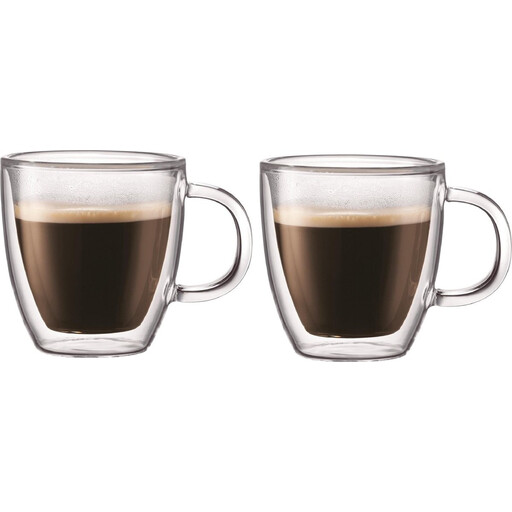
Why this suits the profile: A set of two espresso cups for anyone who values presentation, size and double-walled borosilicate glass.
The product information specifies the material, capacity, quantity and care instructions. This allows you to assess the small 150 ml capacity in advance.
2 pieces; 150 ml; double-walled heat-resistant borosilicate glass; dishwasher-safe according to the product information.
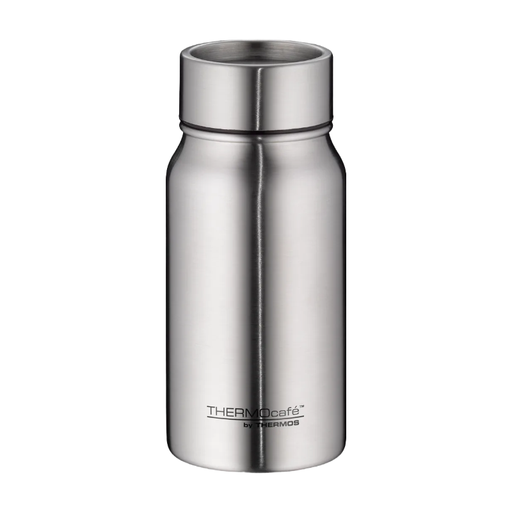
Why this suits the profile: For the office, train, car or bag, a sealable thermal cup is more practical than an open glass or ceramic cup.
The capacity, dimensions, weight and closure are specified. The lid is removable for cleaning.
350 ml; double-walled vacuum-insulated stainless steel; 281 g; leakproof when closed according to the product information.
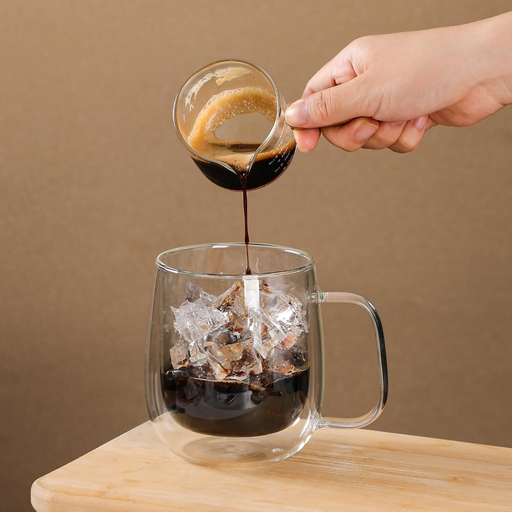
Why this suits the profile: The handles and 350 ml capacity are well suited to coffee, tea, lattes and cold drinks at home or in the office.
The double-walled construction is described clearly. You also know in advance that the set contains two mugs with handles.
Set of 2; 350 ml per mug; double-walled glass; dishwasher-safe according to the product information.
We have put together a complete, up-to-date list of products that fully meet these strict selection criteria and the applicable European safety regulations.
That depends on the product specification. Look for terms such as heat-resistant glass, borosilicate glass or information about use with hot drinks. You should not automatically fill an ordinary glass with boiling water if this information is not provided. Ceramic mugs are often suitable for coffee and tea, but always check the care instructions.
For a small coffee, 150 to 200 ml is sufficient. A capacity of 280 to 350 ml is better suited to filter coffee, cappuccino, latte or tea. If you enjoy a large drink, consider a 480 ml ceramic mug. Also check the height if you want to place the cup beneath a coffee machine.
Follow the care instructions provided by the manufacturer, avoid sudden changes in temperature and check glasses regularly for cracks. If a product is not dishwasher-safe, wash it by hand with a soft sponge. A thermal cup remains practical when you can take the lid fully apart and clean all the components thoroughly.
