
Vandaag of morgen in huis

Kwaliteit gegarandeerd

Welkomstaanbiedingen ontgrendelen: GRATIS bezorging | Tot 80% korting | Gratis 30 dagen JoyPlus-proefperiode
Download de app
Glass food storage containers are handy for leftovers, lunches, meal prep and ingredients in the fridge. However, not every container is suitable for every use. A lid may close securely, for example, without being completely leakproof. And “microwave-safe” usually doesn’t mean you can put the lid in the microwave too.
Use these checks to avoid a poor purchase and choose glass storage containers that suit your household.
Terms such as airtight food containers and leakproof storage containers sound similar, but they don’t always refer to the same feature. A silicone seal can help keep air and moisture out. For liquid dishes, sturdy clips and a well-fitting seal are important too.
So check:
According to the product descriptions, the 1.18-litre and 0.8-litre 5five food containers have airtight clips and are designed to be carried without leaking or spilling. This is a claim made in the product information, so take care when first using a new container with liquid food.
Glass containers may be suitable for reheating, while a polypropylene or silicone lid may not be safe to put in the microwave while closed. Steam can build up under the lid. That’s why the 5five food containers are described as suitable for microwave use without the lid.
Look out for these instructions:
Borosilicate glass containers are popular for use in the fridge and freezer, and sometimes in the oven or microwave. According to the product descriptions, this type of glass is designed to withstand changes in temperature. That doesn’t mean it can handle every sudden change from freezer-cold to hot.
Always check the individual care and use instructions. A borosilicate glass product may be suitable for the freezer but still have restrictions on oven use. For example, the 0.8-litre 5five container is listed as unsuitable for the oven.
Don’t just look at the type of glass. The lid and sealing ring are important for everyday use too:
A wooden lid can look smart, but usually needs more care. The 1-litre 5five jar with a wooden lid is described as dishwasher-safe, while the lid must be cleaned by hand.
Choose a capacity to suit how you’ll use it:
Measure your fridge shelves and the space in your kitchen cupboards too. A rectangular container often makes better use of fridge space than a round one, while a tall glass storage jar may be less practical in a low kitchen cupboard.
Dishwasher-safe containers save time, but check whether this applies to the lid too. Some storage jars can only have their glass parts put in the dishwasher. For everyday use, stackability, transparency and replaceable or sturdy fastenings are useful too.
Also consider:
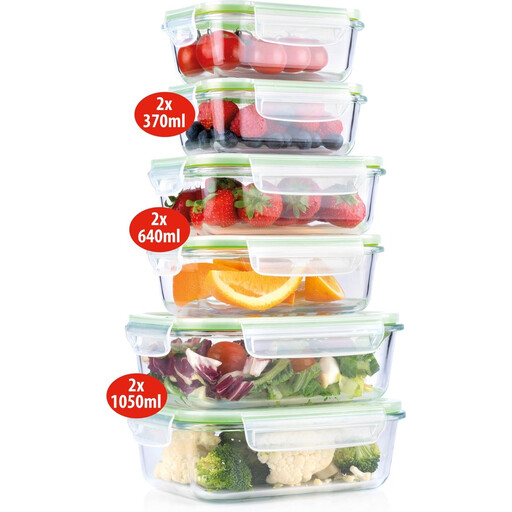
Why it suits this shopper: The set contains six containers in three sizes: 370, 640 and 1050 ml. That gives beginners plenty of options for lunch, leftovers and meal prep.
The capacities are clearly specified in advance. According to the product information, the containers are stackable and have clip-on lids.
The product information lists borosilicate glass and suitability for the dishwasher, microwave and freezer.
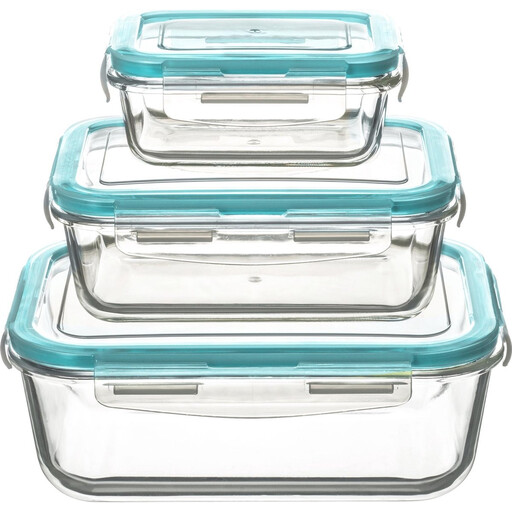
Why it suits this shopper: This set of three rectangular containers is designed for anyone looking for one matching solution for lunch, snacks and leftovers.
The product information explicitly says the containers are suitable for the dishwasher, microwave and freezer. Remove the lid or release it before using the container in the microwave.
Borosilicate glass, a silicone seal, polypropylene clips and a stated total capacity of 1.73 litres.
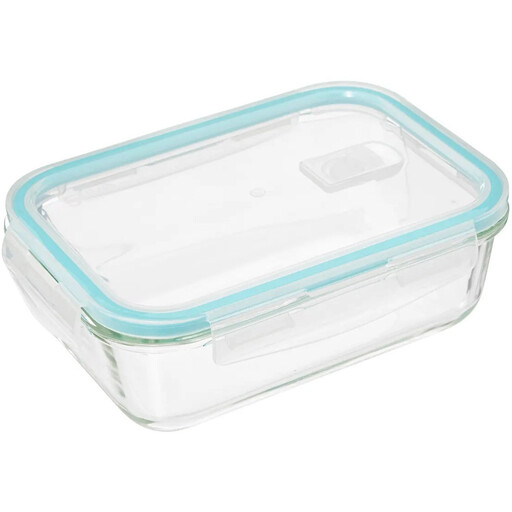
Why it suits this shopper: Its 1.18-litre capacity and rectangular shape make it practical for larger meals, leftovers and use as a glass lunch box.
According to the product description, it has airtight clips and is suitable for the fridge, freezer, microwave without the lid and dishwasher.
Borosilicate glass, a transparent design, a capacity of 1.18 litres and a stated weight of 750 grams.
We’ve put together a complete, up-to-date list of products that meet these strict selection criteria and the applicable European safety regulations.
It depends on the specific product. Look for a clear statement that the containers are freezer-safe and leave room for food to expand. Don’t put a frozen glass container straight onto a hot hob or into a hot oven.
Glass can last a long time with normal use, but its lifespan depends on knocks, temperature changes and how well the fastening is maintained. Clips and silicone rings may wear out sooner than the glass container. So check regularly that the seal still fits properly.
Glass generally absorbs fewer odours and food colourings than many plastics. That makes it practical for sauces, curries and leftovers. Make sure you clean the container and sealing ring thoroughly, and follow the manufacturer’s care instructions. There’s no reason to assume that every glass container has the same properties in all circumstances.
