What should you look for when choosing?
Start with the weight of your recipe and how it needs to be mixed. Then check whether the appliance also suits your cleaning routine and the other tasks in your workshop.
| What to consider |
What to look for when buying |
Who is this important for? |
| Dough weight per batch |
Weigh the entire recipe and compare it with the dough limit for the exact model. Bosch gives a maximum dough capacity of 0,8 kg for the MCM3501M; Kenwood’s 1,5 kg figure is for dry ingredients, while Magimix lists a total capacity of 3 L and a processing capacity of 1,3 L for the CS 4200XL. |
If you mainly want to know how much dough will fit in each batch, portion size comes first. Around 36% of consumers say this is their main buying concern. |
| Control over mixing |
Check whether the appliance has a pulse setting and comes with suitable attachments. Follow the recipe and the manual; don’t assume that a specification for a different type of dough guarantees the same result. |
If you want to bring the dough together briefly and with control, focus on the mixing method and when to stop. Around 29% of consumers prioritise control over mixing. The Consumers’ Association generally describes a stand mixer as better suited to mixing and kneading. |
| Cleaning between batches |
Check the cleaning instructions for the parts you’ll use and plan how you’ll switch between batches. Separately assess whether your workshop falls under the requirements for a food business. |
If you need to clean bowls and attachments between shared batches, allow for the extra steps involved. Around 21% of consumers make cleaning their top priority. |
| Other tasks and storage space |
Choose only attachments you expect to use for jobs beyond biscuit dough, and check that the appliance and accessories will fit in your workspace. |
If you also want to use the appliance for chopping or slicing, weigh up those functions against the space available. Around 14% of consumers prioritise versatility and storage. |
Products at Joybuy
This selection includes food processors and stand mixers for preparing dough. For gingerbread biscuit dough, always check the instructions, included attachments and portion size for the exact model.
 No image available
Stand mixer, 5 L bowl, 10 speeds
The product description lists a dough hook and a mixing attachment; check the instructions for your gingerbread biscuit recipe.
5 L stainless steel bowl, 10 speeds and 600 W; supplied with a dough hook, mixing attachment, whisk and splash guard.
The description states a maximum operating time of 30 minutes; bear this in mind when planning your workshop.
Joybuy
 No image available
Dough mixer and food processor, 4,5 L
The product description lists dough hooks, a mixing attachment and a dough hook; check whether the instructions are suitable for gingerbread biscuit dough.
4,5 L stainless steel bowl, 1.300 W and six speeds; beige finish.
The product information lists a tilt-head design and non-slip feet.
Joybuy
 No image available
ochama food processor, 750 W, 1,8 L
The product name identifies this model as a food processor; before buying, check that the manual and included parts are suitable for your dough.
The product name lists 750 W and a capacity of 1,8 L, with a blender, meat grinder and attachments for slicing, grating and shredding.
Joybuy
 No image available
Bosch MUM 54251 Series 4
According to the product description, this kitchen machine combines dough preparation with other kitchen tasks; it’s designed for domestic use.
3,9 L bowl and 900 W motor. The product description lists a pastry set, a maximum of 2,7 kg of kneaded dough and a maximum of 1,9 kg of yeasted dough.
Joybuy
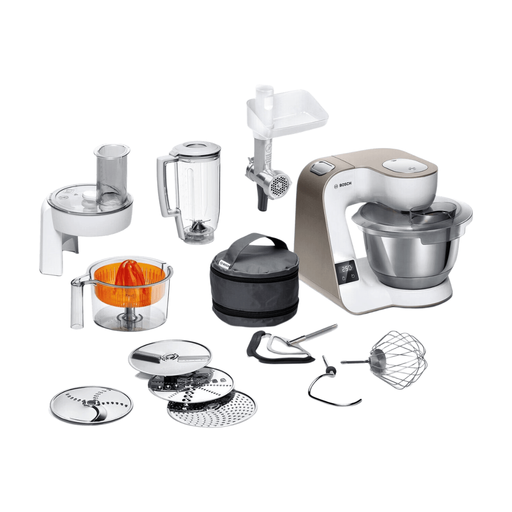 No image available
Bosch MUM5XW40, 1.000 W
The product description lists dough hooks and a dough-kneading function; check the manual for the suitable portion size and method for biscuit dough.
3,9 L bowl, seven speeds and a pulse function. The description lists a maximum capacity of 2,7 kg.
The product description lists integrated scales and dishwasher-safe accessories.
Joybuy
Frequently asked questions
Do I need to process all the gingerbread biscuit dough at once?
No. If necessary, divide the dough into portions that fit the instructions for your chosen appliance. Weigh the whole recipe: the 350 g of flour in Magimix’s published recipe is not the weight of the complete dough. Bosch lists a maximum dough capacity of 0,8 kg for the MCM3501M, but this isn’t a separate test of every gingerbread biscuit recipe.
When should I stop mixing?
Magimix’s gingerbread biscuit recipe says to pulse until the mixture comes together. Then take the dough out of the machine and briefly work it until smooth by hand. For a different recipe or appliance, follow the relevant instructions.
Which cleaning and allergen rules apply to a workshop?
This depends on how the workshop is organised and whether food is served to consumers. The Netherlands Food and Consumer Product Safety Authority says that a food business preparing, processing or selling food must work with a HACCP food safety plan or an applicable hygiene code. The NVWA also outlines rules for providing allergen information about unpackaged food offered to consumers.
Do I need to register a food business with the NVWA?
The NVWA says that businesses selling or supplying food directly to consumers must register, and also lists other food businesses that have to register. Check whether these requirements apply to your workshop activities; simply owning a food processor doesn’t determine this.
What about the guarantee if I buy the machine for workshops?
For a faulty product, ACM ConsuWijzer says the seller is the point of contact for a consumer purchase. ACM ConsuWijzer distinguishes between consumer protections and a contract used mainly or exclusively for business. For a business purchase, also check the contract terms and conditions of use.


