
Vandaag of morgen in huis

Kwaliteit gegarandeerd

Welkomstaanbiedingen ontgrendelen: GRATIS bezorging | Tot 80% korting | Gratis 30 dagen JoyPlus-proefperiode
Download de app
A new set of gel pens might seem simple to choose. Yet many shoppers fall for attractive packaging or eye-catching colours, only to find the pen disappointing in daily use. The ink smudges, the tip writes too thickly for small notes, or the grip becomes uncomfortable during a long study session.
For school pupils, students, office professionals and journalers, there are three main pitfalls to watch out for:
The tip size determines how much space the ink takes up on the paper.
Don’t just look at the number. A twin-ball or bullet tip, the type of paper and the ink formula also affect the writing experience. Those looking for gel pens for school often choose 0.5 or 0.7 mm. For gel pens for the office, a black 0.5 or 0.7 mm pen is practical for forms, meeting notes and documents.
Black gel pens are suitable for general notes and documents. A gel pen set with multiple colours is more convenient for colour-coding, mind maps, planners and gel pens for journaling.
Erasable gel pens usually use heat-sensitive ink. The friction from the eraser makes the text fade. That’s handy for homework and planning, but according to the product information, the text can also disappear due to high temperatures. Therefore, don’t use erasable gel pens for documents that need to be kept long-term, official signing or archiving.
Also check whether you’re buying a set with a cap or a retractable mechanism. A click pen is practical in a lecture hall or office, whereas a pen with a cap must be closed carefully after use to prevent it from drying out.
An ergonomic grip is especially relevant if you write a lot every day. A ribbed, triangular or silicone grip can provide more hold, but personal preference remains important. A grip that’s too soft can actually feel less stable for some users.
Also pay attention to the combination of ink and paper. On smooth paper, gel ink can stay visibly wet for longer; on absorbent paper, the line may dry faster, but it can sometimes show through. Test a new pen on the paper you actually use.
Brands sometimes mention terms like “no smear”, “quick dry” or “smooth writing”. Treat such descriptions as information from the product description, not as a universal result. According to the claims of the respective brands, the models below are designed to write smoothly and reduce smudging. The actual experience may vary per user and paper type.
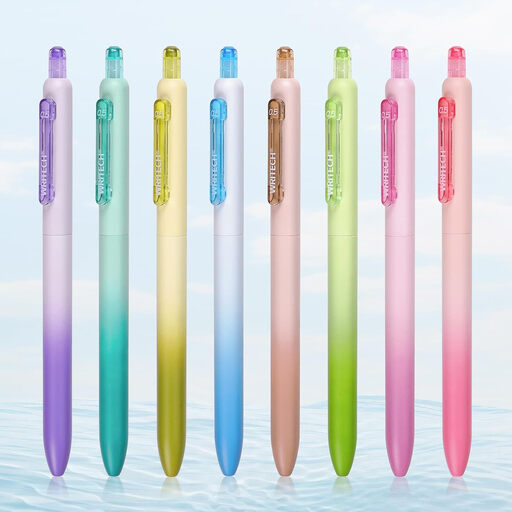
Why this fits the profile: This set contains 8 retractable gel pens with a 0.5 mm tip and various colours. That makes it suitable as a first set for school, notes, colour-coding and simple journaling.
The tip size and number of pens are clearly stated. According to the product description, the set has a silent click mechanism and quick-drying ink; however, do check the result on your own paper.
8 colours, 0.5 mm fine tip, retractable pen and matte anti-slip body.
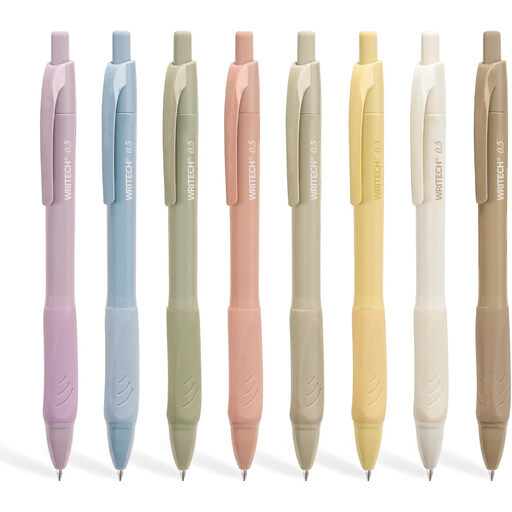
Why this fits the profile: The black ink and fine tip suit neat office notes, study and detailed writing. The set of 8 is practical if you regularly misplace a pen or work in multiple locations.
The product description mentions a triangular soft grip and silent click mechanism. This means you don’t have to rely solely on an attractive appearance; you can compare the shape and operation in advance.
8 black pens, 0.5 mm tip, soft grip and retractable design.
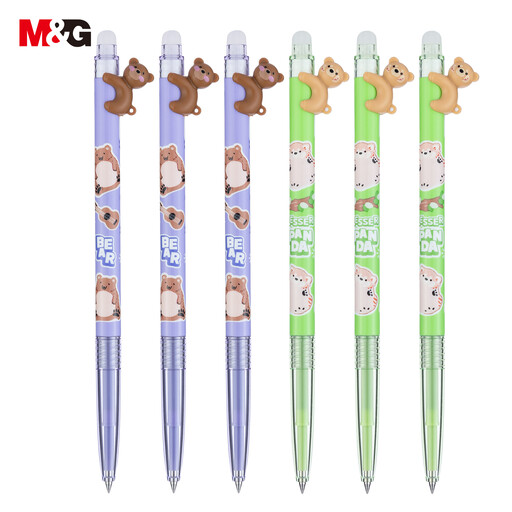
Why this fits the profile: This set is aimed at users who often make corrections in planners, school notes or worksheets. The 0.4 mm tip is suitable for compact text and precise lines.
The erasable function and 0.4 mm tip are clearly described. However, according to the product information, the ink is heat-sensitive and therefore not intended for permanent documents.
6 pens, 0.4 mm fine tip, erasable blue gel ink and protective animal clip.
The lifespan of gel pens depends on usage, storage and how you put the pen away. These simple habits help:
We have compiled a full, up-to-date list of products that fully meet these strict selection criteria and comply with current European safety regulations.
For small letters and detailed notes, a tip of 0.4 or 0.5 mm is the obvious choice. A 0.7 mm tip usually gives a fuller line. The writing experience varies depending on the ink type, paper and hand pressure, so product specifications provide guidance but not a complete guarantee.
Yes, they are practical for homework, planners and notes that you regularly correct. However, according to the product information, the heat-sensitive ink is less suitable for official or long-term documents. Therefore, store important information using regular permanent ink.
Choose a model whose product description mentions quick-drying ink, write on dry and suitable paper, and give the ink a short time to set. Left-handed writers may particularly benefit from a fine tip and a formula that, according to the manufacturer, limits smudging. Always check the result on the paper you use daily.
