
Vandaag of morgen in huis

Kwaliteit gegarandeerd

Welkomstaanbiedingen ontgrendelen: GRATIS bezorging | Tot 80% korting | Gratis 30 dagen JoyPlus-proefperiode
Download de app
A gel pen can be a pleasure to write with, but not every pen suits every task. A fine tip is handy for small notes, while a thicker tip delivers more ink and colour. Also, a gel pen set with lots of colours isn't automatically practical: some shades you'll rarely use, whereas a poor grip or slow-drying ink can be a daily annoyance.
For school pupils, students, office workers, homeworkers and journaling enthusiasts, there are three main purchasing pitfalls to watch out for:
The tip size determines how fine the line appears on paper.
Don't just focus on the number. A gel pen with a fine tip can feel different from a rollerball pen with the same stated line width. Rollerball pens use liquid ink and can therefore write very smoothly, but the ink may bleed through on thin paper more easily.
For everyday use, black gel pens and blue gel pens are usually the most practical. Black suits notes and administration; blue is handy for schoolwork, forms and documents where you want a clear colour.
Coloured gel pens are great for:
Product descriptions for various WRITECH models mention quick-drying, smudge-resistant or waterproof gel ink. Treat this as a product feature according to the brand's description, not as a universal guarantee. For important documents, always test a pen on the same paper first.
An ergonomic grip can help you hold the pen more steadily during longer writing sessions. A ribbed or silicone grip may, according to the product description, prevent your fingers from slipping, but comfort remains a personal thing.
Also pay attention to the closure:
Store gel pens preferably closed, away from direct sunlight and extreme temperatures. For a pen with a cap, closing it properly prevents the tip from drying out. A ballpoint pen with oil-based ink, such as the Deli 0.7 mm, also needs its cap on when not in use.
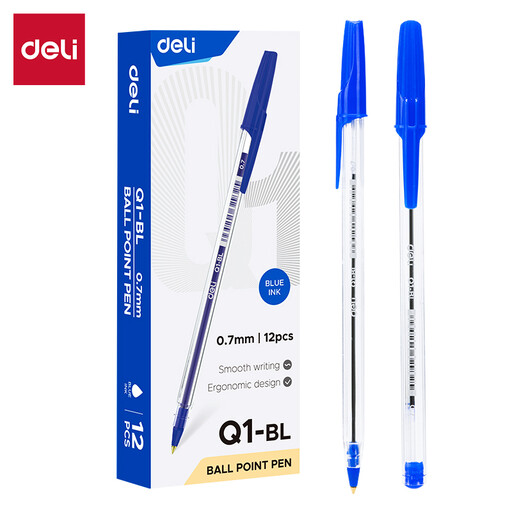
Why this fits: A stock of 12 blue pens is practical for school, a shared office or a home workspace.
The specifications clearly state 0.7 mm, blue ink and a pack of 12. This is a ballpoint pen with oil-based ink, not a gel pen.
12 pens, 0.7 mm bullet tip and blue oil-based ink for everyday writing tasks.
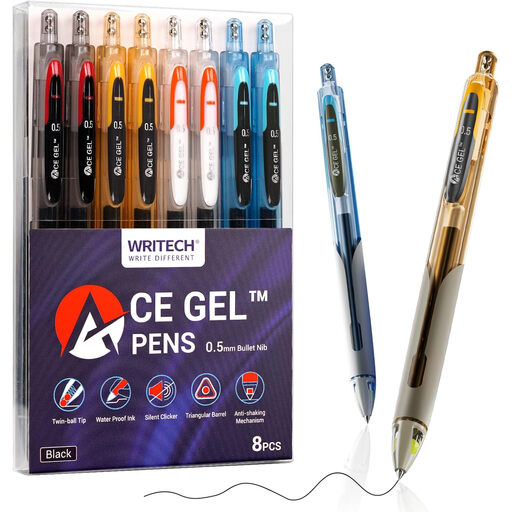
Why this fits: The fine tip and black ink are suitable for compact notes, study cards, office work and detailed journaling.
The set states a line width of 0.5 mm, a silent click button and a soft silicone grip. For important work, still check the paper for bleed-through.
8 pens, twin-ball tip of 0.5 mm and soft grip; according to the product description, designed for quiet use.
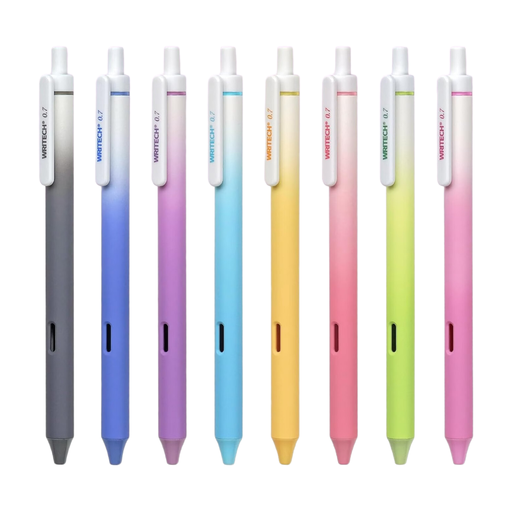
Why this fits: The eight colours are useful for planners, creative projects, highlighting and daily notes.
The product information mentions 0.7 mm, retractable tips and a 2 mm silicone grip. Don't choose this set if you only need an ultra-fine line.
8 retractable pens in different colours with a soft, non-slip grip.
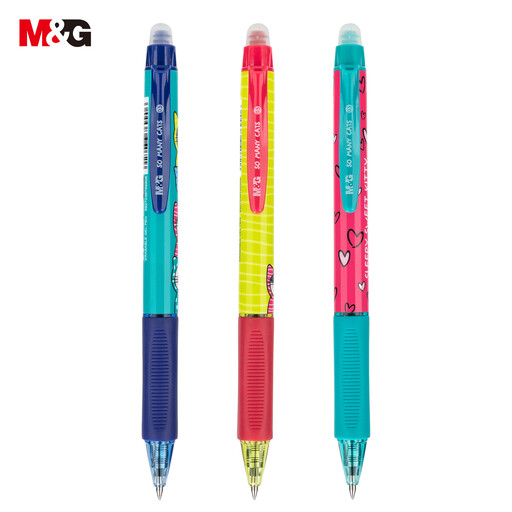
Why this fits: Handy for planners, homework and notes where you regularly make changes.
The ink is heat-sensitive and can be erased according to the product information. Therefore, do not use these for documents that need to be stored long-term or under varying temperatures.
6 pens, 0.5 mm tip, blue erasable gel ink and a retractable side mechanism.
Browse a current selection of ink writing pens in various tip sizes, colours and closing mechanisms.
Yes, provided the tip size and ink colour match the intended use. A 0.5 mm gel pen is suitable for compact notes and diaries. For forms and everyday writing, many users prefer 0.7 mm. For official documents, always check that the ink is not erasable and has sufficient contrast.
Use the cap or retract the tip after writing. Do not store pens for long periods in direct sunlight or at extreme temperatures. If a pen is writing less smoothly, try scribbling lightly on scrap paper. Don't force the tip and don't try to refill a pen yourself if the product information doesn't indicate it.
Gel pens use gel ink and often produce a striking, smooth line. Ballpoint pens typically use oil-based ink and are practical for large amounts of everyday writing. Rollerball pens work with liquid ink and often feel light when writing, but can bleed through more on thin paper. Choose based on your paper, desired drying time, line width and whether you want to be able to make corrections.
