
Vandaag of morgen in huis

Kwaliteit gegarandeerd

Welkomstaanbiedingen ontgrendelen: GRATIS bezorging | Tot 80% korting | Gratis 30 dagen JoyPlus-proefperiode
Download de app
Garden lighting makes a pathway easier to see, adds atmosphere to a patio, and can dress up a balcony or façade for a festive feel. Yet the range isn't always easy to compare. A product might look suitable for outdoor use, while the specifications only allow indoor use. Terms like "waterproof", "energy-efficient" and "bright" don't always tell the full story either.
With this guide, you can compare solar garden lighting, solar garden lights, LED string lights and other decorative lighting on the points that really make a difference in practice.
Not every decorative string light is suitable for rain. Always check the IP rating:
Hanging an indoor string light on a pergola or balcony can be risky if moisture reaches the plug or control unit. A product description should therefore clearly state where the lighting can be used.
With solar garden lights, the actual burn time depends on the weather, the location and the amount of direct sunlight. A panel placed in the shade of a fence will charge less efficiently than one in a sunny spot. Product information stating, for example, 8–14 hours of lighting is a stated value under certain conditions, not a fixed guarantee for every night.
Also pay attention to the first use: the switch often needs to be set to "on" before the automatic dusk sensor will work.
With an outdoor string light, the total cable length is not always the same as the illuminated length. A product may, for example, have a lead-in wire between the plug and the first light point. So measure beforehand:
Solar garden lighting works without a fixed power connection and is handy for a driveway, border or garden path. Installation usually consists of a ground stake and a separate solar panel or an integrated panel. Bear in mind that charging capacity is lower during dark, rainy days.
Battery-powered lighting is flexible and suitable for places without a socket. Check which batteries are needed and whether they are included. For occasional decoration, such as a party or Christmas decorations, this can be practical.
Mains power generally offers constant operation. A long 30-metre LED string light, for example, is suitable for a patio or wall where a socket is available. Make sure the plug, adapter and connections stay dry.
For warm white garden lighting, a colour temperature around 2700–3000K is the obvious choice. This usually gives a softer look for patios, gardens and balconies. Cool white light looks brighter and more modern, but can feel less restful in a green setting.
With pathway lighting, pay attention to the number of lumens. A lamp with 10 lumens per unit mainly provides accent and orientation light. That's different from strong lighting for a driveway or entrance. Place several lamps at equal distances if you want a continuous light pattern.
Copper-coloured wire is flexible for trees, plants and fences. ABS plastic is lightweight and often used for housings. Metal poles can give a different look, but check whether the material is corrosion-resistant.
Clean solar panels regularly with a soft, damp cloth. Place ground stakes firmly enough to prevent wobbling and tripping hazards. With mains-powered lighting, unplug the light from the socket before cleaning or replacing bulbs.
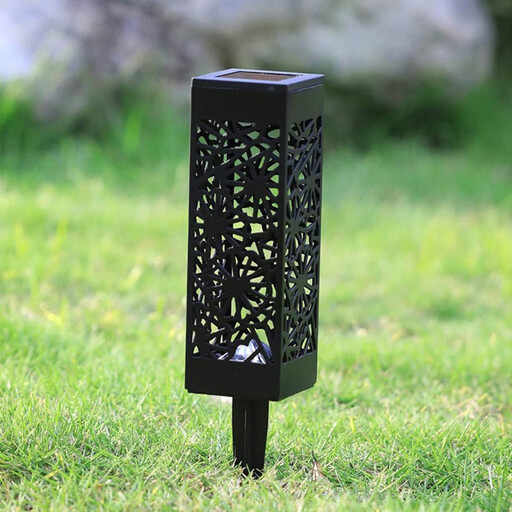
Why this fits the profile: Six solar lights offer a simple way to mark out a garden path, border or patio edge without running any cables.
The product information states IP65, automatic on/off switching and a stated charging time of 4–6 hours in sunlight. Do check the sun exposure in your garden.
Set of 6, warm white LED light, ground installation without wiring and a stated burn time of 5–8 hours.
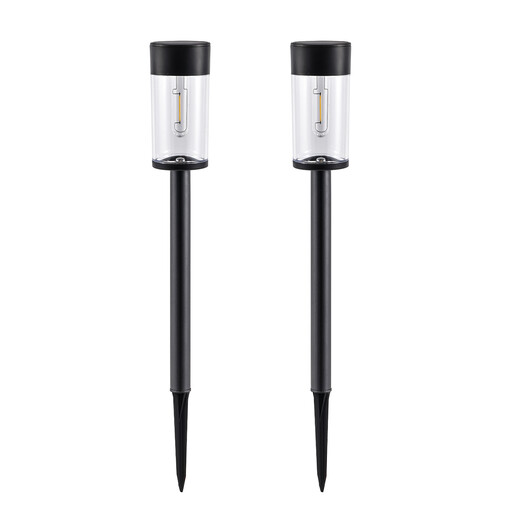
Why this fits the profile: This set suits anyone who wants a focused light point along a driveway, path or lawn edge and values metal components and clear light specifications.
The specifications state 10 lumens per lamp, 3000K and IP65. This lets you see upfront that it is primarily accent and pathway lighting, not a powerful floodlight.
2 lamps, rust-resistant steel poles, warm white light and a stated burn time of 8–12 hours after 6–8 hours of charging in sunlight.
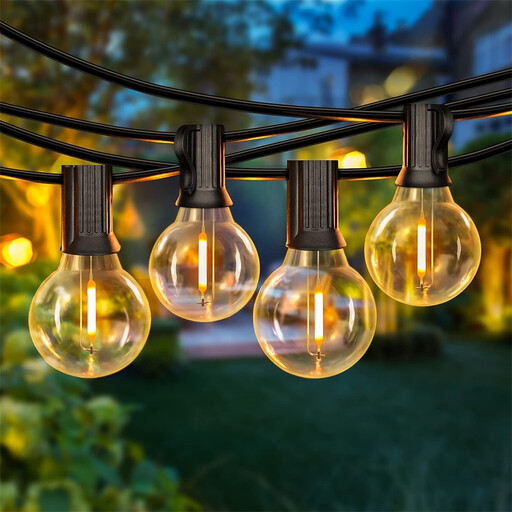
Why this fits the profile: Handy for a large patio, party venue, balcony or wall where a socket is available and constant light is needed.
The plug-in power supply removes reliance on sunlight. Before installation, check the IP rating and keep plug connections away from standing water.
30 metre length, dimmer function, timer, multiple light modes and replaceable G40 bulbs. According to the product information, up to 500 lamps can be connected.

Why this fits the profile: A practical choice for outdoor Christmas lights, windows, branches or a wall where a cascading light effect is desired.
The IP44 rating is clearly stated. Therefore, only use the product in a sheltered spot and avoid submersion or prolonged exposure to water.
192 LEDs, 8 hanging points, colour-changing lighting, memory function and an adapter for 220–240V.
We've put together a full, up-to-date list of products that fully meet these strict selection criteria and comply with current European safety regulations.
Choose a spot with several hours of direct sunlight and avoid shade from trees, fences or walls. Point the solar panel freely towards the sky and clean the surface occasionally. In winter or during prolonged cloud cover, the burn time may be shorter.
No. Check the IP rating, the manufacturer's instructions and the location of the plug or adapter. A product with IP20, such as some decorative indoor string lights, should not be used outdoors. IP44 is suitable for splashing water under appropriate conditions; IP65 offers more protection, but submersion is still not permitted.
Solar lighting uses no mains electricity while charging, but the purchase price and any battery replacement do add up. LED mains-powered lighting generally uses less electricity than older bulb technology, but the total consumption depends on the wattage and the number of hours it's on. A timer or automatic dusk sensor can help limit unnecessary long burn times.
