
Vandaag of morgen in huis

Kwaliteit gegarandeerd

Welkomstaanbiedingen ontgrendelen: GRATIS bezorging | Tot 80% korting | Gratis 30 dagen JoyPlus-proefperiode
Download de app
Good garden lighting makes a garden, driveway, balcony or patio more usable once darkness falls. However, it is not wise to base your choice solely on appearance or an attractive offer. A light that looks beautiful during the day may provide too little light in practice, be installed in the wrong place or not be sufficiently protected against rain.
Pay particular attention to these three common pitfalls:
Misinterpreting an IP rating
IP44 means protection against solid objects and splashing water. It does not mean completely waterproof. Do not install an IP44 light where it will be continually exposed to jets of water, puddles or immersion.
Confusing lumens with ambient lighting
A solar light with 10 lumens is suitable as a subtle marker along a border, but not as the main light for a dark driveway. For practical lighting, the light level, light distribution and installation height are more important than the number of LEDs alone.
Placing solar garden lighting in a shady spot
Solar garden lighting needs direct light during the day. Under a solid canopy, next to a tall fence or beneath trees, the battery may not charge fully. Also check that the panel stays clean and that the stated operating time suits the way you intend to use it.
The IP code consists of two digits. The first digit indicates protection against solid particles; the second relates to water.
Always check the installation instructions. A light with a high IP rating may still function incorrectly if the connection or cable is not suitable for outdoor use.
The number of lumens indicates how much light the lamp emits. For decorative garden lights, a low light intensity is often sufficient. For path lighting, an entrance or a driveway, you will usually want a clearer light pattern.
Colour temperature is measured in kelvin:
Also consider the direction of the beam. A downward-facing light helps to limit distracting glare. An adjustable ground spotlight is ideal when you want to highlight a tree, wall or border.
LED garden lighting generally uses little power and often has an integrated light source. However, check whether the LED can be replaced. On many models, it cannot be replaced by the user.
Outdoor solar lights do not require a fixed connection, but they depend on sunlight and battery capacity. A model with USB charging offers extra flexibility in cloudy weather. For smart garden lighting, pay attention to the connection: some models work via Bluetooth, while others use Wi-Fi and require an app account.
For mains-powered lighting, a suitable outdoor socket, proper cable routing and protection against trip hazards are essential. Fixed electrical connections should be installed in accordance with the applicable safety regulations.
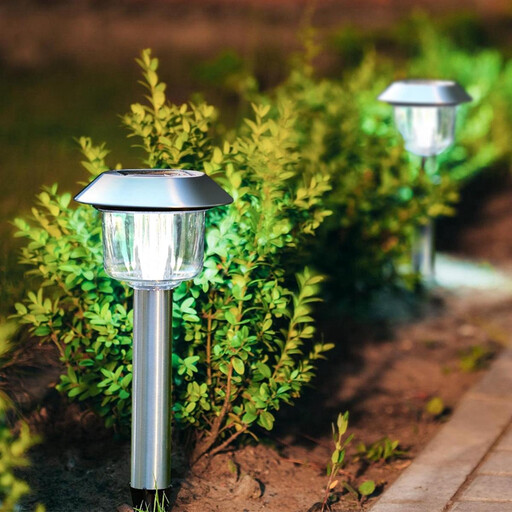
Why it suits this profile: This compact solar garden light works without fixed wiring and is easy to position along a border, patio or small path.
The product details specify solar power, a charging time of 4-6 hours and a stated operating time of 8-12 hours. Positioning it in direct sunlight is still essential.
Stainless steel, 36.6 cm tall, 6500 K and an IP44 rating. Suitable for simple decorative outdoor lighting.
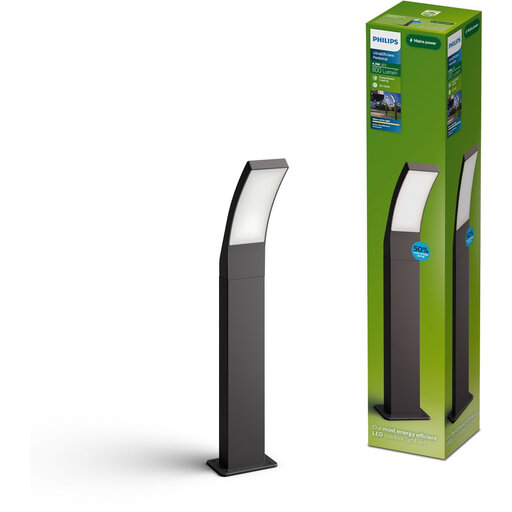
Why it suits this profile: This aluminium standing lamp is ideal for anyone looking for a fixed garden light for a path, patio edge or border, with a calm, warm light.
The E27 fitting lets you choose a suitable LED bulb yourself and replace it later. Please note: the light source is not included.
Aluminium and glass, 75 cm tall, E27 fitting and IP44. The lamp can be tailored to your preferred light colour and intensity.
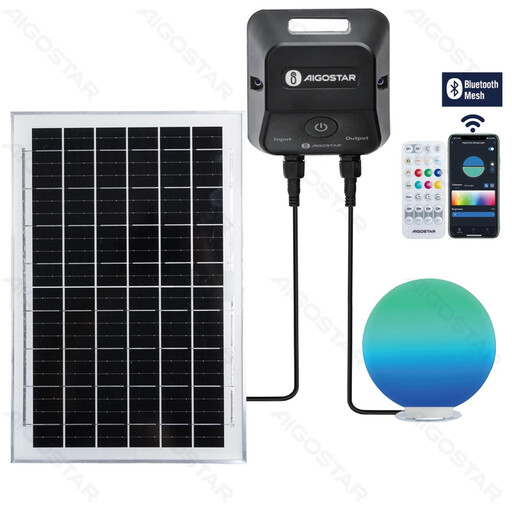
Why it suits this profile: This model is designed for anyone who values colour settings, brightness control and multiple linked lights in a larger garden.
The specifications state IP65 and a solar design without fixed wiring. Before installation, check the available sunlight and the required Bluetooth range.
RGBCCT lighting, scheduling and brightness control, a 120° beam angle and a stated battery life of up to 24 hours.
We have put together a complete, up-to-date list of products that fully meet these strict selection criteria and the applicable European safety regulations.
Do not place path lights so close together that the lighting becomes distracting. With solar lights, even spacing is more important than maximum brightness. Keep patio-lighting cables outside walkways and, when using mains power, use a socket suitable for outdoor use.
A ground spotlight must be firmly secured and must not create a trip hazard. After installation, check that water can drain away, and do not point the light directly at windows or people’s eyes. Clean solar panels, diffusers and fittings with a soft, slightly damp cloth when dirt reduces the light output.
For subtle marking, a low light intensity may be sufficient. For a path where you actually need to see where you are walking, several evenly spaced lights are often more practical than one very bright light. As well as lumens, consider the height, beam angle and distance between the garden lights.
It can be, but performance depends on the amount of daylight, positioning and battery capacity. During the darker months, the light may stay on for less time or shine less brightly. Choose a model with a suitable IP rating and keep the solar panel free from leaves, mud and grime.
Consumption depends on the wattage, number of lights and operating time. A 4.3-watt LED bulb used for four hours each evening consumes less energy than a traditional bulb with a higher wattage. Solar garden lighting does not use a fixed mains connection, but it does have a battery that may provide less capacity over time.
