
Players around a bright dining table
You play in daylight or with lights reflecting on the screen, and want to follow characters and arena details from the places where you usually sit.


Start with a screen size that’s easy to see from every gaming spot, then assess reflections and viewing angles where you’ll be playing. Consumentenbond generally describes OLED TVs as offering wider viewing angles and deeper blacks, while LCD TVs can often be bright; which matters more depends on the daylight and seating positions in your room. Choose 120 Hz or VRR only if your console, game and chosen HDMI input support the feature: PlayStation specifies 120 Hz output for compatible games, while Nintendo lists a maximum of 60 fps at 4K for Switch 2.
You play in daylight or with lights reflecting on the screen, and want to follow characters and arena details from the places where you usually sit.
You play with people sitting beside or at an angle to the screen, and want a clear enough picture from the outer seats too.
You want to know whether your console and games can benefit from low latency, 120 Hz output or VRR, without assuming every game uses these features.
First decide where the screen will go and where you’ll be sitting to play. Then compare the picture in your usual lighting conditions and check that the gaming features work with your console and games.
| What to consider | What to look for | Who it matters to |
|---|---|---|
| Visibility and reflections | Compare the picture in similar lighting and view the screen from your gaming spots. Consumentenbond notes that LCD TVs can often be bright; reflections also need to be assessed on the specific model. | When I play during the day, I want to see arena details without windows or lights getting in the way. Around 31% of consumers prioritise visibility in daylight. |
| Viewing angle | View the screen from the furthest seat to the side. According to Consumentenbond, OLED TVs generally offer wider viewing angles and can display deeper blacks; check the specific model from the side for yourself. | When we sit around the table, I want to be able to follow the game from an angled seat too. Around 25% of consumers prioritise viewing angles for players sitting to the side. |
| Console and gaming features | Check your console, the specific game, output settings and HDMI input. PlayStation links 120 Hz output to compatible games; Nintendo lists a maximum of 60 fps at 4K for Switch 2. | I want features such as 120 Hz or VRR to work with the console and game I actually use. Around 25% of consumers give compatible gaming features top priority. |
| Screen size and running costs | Measure your viewing distance and available space. Consumentenbond gives viewing distance in centimetres divided by 2.4 as a rough guide to screen diagonal in centimetres; Energielabel.nl recommends comparing energy use per 1,000 hours too. | I want a screen that’s easy to see from our gaming spots and fits the available space. Around 19% of consumers prioritise screen size and running costs. |
What’s possible depends on your console and game. PlayStation specifies 120 Hz output for games that support 120 Hz; Nintendo lists a maximum of 60 fps at 4K for Switch 2.
Before making refresh rate the deciding factor, check the output settings, the game and the HDMI input you plan to use.
Players sitting to the side may see the screen from a different angle and experience different reflections from their seats.
Check the picture and reflections from the furthest gaming spots to the side, in the kind of lighting you usually have at home.
General differences between panel types don’t tell you everything about a specific model’s viewing angle, brightness or reflections. Consumentenbond describes LCD TVs as often bright and OLED TVs as generally offering wider viewing angles, but that’s no substitute for comparing specific screens.
Compare the size and relevant features of the models you’re considering, based on your own seating positions and lighting conditions.
The energy label and energy use per 1,000 hours help you compare specific models. In the Netherlands, statutory guarantees have no fixed legal time limit, according to the government; additional warranties have their own terms and conditions.
Compare the stated energy use on the same basis and check what an additional warranty package does and doesn’t cover.
These brands are useful points of reference for different TV technologies and gaming features. The features mentioned apply to the specific models below, not necessarily to the entire brand.
The QE55QN83HAUXXN is an example of a Neo QLED Mini LED model to compare if you’re looking at an LCD option with gaming features.
The OLED77G67LW is an OLED evo model to compare if OLED and a wide range of gaming features are important to you.
The BRAVIA 5 K-55XR5 is a Mini LED model to compare if you’re connecting a console or another HDMI device.
The 55OLED760/12 is an OLED model featuring Ambilight.
The 55T8C is a 55-inch 4K QLED TV to compare for screen size and gaming features.
This Joybuy selection includes OLED, QD-Mini LED and QLED TVs to compare for multiplayer gaming. Pay particular attention to viewing angle, screen size and the features supported by your console and games.
 Image unavailable
An OLED model to compare if players also view the screen from an angle; check the picture from the furthest seats to the side.
55-inch, OLED evo, 4K, 120 Hz native and VRR up to 165 Hz.
 Image unavailable
A QD-Mini LED model to compare if you’re looking at an LCD option with gaming features; check the picture from the furthest gaming spots too.
4K, 1000 nits and 144 Hz.
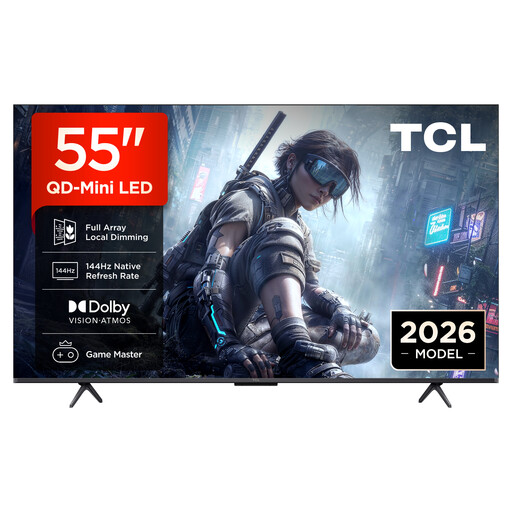 Image unavailable
A model to compare if QD-Mini LED dimming and features for compatible games matter to you; check which features your equipment uses.
55-inch, 4K HDR, 144 Hz VRR and FreeSync Premium.
 Image unavailable
A QD OLED model to compare if players sit in different positions; assess viewing angles and reflections from the places where you play at home.
55-inch, 2026 version.
 Image unavailable
A QLED model to compare if you’re looking for a 55-inch screen with a high refresh rate specification; check visibility from the different gaming spots.
55-inch, 4K and 144 Hz.
No, not always: first check what output your console and game support. PlayStation specifies 120 Hz output for games that support 120 Hz; Nintendo lists a maximum of 60 fps at 4K for Switch 2.
On your PS5, go to Settings > Screen and Video > Video Output and check the information about the connected HDMI device, including resolution, VRR and HDR. Also check that the TV input you’ve selected supports the feature you want.
Measure the viewing distances from the players’ seats and check that details remain easy to see from the outer seats. Consumentenbond gives viewing distance in centimetres divided by 2.4 as a rough guide to screen diagonal in centimetres.
Take breaks from images that remain unchanged for long periods and follow the care instructions for your chosen model. In a 2022 test, Consumentenbond reported temporary image retention under prolonged, unusual test conditions; this doesn’t establish a fixed safe playing time for current TVs.
No, not automatically. According to the Dutch government, statutory guarantees in the Netherlands have no fixed legal time limit; additional warranties have their own terms and conditions and are on top of your statutory rights. Check what the package covers and report a faulty product to the retailer.