
Players with tall windows
You play during the day and want to see game text and dark scenes clearly. Compare the exact model’s reflection handling and brightness; RTINGS.com highlights both as important factors when dealing with incoming light.


Start by checking how the exact model handles reflections and brightness; a high brightness figure alone doesn’t tell you enough about visibility with tall windows. Then check the picture from every player’s seat and match gaming features such as 120 Hz and VRR to your console and games, so you don’t give weight to features you won’t use.
You play during the day and want to see game text and dark scenes clearly. Compare the exact model’s reflection handling and brightness; RTINGS.com highlights both as important factors when dealing with incoming light.
Your fellow players sit at an angle to the TV too. The Consumers’ Association and RTINGS.com point to viewing angle as a factor to consider when several seats need a clear view.
You want responsive controls, but match features such as 120 Hz and VRR to your console and the games you play. Nintendo and PlayStation describe different output options for each console.
First compare reflection handling and brightness for your window setup, then check the picture from the available seats, and finally consider the gaming features your console can actually use.
| What to consider | What should you check? | Who should pay extra attention? |
|---|---|---|
| Visibility in daylight | Compare independent measurements of reflections and brightness for the exact model. RTINGS.com stresses that brightness alone won’t eliminate visible reflections. | If I play during the day with tall windows in or opposite my field of view, I want dark scenes to remain clear. Around 33% of consumers give visibility in daylight their top priority. |
| Viewing angle for the group | Check independent viewing-angle results and match the screen size to your viewing distance and seating positions. The Consumers’ Association explains that viewing angles can vary between screen types. | When players sit in different places, I want to be able to follow the game clearly from the side too. Around 27% of consumers prioritise a good view from several seats. |
| Controls and console | Look up input lag in Game Mode at the output setting you use. Check 120 Hz and VRR only if your console and games support them; Nintendo and PlayStation publish the output options for each console. | If timing matters in my party games, I want the screen’s response to suit my console and settings. Around 27% of consumers prioritise responsive controls and console features that meet their needs. |
| Suitable features and energy use | Check your console first, then compare the details and EU energy label for the exact screen variant. The European Commission uses a scale from A to G for electronic displays. | I want to choose a screen and features that suit the way I play, without factoring in capabilities I won’t use. Around 13% of consumers focus on suitable features and running costs. |
A bright screen can still show distracting reflections from a window, making dark areas of the picture difficult to see.
For the exact model, also look for independent data on direct and indirect reflections. Compare the test setup with the direction of the light in your room.
What a console can output varies by model; a high refresh rate also doesn’t tell you what an individual game supports.
Check your console and game first, then compare input lag in Game Mode at your intended output setting. The original Nintendo Switch Lite doesn’t support TV mode.
The picture can change when viewed from the side, depending on the panel and the specific model.
Decide where players will sit and compare independent viewing-angle results before choosing the screen size.
Delivery and installation may involve extra costs. An extended warranty doesn’t replace your statutory rights.
Ask about delivery and installation before you buy, compare the energy label and keep the seller’s details.
Samsung describes Neo QLED as an LCD option with Mini-LED backlighting.
LG has models such as the QNED93A6A Mini-LED and OLED55C5ELB OLED that are worth comparing.
According to Philips, the 55MLED910/12 combines QD Mini-LED with Ambilight.
The 65U6NQ is a 65-inch Mini-LED model that you can compare with other screen sizes.
These product picks are QLED and QD Mini-LED models for anyone considering an LCD option with gaming features. Compare reflection handling and brightness for each variant; the listed gaming features alone don’t tell you how well a TV performs with tall windows.
 No image available
A 65-inch model to compare if you’re looking for a QD-Mini LED TV with gaming features.
The product description lists native 144 Hz, HDMI 2.1, ALLM and VRR.
 No image available
A 50-inch QD-Mini LED model to consider if that screen size suits your viewing distance.
The product name lists 4K, 1000 nits and 144 Hz; the description mentions HDMI 2.1, ALLM and VRR.
 No image available
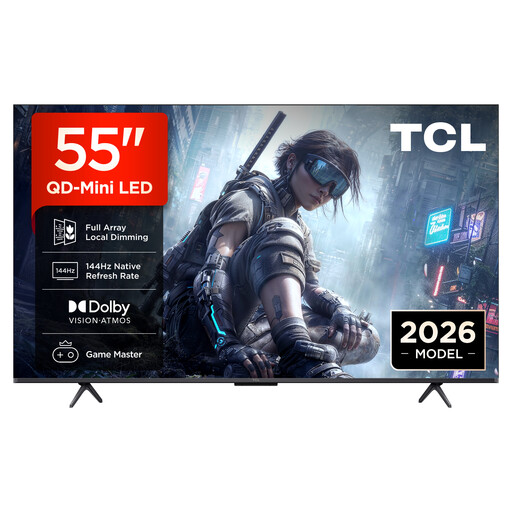
A 55-inch model to compare if you’re looking for QD-Mini LED and gaming features.
The product description lists 4K, native 144 Hz, HDMI 2.1, ALLM and VRR.
 No image available
A 75-inch model to compare with your viewing distance and the players’ seating positions.
The product description lists 4K, native 144 Hz, HDMI 2.1, ALLM and VRR.
 No image available
An 86-inch model to assess in relation to your viewing distance and the space available for players.
The product name lists 4K, HDR10+, HDMI 2.1, FreeSync Premium and 144 Hz.
Not necessarily. Nintendo says the original Switch supports output up to 1080p at 60 fps in TV mode; Switch 2 lists up to 4K at 60 fps or 120 fps at 1080p and 1440p. PlayStation lists 4K/120Hz output for PS5. Also check what the specific game supports and the input lag at your chosen output setting.
No. Nintendo says the Switch Lite doesn’t support TV mode. For other Switch models, check which dock and output settings you need.
Assess the intended location from every player’s seat and compare reflection measurements with the direction of the light in your room. Match the screen size to your viewing distance; higher brightness alone won’t necessarily eliminate direct reflections.
Compare the EU energy label and product information for the exact screen variant. The European Commission’s energy label scale for televisions runs from A to G; how long you use the TV and which variant you choose will also affect your energy use.
In the Netherlands, you should contact the seller to resolve a fault. The Dutch government says there’s no fixed term for the statutory guarantee; the assessment depends on what you could reasonably expect from the product. An extended warranty doesn’t replace those rights.