
2D tileset creator
You mainly create tilesheets and tilemaps, and want to choose a PC that suits your editor and project size without assuming you need a powerful GPU.


For simple 2D tilesets, you don’t automatically need a powerful dedicated graphics card. Choose a PC that suits your editor, renderer and project size. If you also create or render 3D assets in Blender, compare the RAM, supported graphics cards and video memory with the recommendations for your operating system. Finally, measure the space you have available and check the full specification, not just the name of a PC range.
You mainly create tilesheets and tilemaps, and want to choose a PC that suits your editor and project size without assuming you need a powerful GPU.
You also create 3D assets or renders, and want to compare your Blender workflow with the available RAM, GPU support and video memory.
You have a fixed workspace, so the case dimensions and options for future upgrades are important considerations.
First, decide whether you’ll mainly be creating in 2D or also modelling and rendering in 3D. Godot sets out the basic requirements for a simple project. For Windows, Blender recommends 32 GB RAM and 8 GB VRAM, but these aren’t fixed requirements for every workflow.
| What to consider | What to look for | Who should pay extra attention? |
|---|---|---|
| Suitability for 2D | Check your editor, renderer, project size and operating system. | If I mainly create tilesheets and simple tilemaps, I want to choose a PC that suits my 2D software. Around 42% of consumers make 2D suitability their top buying priority. |
| 3D capability | Compare the Blender version, rendering method, RAM and VRAM of the exact configuration. | If you also create or render 3D assets, pay close attention to memory and GPU support. Around 25% of consumers prioritise 3D creation. |
| Case size | Measure your available space and check the dimensions of the full model. | On a small home desk, the case can determine how much workspace you have. Around 17% of consumers prioritise desk space. |
| Upgradability | Check the available RAM and storage slots on the specific configuration. | If I want to add memory or storage later, I want to know what the PC actually supports. Around 16% of consumers make upgradability their top priority. |
Godot’s basic requirements for a simple project and Blender’s recommendations for 3D work apply to different workflows.
First, decide whether you’ll only be creating in 2D or also modelling and rendering in 3D. Then compare the configuration with the requirements of the software you use.
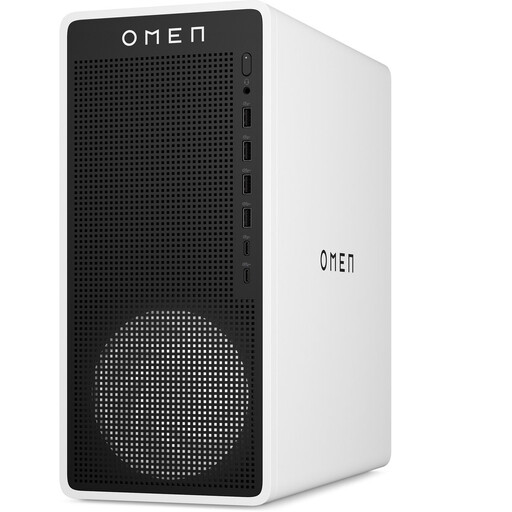
Models in the same PC range can have different components. According to HP, the OMEN 16L TG03-0600nd has 16 GB RAM and an RTX 5060 Ti with 16 GB of video memory; a review of the TG03-0650nd describes a different configuration.
Check the full model code and the components in the specific configuration you’re considering.
A review of the specific OMEN 16L TG03-0650nd mentions options for upgrading the RAM and SSD, as well as limitations on more extensive upgrades. This doesn’t automatically apply to other configurations.
Check both the external dimensions and the available upgrade options for the exact PC.
The OMEN 16L is a desktop range worth comparing if you’re looking for a more compact gaming PC for creative work.
The MPG Infinite Z3 X3D is a tower worth comparing if 3D creation and upgrade options are important to you.
The Predator Orion 3000 is a desktop range to consider when weighing up case size and configuration.
Legion desktops are another range to consider when comparing towers for creative work.
These gaming desktops are for anyone considering 3D creation in Blender alongside their tileset work. Compare the RAM, video memory and case size of each configuration with your own workflow and workspace.
 No image available
The listed 32 GB DDR5 and 16 GB of video memory meet or exceed Blender’s Windows recommendations for RAM and VRAM.
Ryzen 7 7800X3D, GeForce RTX 5080, 32 GB DDR5 and 1 TB NVMe SSD.
Blender’s recommendations don’t guarantee performance for a specific project.
 No image available
This tower has 32 GB RAM and 12 GB of video memory. Also check that the case size and storage upgrade options suit your workspace and plans.
32 GB DDR5, 1 TB PCIe 4.0 SSD, GeForce RTX 5070 and Wi-Fi 7.
According to the product description, the case has a capacity of 30 litres. It supports up to three M.2 SSDs and one 3.5-inch drive.
 No image available
Its compact size may suit a small desk. For Blender, the listed RAM is below the Windows recommendation of 32 GB.
16-litre case, 16 GB RAM, 1 TB SSD and 8 GB of video memory.
The listed 16 GB RAM is below Blender’s Windows recommendation. Requirements depend on your project and workflow.
 No image available
This configuration has 8 GB of video memory and 16 GB RAM. For Blender, that’s below the Windows recommendation of 32 GB.
RTX 5060, 16 GB DDR4, 480 GB M.2 SSD and Wi-Fi adapter.
The actual requirements depend on your software and project size.
 No image available
This configuration lists 8 GB of video memory and 16 GB RAM, which is below Blender’s Windows recommendation of 32 GB.
AMD Ryzen 7 5700X, GeForce RTX 5060 Ti 8GB, 16 GB DDR4 and 480 GB NVMe PCIe SSD.
Blender’s recommended configuration isn’t a universal requirement for every 3D project.
Not necessarily. For a simple project, Godot lists integrated graphics as an option, provided they support the requirements of your chosen renderer. Larger projects or different software may have different requirements.
Create a TileSet for a TileMapLayer and match the tile size to your images. Godot’s guide also explains how to add a tilesheet as an atlas. This is a software step, not a specific PC requirement.
For a consumer purchase, the seller must resolve an issue if a product doesn’t perform as you could reasonably expect under normal use, according to ACM ConsuWijzer. Online purchases generally come with a cooling-off period of up to 14 days after delivery; check which exceptions apply. This guidance doesn’t necessarily apply to business purchases.
In the Netherlands, the take-back scheme for household electrical equipment means that when you buy a new, similar appliance, the old one must be taken back free of charge. The Dutch government also explains how this works for online deliveries. The scheme doesn’t apply to business equipment.
When handling an organisation’s data, follow its security procedures. The Dutch Data Protection Authority recommends using a secure home-working environment and equipment provided by the organisation where possible. This isn’t a general ban on using a personal PC for tileset work.