Start by distinguishing between GIS elevation data and 3D modelling or rendering: these workflows place different demands on a PC. Then compare the exact software requirements with the configuration’s RAM, video memory and storage, and check that the case and cables will work with your sit-stand desk.
Who is this choice relevant to?
3D terrain creator
You build or render terrain in Blender or Unreal Engine and want to match your PC configuration to your scenes and rendering features. Blender Foundation and Epic Games publish software requirements and recommendations for their respective applications.
Elevation map creator
You mainly work with digital elevation data and map analysis, for example in QGIS, and want to match your PC to that workflow rather than automatically assuming you need 3D rendering. QGIS documents a range of raster terrain analysis operations.
Sit-stand desk user
You use your PC at an adjustable workstation and want to position the case, connections and monitor setup practically. The Arboportaal describes sit-stand desks as a way to alternate between sitting and standing while working.
What should you consider when choosing?
| What to consider |
What should you check? |
Who should pay particular attention? |
| 3D scenes and rendering |
Check the software version and rendering backend. Blender Foundation recommends 32 GB RAM and 8 GB video memory for Windows. For Unreal Engine 5.8, Epic Games recommends 32 GB RAM and at least 8 GB of graphics memory. |
If I build complex terrain or use GPU rendering, I want to match the exact graphics card and rendering backend to my software. Around 40% of consumers prioritise suitability for 3D rendering. |
| Elevation data and map files |
Identify the GIS operations and files you use, then check the requirements of your chosen software and the PC’s storage capacity. |
If I mainly analyse elevation data, I want to choose a capacity that suits my GIS projects rather than starting with extra rendering features. Around 30% of consumers prioritise elevation map processing. |
| Positioning at your desk |
Measure the available space and check the case dimensions, ventilation clearance, connections and cable routing throughout the desk’s height range. |
If I adjust the desk height, I want the case to fit comfortably and connected devices to remain within reach. Around 20% of consumers put practical fit first. |
| Configuration and upgrades |
Compare the full model or item number and the installed RAM, GPU and SSD, then check the documentation on upgrades. |
If I want to match my spending to my current project and perhaps upgrade later, I want to know the exact configuration and its upgrade options. Around 10% of consumers prioritise affordability and upgradeability. |
Pitfalls to avoid when choosing
-
Assuming a gaming label proves a PC is suitable for every terrain mapping task
Elevation data analysis and GPU rendering of a 3D scene are different workflows. A PC’s category name alone won’t tell you whether its configuration suits your software.
First, identify your software, project type and any rendering backend. Then compare the full configuration with the relevant requirements.
-
Assuming every configuration in a product range is the same PC
Configurations within a product range can differ in RAM, storage and GPU specifications, so comparing products by name alone can be misleading.
Check the full item number and the specifications for the exact configuration you’re considering.
-
Waiting until after you buy to find a spot beside your adjustable desk
The case and cables need to fit without obstructing ventilation or the desk’s movement. You may need to position the PC elsewhere or use longer cables.
Measure the available space beforehand and check the dimensions, connections, ventilation clearance and cable routing.
Plan a ventilated spot for the case and check that the cables can stay connected while you adjust the desk.
Brands to compare
These brands offer specific desktop configurations that you can compare with your software requirements and workspace. The configurations mentioned are not a performance assessment of an entire product range.
Lenovo
The Legion Tower 5 is a useful point of comparison for a fixed desktop setup for 3D work.
- Lenovo Netherlands lists 32 GB RAM, a 1 TB SSD and an RTX 5070 with 12 GB video memory for configuration 90YJ008KMH.
- These specifications apply to this configuration. They don’t show measured terrain mapping performance and don’t apply to all Legion models.
HP
The OMEN 35L offers another gaming desktop configuration to assess for more demanding 3D work.
- HP lists 32 GB RAM, a 2 TB SSD and an RTX 5070 Ti with 16 GB video memory for GT16-0606nd.
- HP’s claims about cooling and upgrades are manufacturer claims, not independent performance tests.
Acer
The Predator Orion 5000 is worth considering if case dimensions, connections and memory upgrades are important to you.
- For part DG.E3AEH.002, Acer lists 32 GB installed RAM, support for up to 64 GB, a 1 TB SSD and dimensions of 485 × 219 × 504,8 mm.
- Check the exact GPU and video memory for this configuration before assessing it for GPU rendering.
Joybuy products
The desktops below are aimed at 3D terrain modelling and rendering. Check your software requirements, rendering backend and available workspace before choosing one for your projects.
 No image available
Gaming Desktop PC Ryzen 7 7800X3D, RTX 5080, 32 GB DDR5, 1 TB NVMe SSD
A configuration to compare for 3D terrain work in Blender. Check that the rendering backend is compatible with the graphics card.
Specifications: Ryzen 7 7800X3D, RTX 5080 with 16 GB video memory, 32 GB DDR5 and a 1 TB NVMe SSD. The operating system is listed as Windows 11 Trial.
Joybuy
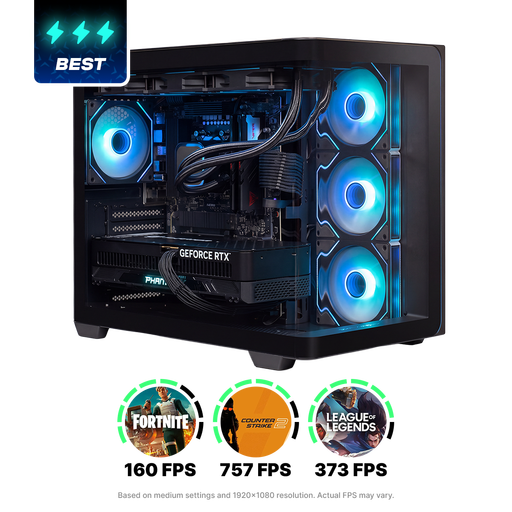 No image available
Almighty Shark R900 Gaming Desktop, Ryzen 9, RTX 5090, 32 GB RAM, 2 TB SSD
This configuration is aimed at 3D terrain work. Compare its memory capacity with the demands of your scenes and software.
Listed configuration: Ryzen 9, RTX 5090 with 24 GB video memory, 32 GB RAM and a 2 TB NVMe SSD. The product information says the charger must be purchased separately. Check which component this refers to before ordering.
Joybuy
 No image available
ASUS ROG G700TF-07265F666W, Core Ultra 7 265F, RTX 5070 12 GB, 32 GB DDR5, 1 TB SSD
An option to compare for 3D terrain work and rendering. Match your choice to the software and features you use.
Specifications: Intel Core Ultra 7 265F, 32 GB DDR5, RTX 5070 with 12 GB video memory and a 1 TB SSD. Windows 11 Home is listed.
Joybuy
No image available
ASUS ROG G700TF-05225F170W, Core Ultra 5 225F, RTX 5070 12 GB, 32 GB DDR5, 1 TB PCIe 4.0 SSD
This configuration is aimed at 3D terrain work. Check your software and project requirements before choosing it.
Specifications: Intel Core Ultra 5 225F, 32 GB DDR5, RTX 5070 with 12 GB video memory and a 1 TB PCIe 4.0 SSD. Windows 11 Home is listed.
Joybuy
 No image available
Lenovo Legion T5 30IAX10, Core Ultra 7, RTX 5070 12 GB, 32 GB DDR5, 1 TB PCIe 4.0 SSD
A configuration to compare for 3D terrain work, with attention to the stated option to add more storage.
Listed specifications: Intel Core Ultra 7, 32 GB DDR5, RTX 5070 with 12 GB video memory and a 1 TB PCIe 4.0 SSD. The product information lists support for additional M.2 SSDs and Windows 11 Home.
Joybuy
Frequently asked questions
Do I always need a powerful gaming graphics card for terrain mapping?
No. The task description alone doesn’t mean you need a powerful gaming graphics card. QGIS documents digital elevation data analysis, while Blender GPU rendering and Unreal Engine development have different requirements. First, identify your software, workflow and projects, then check the required GPU and rendering backend.
What should I look for in a PC next to a sit-stand desk?
Check that the case has enough space and ventilation, and that the cables won’t get in the way when you adjust the desk height. Adjust your monitor setup and change position regularly; the Arboportaal describes sit-stand desks as a way to alternate between sitting and standing while working.
What cooling-off period and warranty apply to an online purchase?
According to the Dutch government, online purchases from a business generally come with a 14-day cooling-off period, although exceptions apply. You’re also entitled to a product that meets reasonable expectations; a manufacturer’s or seller’s warranty may provide additional cover. Check who the seller is and which terms apply to your order.
What can I do with my old computer when I buy a new one?
According to the Dutch government, the old-for-new scheme also applies to online orders when a private individual buys a similar device. Ask the seller how collection of your old device will be arranged for your chosen delivery method.
Do the rules for working with display screens automatically apply to my home sit-stand desk?
No. The legal obligations described are aimed at employers and depend on the working situation; they’re not general product requirements for private buyers. However, advice on changing position and setting up your workspace can also be useful at home.


