
Star Citizen explorer
If you also want to play Star Citizen, pay particular attention to the memory, SSD storage and complete graphics card configuration, and compare them with the requirements from Roberts Space Industries.


Start with the game you want to play, then decide on your preferred screen settings and whether you want to use VR. SpaceEngine and Star Citizen have different requirements: Roberts Space Industries recommends 32 GB RAM for Star Citizen and requires an SSD with 150+ GB of storage. So compare the full PC configuration with the requirements of your game. A game’s VR support alone does not confirm that a particular PC and headset will work well together.
If you also want to play Star Citizen, pay particular attention to the memory, SSD storage and complete graphics card configuration, and compare them with the requirements from Roberts Space Industries.
If you want to explore celestial bodies on a standard screen, choose a PC to suit your preferred graphics settings. SpaceEngine’s Quick Start Guide recommends, among other things, 8 GB RAM; according to the manual, higher settings require a more powerful GPU.
If you want to use a headset for a space simulation, check that the game, headset, connections and PC are compatible. SpaceEngine lists support for headsets with SteamVR or Oculus support, while Frontier Developments lists VR support for Elite Dangerous.
Best for: exploring a virtual universe, without a more demanding game or VR as your main consideration.
Bear in mind: the recommended requirements do not guarantee smooth performance at the highest graphics settings; the SpaceEngine manual links higher settings with a more powerful GPU.
Best for: Star Citizen is on your games list and you want to check the full PC configuration against the game’s current requirements.
Bear in mind: the specifications listed by Roberts Space Industries do not guarantee a fixed frame rate. Your experience can be affected by location, server load, background programmes and network conditions.
Best for: you already have a headset and know which game you want to use it with.
Bear in mind: a game’s support does not confirm that every headset, PC and connection will work together or deliver the picture quality you want.
First decide which game and settings matter most to you, then check the memory, storage and graphics card in the full configuration. The percentages below show, for each row, which consideration consumers may want to prioritise when making this choice.
| What to consider | What should you check? | Who is this important for? |
|---|---|---|
| Game requirements | Check the current requirements for the specific game. Roberts Space Industries recommends 32 GB RAM and a DirectX 12-compatible graphics card with 8 GB VRAM for Star Citizen; the game requires an SSD with 150+ GB of storage. | If I mainly want to play Star Citizen, I want to know whether the full configuration is suitable for it. Around 33% of consumers prioritise suitability for a demanding space simulation. |
| Graphics settings | Compare your preferred settings and screen setup with the GPU and video memory in the specific PC. The SpaceEngine manual links higher settings with more powerful GPUs. | If I want to view stars and planets with specific picture settings, I pay particular attention to the graphics configuration. Around 27% of consumers prioritise picture quality. |
| Placement and cooling | Check the dimensions, the space around the vents and the cooling design of the specific model; don’t judge noise levels by marketing claims alone. | If I place the desktop in my games room, the case needs to fit and I want to be able to keep the space around it clear for ventilation. Around 20% of consumers prioritise placement and cooling. |
| Storage and expansion | Check the installed SSD capacity and which expansion slots are free in that specific PC. Lenovo lists up to three M.2 SSD slots and one 3.5-inch HDD slot for the Legion Tower 5i product family; configurations vary. | If I want to install several games or upgrade later, I want to know how much space and which suitable expansion options this model has. Around 13% of consumers prioritise storage and expansion. |
| VR compatibility | Choose your headset and game first, then check the current headset requirements, the connections you need and the exact PC configuration. | If I want to play with a VR headset, I want to know in advance whether my chosen game, headset and PC are compatible. Around 7% of consumers make VR compatibility their main consideration. |
The published memory and storage requirements for SpaceEngine and Star Citizen differ. A PC that suits one game will not necessarily meet the requirements of the other.
Make a list of the games you really want to play and compare the current system requirements for each one.
HP offers various OMEN models, and Lenovo notes that configurations may vary by model and region. So a product family name does not tell you exactly which components are in the model on offer.
Before buying, check the full model code and the specifications for the exact model.
ACM ConsuWijzer distinguishes between any retailer’s or manufacturer’s warranty and the statutory guarantee.
Compare the cover of any additional warranty package separately, and consider your statutory rights independently.
OMEN desktops come in various case sizes and configurations, so the full model code is important when comparing them.
The Legion Tower 5i is a desktop range worth including in your comparison if storage expansion is important to you.
The MAG Infinite S AI 2nd is another desktop range to compare if the case, cooling and graphics configuration are key considerations.
These desktops are designed for games and simulations where the combination of memory, SSD storage and graphics card matters. Check each model to see whether its configuration meets the requirements of your game; models differ in areas such as memory and video memory.
 No image available
The listed configuration may be worth considering if you want to play a demanding space game; compare the full PC with that game’s requirements.
32 GB DDR5 memory, 1 TB NVMe SSD, GeForce RTX 5080 with 16 GB VRAM and Windows 11 Trial.
 No image available
Compare this model with the requirements of your chosen game, paying particular attention to the memory and graphics card configuration.
32 GB DDR5 memory, 1 TB SSD, NVIDIA GeForce RTX 5070 with 12 GB and Windows 11 Home.
No image available
Check whether the components in this model are suitable for the games and settings you have in mind.
32 GB DDR5 memory, 1 TB PCIe 4.0 SSD, NVIDIA GeForce RTX 5070 with 12 GB and Windows 11 Home.
 No image available
The listed SSD capacity is worth considering for games with a published storage requirement. Roberts Space Industries recommends 32 GB RAM for Star Citizen; this configuration lists 16 GB.
16 GB RAM, 500 GB NVMe SSD and RTX 5060 with 8 GB video memory.
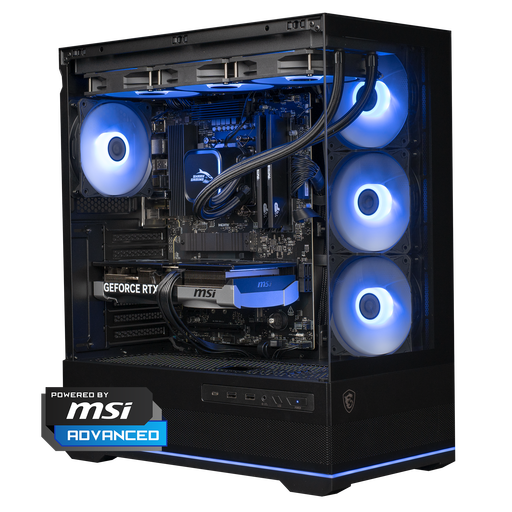 No image available
Compare the configuration with the requirements of your chosen game. Roberts Space Industries recommends 32 GB RAM for Star Citizen; this PC lists 16 GB.
16 GB RAM, 1 TB NVMe SSD and RTX 5070 with 12 GB video memory.
No, the published recommendations differ between games. SpaceEngine’s Quick Start Guide recommends, among other things, 8 GB RAM; Roberts Space Industries recommends 32 GB RAM for Star Citizen, which requires an SSD with 150+ GB of storage. Choose based on the games you actually want to play.
Before setting it up, check the dimensions of the exact case, the space around the vents and the connections you need. Specifications for a product range do not necessarily apply to every model.
An additional package is not the same as the statutory guarantee. According to ACM ConsuWijzer, the statutory guarantee is separate from any retailer’s or manufacturer’s warranty; compare the terms and cover of a paid package separately.
According to ACM ConsuWijzer, a standard online consumer purchase usually comes with a statutory 14-day cooling-off period after delivery. Before buying, check the terms and whether an exception applies to your specific order.
According to the European Commission, computers sold in the EU are covered by ecodesign rules, including requirements for power supplies and energy management. The Commission also says the existing rules are being revised; a future energy labelling scheme for computers should not be treated as a rule that is already in force.