Start with the requirements of the railway management games you play and the size of your maps. For Transport Fever 2, the developer recommends 16 GB of RAM, while the game manual says larger maps need more RAM and usually more processing power. Extra graphics power is mainly worth considering if your resolution and settings call for it. For long sessions, cooling, noise and power consumption matter too, and a list of components alone is no guarantee of performance.
Who is this choice relevant to?
Builder of sprawling railway networks
You let maps and transport networks grow over time and want to know whether the processor and RAM suit the way you play. The Transport Fever 2 manual links larger maps to higher RAM requirements and usually more processing power too.
Player with lots of mods
You use extra game content and want enough room for your combination of game, mods and background tasks. Urban Games describes mods as additional content created by the community; more RAM is not a proven fix for every slowdown.
Long-session player
You want to balance your screen's picture settings against cooling, noise and power consumption. Milieu Centraal points out that gaming PCs often use a lot of electricity; a component list does not provide measured power consumption or noise levels.
What should you look for when choosing?
| What to consider |
What should you check? |
Who is this important for? |
| Growing maps |
Compare the exact processor model and the map size you play on. The Transport Fever 2 manual links larger maps to higher RAM requirements and usually more processing power. |
If my railway network keeps growing, I want to know whether the processor and memory are suited to my maps. Around 33% of the group prioritise maps that grow over time. |
| Memory and mods |
Check the amount of RAM, upgrade options and the requirements of your own game and mods. For Transport Fever 2, Urban Games recommends 16 GB of RAM. |
When I combine mods and large maps, I want enough room for my own use and background tasks. Around 27% of the group prioritise memory capacity and extra content. |
| Picture quality |
Check the full graphics card model, graphics memory, screen resolution and test results at the settings you want to use. For Transport Fever 2, Urban Games recommends a graphics card with 4 GB of VRAM. |
If I want to use higher settings on my own screen, I want to choose a graphics card to match. Around 20% of the group prioritise picture quality. |
| Comfort and power consumption |
Check ventilation, independent noise measurements if available, and actual power consumption. Milieu Centraal suggests using a plug-in energy meter to measure consumption. |
During long gaming sessions, I want to know what level of noise and power consumption to expect in my setup. Around 20% of the group prioritise session comfort and running costs. |
Common pitfalls
-
Choosing based only on the word ‘gaming’ or the graphics card
In Transport Fever 2, the requirements for larger maps also depend on RAM and processing power. A powerful graphics card alone does not tell you how a particular PC will handle your game map.
First compare your game, map size, processor and RAM. Then assess the graphics card in relation to your screen and settings.
-
Assuming every model in a series has the same specifications
Desktops in the same series can have different components and included accessories. Acer, for example, states that a keyboard and mouse are not included with the Predator Orion 3000 version reviewed.
Compare the full model and product code, components, Windows status and what’s in the box.
-
Confusing the manufacturer’s warranty with your statutory rights
A stated manufacturer’s warranty does not remove your statutory rights in the Netherlands if a product is faulty. There is no standard statutory warranty period that applies to every PC.
Keep your proof of purchase and product description, and report any fault to the seller.
Brands to compare
Lenovo
The Legion Tower 5 Gen 10 is a specific point of comparison for processor, memory and graphics card configurations.
- For version 90YJCTO1WWNL2, Lenovo lists a Ryzen 5 7600, 32 GB of RAM, an RTX 5060 and a 1 TB SSD.
- These are the specifications for that version, not measured performance in railway management games; configurations vary within the series.
HP
The OMEN 35L GT16-1689nd is an example you can use to compare a more powerful graphics configuration.
- For this version, HP lists a Ryzen 7 9700X, 32 GB of RAM, an RTX 5080 and a 2 TB SSD.
- The stated components alone do not tell you what performance to expect in a particular game.
- HP describes tool-free upgrades as a feature; this is not an independent compatibility or performance test.
Acer
The Predator Orion 3000 PO3-650 is a specific point of comparison for a desktop with 32 GB of RAM.
- For version DG.BK4EH.00H, Acer lists a Core i7-13700F, 32 GB of RAM, an RTX 4060 and a 1 TB SSD.
- Acer says that a keyboard and mouse are not included with this version; features of other Orion versions do not automatically apply to it.
MSI
The MAG Infinite S3 range is worth considering when comparing the case and cooling design of a complete desktop.
- MSI describes Frozr AI Cooling on the MAG Infinite S3 14th as a feature that learns to predict temperatures and changes in fan speed.
- That description does not provide independent noise results or measured gaming performance for a specific version sold in the Netherlands.
Joybuy desktops for long gaming sessions
These desktops offer different combinations of processor, memory, graphics card, storage and cooling to consider for large maps and long gaming sessions.
 No image available
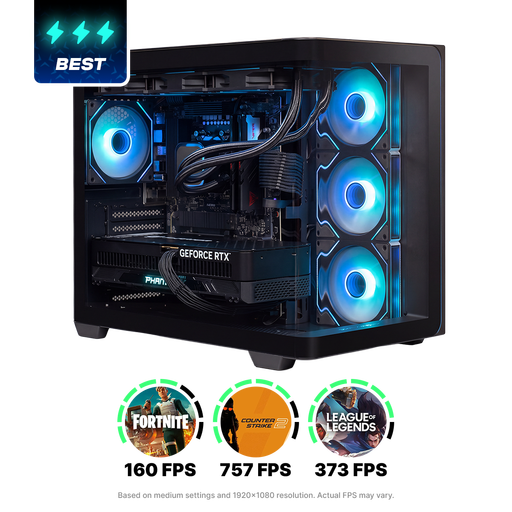
Gaming desktop Ryzen 7 7800X3D, GeForce RTX 5080
The listed processor and 32 GB of memory give you a starting point for comparing configurations for large maps and extra content.
Processor: Ryzen 7 7800X3D.
Memory: 32 GB DDR5.
Graphics card: RTX 5080 with 16 GB.
Storage: 1 TB NVMe SSD.
Cooling: 360 mm liquid cooling and seven case fans, according to the product description.
Windows 11 is listed as Trial/Evaluation Version.
View at Joybuy
 No image available
Almighty Shark R900, Ryzen 9 9900X3D, RTX 5090
The listed processor and 32 GB of memory are useful points of comparison if you play with large maps and extra content.
Processor: Ryzen 9 9900X3D.
Memory: 32 GB DDR5.
Graphics card: RTX 5090 with 24 GB.
Storage: 2 TB NVMe SSD.
Cooling: 360 mm liquid cooling, according to the product description.
View at Joybuy
 No image available
ASUS ROG G700TF-07265F666W, Core Ultra 7 265F
The processor and 32 GB of memory give you specific points to compare with the requirements of your own game and map size.
Processor: Intel Core Ultra 7 265F.
Memory: 32 GB DDR5.
Graphics card: NVIDIA GeForce RTX 5070 with 12 GB.
Storage: 1 TB SSD.
The product name lists Windows 11 Home; the description mentions liquid cooling.
View at Joybuy
No image available
ASUS ROG G700TF-05225F170W, Core Ultra 5 225F
The processor and memory are useful points of comparison if you are choosing a PC for large maps and extra content.
Processor: Intel Core Ultra 5 225F.
Memory: 32 GB DDR5.
Graphics card: NVIDIA GeForce RTX 5070 with 12 GB.
Storage: 1 TB PCIe 4.0 SSD.
Cooling: 240 mm AIO liquid cooling. The product name lists Windows 11 Home.
View at Joybuy
 No image available
Lenovo Legion T5 30IAX10, Intel Core Ultra 7
The listed 32 GB of memory and Intel Core Ultra 7 processor help you assess this configuration for maps that grow over time.
Memory: 32 GB DDR5.
Graphics card: NVIDIA GeForce RTX 5070 with 12 GB.
Storage: 1 TB PCIe 4.0 SSD.
The product name lists Wi-Fi 7 and Windows 11 Home; the description mentions air cooling and support for storage expansion.
View at Joybuy
Frequently asked questions
Is 16 GB of RAM enough for Transport Fever 2?
Urban Games recommends 16 GB of RAM for Transport Fever 2. The official game manual specifies a minimum of 16 GB for experimental map sizes and explains that larger maps need more RAM; this does not guarantee that every map or mod will run smoothly.
How can I keep my PC running well during a long gaming session?
Keep the ventilation openings clear and check the cooling system of the exact desktop model. If Transport Fever 2 slows down, you can also consider the map size and demands of the game; a manufacturer’s description is not an independent endurance or noise test.
How can I estimate the power consumption of long gaming sessions?
Measure the actual consumption of your setup in kWh and multiply it by your rate per kWh. Milieu Centraal suggests using a plug-in energy meter to measure a device’s consumption; the power supply’s rated wattage is not a measure of consumption while gaming.
Does the manufacturer’s warranty give me full protection?
No. ACM ConsuWijzer explains that consumers in the Netherlands have statutory rights alongside any manufacturer’s or seller’s warranty. If a product develops a fault during normal use, contact the seller; there is no standard warranty period that applies to every PC.
Does a gaming desktop sold in the Netherlands have to meet European product requirements?
Yes. According to Dutch government information, electrical and electronic equipment sold in the Netherlands must meet the applicable European requirements. The manufacturer applies the CE mark once the technical and administrative requirements have been met; the Dutch government stresses that CE is not an independent quality mark.


