
Creator of a simple 2D puzzle
You mainly build and test small levels. The published requirements for Godot Engine and Unity can help you match your PC to your editor and the size of your project.


For a simple 2D puzzle project, you don’t automatically need a powerful graphics card. Match your PC to your editor and the size of your project. For more complex 3D scenes in Unreal Engine, you can compare configurations with Epic’s recommendations for Windows development, including 32 GB RAM and at least 8 GB of graphics memory. Also check the exact configuration, connections and available space.
You mainly build and test small levels. The published requirements for Godot Engine and Unity can help you match your PC to your editor and the size of your project.
You work with more complex scenes or Unreal Engine and want to compare RAM and graphics memory with Epic Games’ recommendations.
Your PC needs to fit alongside screens and other work essentials. Compare the dimensions of the exact configuration and check which connections you need.
Choose this approach: if you mainly create and test small levels, match your PC to your editor, renderer and project.
The trade-off: working on a game doesn’t automatically mean you need a more powerful configuration; Unity notes that more complex projects may require more RAM.
Choose this approach: for Unreal Engine development on Windows, compare configurations with Epic’s recommendations of 32 GB RAM, at least 8 GB of graphics memory and a DirectX 12-compatible graphics card.
The trade-off: these are recommendations, not a performance guarantee for every scene. A more powerful configuration may cost more and take up more space.
| What to consider | What should you check? | Who is this important for? |
|---|---|---|
| Creating a simple level | Godot Engine lists 4 GB RAM as the minimum for a simple project; Unity 6.6 recommends at least 8 GB for the editor. Also check the graphics API and drivers required by your editor. | If I’m building small levels, I want to match the configuration to my editor and project rather than choose something unnecessarily powerful. This is a priority for around 33% of consumers. |
| More complex 3D levels | For Unreal Engine development on Windows, Epic Games recommends 32 GB RAM and at least 8 GB of graphics memory, plus a DirectX 12-compatible graphics card with up-to-date drivers. | If my puzzle includes complex 3D scenes, I compare the full configuration with the recommendations for my engine. Around 27% of consumers prioritise 3D capability. |
| Space and connections | Measure the available space and check the dimensions and ports of the exact configuration you’re considering; these can vary between models or variants. | If my workspace is shared or limited, the case and connections need to suit my screens and peripherals. Around 20% of consumers consider this important. |
| Upgrades and aftercare | Check which memory and storage upgrades are possible for each configuration. Keep your proof of purchase so you can contact the seller if there’s a problem. | If I might need more memory or storage later, I want to know what the chosen configuration allows and who to contact if something goes wrong. Around 20% of consumers put upgradability and aftercare first. |
The published requirements for a simple Godot project differ from Epic’s recommendations for Unreal Engine development. So you don’t automatically need one powerful configuration for every puzzle project.
First choose your engine, renderer and project size, then compare the relevant requirements.
Configurable desktops and product ranges can offer different processor, graphics card and memory options. The range name alone doesn’t tell you which configuration you’re buying.
Check the full specifications of the exact configuration, including RAM, graphics card, storage and connections.
According to ACM ConsuWijzer, your statutory rights are separate from any warranty offered by the seller or manufacturer.
If a product doesn’t do what you could reasonably expect, contact the seller.
The Predator Orion 3000 PO3-655, part number DG.E47EH.006, is a specific example you can use to compare case size and configuration.
The OMEN 35L GT16-1686nd is an example of a configuration you can compare for more complex projects.
The configurable Aurora ACT1250 is an example you can use to compare your chosen components with the final configuration.
The MAG Infinite S3 14th is a desktop range with different processor and graphics card options.
These Joybuy desktops are aimed at more complex 3D projects and Unreal Engine development. Check the specifications of the configuration you choose.
 No image available
You can compare this configuration with Epic Games’ recommendations for Unreal Engine development; they don’t guarantee performance for your project.
Ryzen 7 7800X3D; RTX 5080 with 16 GB of graphics memory; 32 GB DDR5; 1 TB NVMe SSD. Windows 11 is listed as an evaluation version.
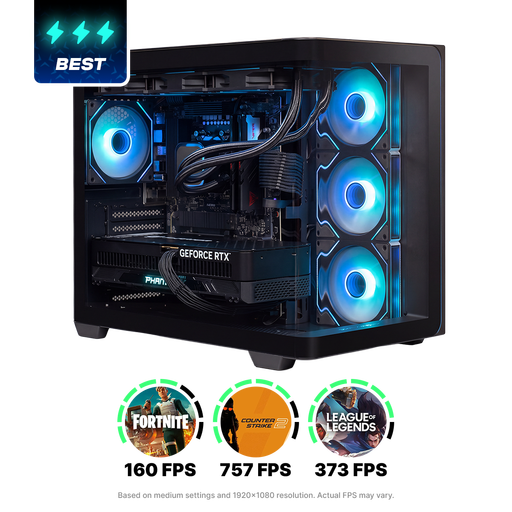 No image available
This desktop is an option to compare for more complex 3D projects; choose based on your own scenes and software.
Ryzen 9 9900X3D; RTX 5090 with 24 GB of graphics memory; 32 GB RAM; 2 TB NVMe SSD.
 No image available
You can compare this configuration with the recommendations for Unreal Engine development; also check that its connections suit your home workspace.
Core Ultra 7 265F; RTX 5070 with 12 GB of graphics memory; 32 GB DDR5; 1 TB PCIe 4.0 NVMe SSD. The description lists several USB ports and display connections.
No image available
This configuration is worth comparing for more complex 3D projects; check the full specifications and connections you need.
Core Ultra 5 225F; RTX 5070 with 12 GB of graphics memory; 32 GB DDR5; 1 TB PCIe 4.0 SSD. The description lists Wi-Fi, Bluetooth and several USB ports.
 No image available
This desktop may suit a multi-screen setup; check the connections on the configuration you choose.
Core Ultra 7; RTX 5070 with 12 GB of graphics memory; 32 GB DDR5; 1 TB PCIe 4.0 SSD. The description lists support for up to four displays and USB-C.
No, 32 GB RAM isn’t a general requirement for every puzzle project. Godot Engine lists 4 GB as the minimum for a simple project, while Unity 6.6 recommends at least 8 GB for the editor. Epic Games recommends 32 GB for Unreal Engine development on Windows. The configuration you need depends on your engine and project.
Measure the available space and compare it with the dimensions of the exact case. Also check the connections for your screens and peripherals, as well as the graphics API and drivers required by your engine.
For a consumer purchase in the Netherlands, contact the seller to make a claim under your statutory guarantee. ACM ConsuWijzer says the seller must put right, free of charge, any product that doesn’t do what you could reasonably expect. Repairs must be completed within a reasonable time; there’s no fixed legal number of days.
For online consumer purchases, you generally have up to 14 days from delivery to change your mind. ACM ConsuWijzer lists some exceptions, including certain made-to-measure or personalised products. Check the terms if you’re placing a special order.
If you’re an employee working from home, the Dutch government describes the employer’s duty of care to provide a good and safe workspace. This employment requirement doesn’t apply just because you design puzzle levels at home as a hobby.