Start with the historical games you play: Hearts of Iron IV centres on campaign management, while Total War: PHARAOH also features real-time battles. Then choose a configuration based on your preferred settings, the space and ventilation in your home office, and the programmes you use at the same time. Specifications alone can’t tell you how quiet a PC is or how well it will run your game.
Who is this choice relevant to?
Grand campaign player
You mainly play historical grand strategy games such as Hearts of Iron IV, and want to match your PC to your games and the programmes running alongside them, rather than focusing solely on graphics specifications. Paradox Interactive publishes system requirements for Hearts of Iron IV; bear in mind that these alone can’t guarantee how every campaign or background task will run.
Real-time battle player
You want to combine historical campaigns with visually rich battles, as in Total War: PHARAOH. Compare the processor and graphics card against your preferred game settings; SEGA cites the built-in benchmark and adjustments to settings such as detail and shadows as ways to help address performance issues.
Work-from-home gamer
You use the same room for work and gaming, and want to know whether the case, connections and ventilation will suit the space. If quiet operation matters, check noise levels for the exact configuration; a manufacturer’s design or acoustic claim isn’t the same as a noise measurement.
What should you look for?
First, decide which games and settings matter to you. Then check that the complete configuration and case placement will work in your office.
| Consideration |
What to look for when buying |
Who is this important for? |
| Campaigns and background tasks |
Compare the processor and memory in the exact configuration with your games and programmes. |
If I mainly play large Hearts of Iron IV campaigns and keep other programmes open at the same time, I want to choose a processor and memory suited to that use. Around 31% of consumers prioritise campaigns and simultaneous tasks. |
| Graphics settings in battles |
Assess the processor and graphics card together; use the built-in benchmark where available. |
If real-time battles and my preferred graphics settings are my main priorities, I want to weigh up the components for the specific game. Around 31% of consumers put battles and graphics settings first. |
| Space and noise |
Check the dimensions, required connections and ventilation clearance for the version you choose. |
If I use the same room for work and gaming, I want to know where the case will fit and whether the noise level will be acceptable. Around 23% of consumers prioritise a shared workspace and where to place the PC. |
| Cost and future upgrades |
Check the final configuration, included components and access for any potential upgrades. |
If I want to weigh up the complete setup and possible upgrades before ordering, I check exactly what the chosen version includes. Around 15% of consumers prioritise cost and future upgrades. |
Common buying mistakes
-
Focusing only on the graphics card
Different components and settings can matter in historical games. For Total War, your preferred settings and the rest of the configuration are important too.
Start by choosing your games and preferred settings. Then compare the complete PC, rather than just one component.
Choosing a graphics card that doesn’t suit the games you care about most could mean paying for capacity you don’t need.
-
Treating a claim about quiet operation or cooling as a measurement
A manufacturer’s description doesn’t tell you how much noise the exact configuration makes while you’re working or gaming.
Check where the case will go, and look for a measurement of the same version under a similar workload if quiet operation is essential.
-
Assuming a customised PC has the same cancellation period as every standard product
ACM ConsuWijzer explains that online purchases come with a statutory cancellation period, subject to exceptions, including certain made-to-order products. Whether an exception applies to your configuration depends on the order.
Check the final configuration and ask before buying how the cancellation period applies to that specific order.
Brands to compare
Lenovo
The Legion Tower range is worth comparing if you’re looking for a desktop with a dedicated graphics card for battles or combined use.
- For version 90YJ002AMH, Lenovo lists a Ryzen 7 7700X, RTX 5070, 16 GB RAM and 1 TB SSD.
- These are configuration specifications, not measurements of gaming performance.
HP
The OMEN 35L is a range to compare if you’re considering a gaming tower and access to its components.
- HP lists 32 GB RAM, a 2 TB SSD and an RTX 5070 Ti with 16 GB for the GT16-0606nd.
- The manufacturer says this version supports tool-free upgrades; that isn’t an independent comparison of its upgrade options.
Dell
The Alienware Aurora ACT1250 is a configurable range to explore if you want to tailor the setup to your work and gaming needs.
- Dell lists, among other options, a selected RTX 5060 Ti and 16 GB RAM.
- Dell describes improved acoustics, but this isn’t an independent noise measurement. Changing the configuration may alter other specifications.
MSI
The Dutch desktop catalogue includes ranges such as MAG Infinite S3 and MAG Codex 5, which you can compare by version.
- Assess a model based on the configuration and specifications of the exact version, not just the range name.
Gaming PCs at Joybuy
These desktop PCs are aimed at historical strategy and battle games, with configurations you can also compare by memory, storage and the space available in your home office.
 Image unavailable
Shark Max Bite R500 Gaming PC
A desktop option to compare for historical games and everyday computing.
Ryzen 5 processor and RTX 5060 graphics card.
16 GB memory and 500 GB storage.
View at Joybuy
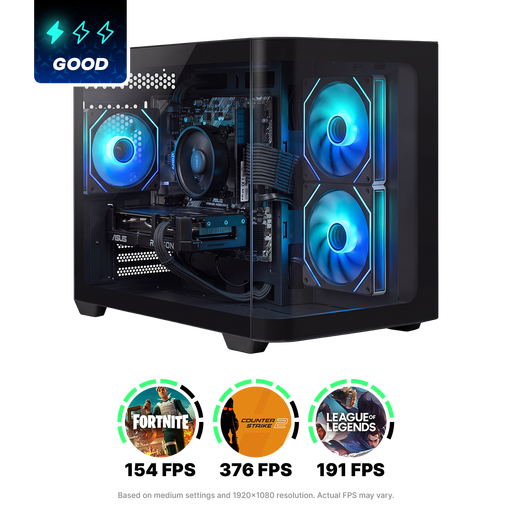 Image unavailable
Shark Max Bite R502 Gaming PC
A desktop to compare for games and work programmes, looking at memory and storage as well as the processor and graphics card.
Ryzen 5 5500 processor and Radeon RX 9060 8 GB.
16 GB DDR4 memory and 500 GB NVMe SSD.
Windows 11 Home.
View at Joybuy
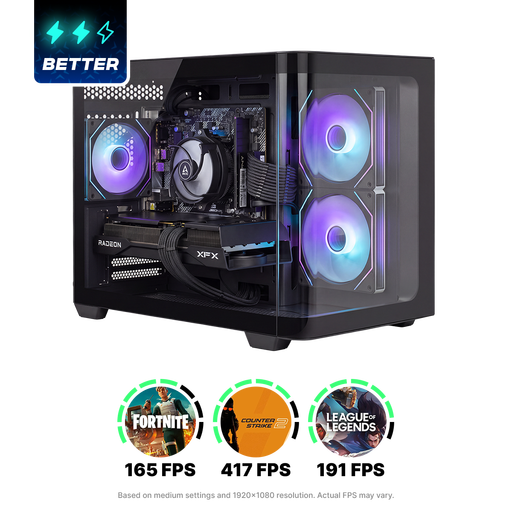 Image unavailable
Shark Bloodlust R700 Gaming PC
A tower to compare for campaigns, battles and running several programmes at once.
Ryzen 7 processor and Radeon RX 9070 graphics card.
16 GB memory and 1 TB storage.
The product description advises leaving at least 10 cm of clearance around the ventilation grilles.
View at Joybuy
 Image unavailable
ASUS ROG G700TF-05225F170W
A configuration to compare if you also want to use your gaming PC for office work.
Intel Core Ultra 5 225F and RTX 5070 12 GB.
32 GB DDR5 memory and 1 TB PCIe 4.0 SSD.
Windows 11 Home.
View at Joybuy
 Image unavailable
Lenovo Legion T5 30IAX10
A tower to compare for real-time battles, campaigns and running several programmes at once.
Intel Core Ultra 7 and RTX 5070.
32 GB DDR5 memory and 1 TB PCIe 4.0 SSD.
Windows 11 Home.
View at Joybuy
Frequently asked questions
Do the recommended system requirements guarantee that a game will run smoothly?
No. System requirements don’t guarantee performance with every configuration and game setting. Compare them with the exact PC and, where possible, use the built-in benchmark in Total War; SEGA also recommends adjusting detail and shadow settings.
What can I do if a Total War game stutters?
Check the game settings, available memory, active programmes and drivers. If you’re having problems with mods, SEGA also recommends checking whether the issue persists without them.
How can I avoid surprises when buying a configurable PC?
Before ordering, check which components have been selected and what’s included with the PC. Dell warns that choosing a configuration may change other specifications; also check the warranty terms and your statutory rights separately.
Do I have a cancellation period when I buy a gaming PC online in the Netherlands?
For a standard online consumer purchase, ACM ConsuWijzer says you generally have a statutory cancellation period of up to 14 days after delivery. There are exceptions, including certain made-to-order products; check before buying how the rules apply to your specific configuration.
Does the statutory guarantee end when the manufacturer’s warranty expires?
No. According to ACM ConsuWijzer, your statutory guarantee is separate from a seller’s or manufacturer’s warranty. If a product becomes faulty too soon under normal use, the seller must resolve the issue free of charge, in line with the applicable terms.


