
Players of long, demanding campaigns
You want extended simulations to run smoothly, so you compare the processor and memory with the requirements of your most demanding game. Paradox Interactive publishes different system requirements for each game.


Start with the games you play and your screen’s resolution. In demanding simulations, the processor affects how smoothly the game runs, while a high display resolution makes your choice of graphics card more important. Compare the complete PC with the requirements of your most demanding game, and check the memory, display connections and readability too. A large screen alone isn’t a reason to choose the most powerful configuration.
You want extended simulations to run smoothly, so you compare the processor and memory with the requirements of your most demanding game. Paradox Interactive publishes different system requirements for each game.
You want to make the most of your screen’s resolution, so you check the graphics card, video output and display settings. Keep simulation speed and frame rate in mind as separate things.
As well as the PC, you consider text sharpness, scaling settings and viewing distance. More graphics processing power won’t automatically make small text easier to read; Microsoft Support explains how to set your resolution and scaling in Windows.
When: If keeping a long campaign moving at a good pace is your priority, start with the recommended processor requirements for your most demanding game.
Trade-off: A processor suited to the simulation doesn’t, by itself, tell you how well the PC will perform at a high screen resolution.
When: If you want to use your large screen at a high resolution, compare the graphics card and connections with your screen’s capabilities.
Trade-off: A large screen alone doesn’t determine which graphics card a game needs; that also depends on your preferred resolution and settings.
When: If you mainly play a game with lower system requirements, compare the configuration with the requirements of that specific title.
Trade-off: Recommended requirements vary by game: Paradox lists 32 GB RAM for Europa Universalis V and 16 GB RAM for Crusader Kings III.
| What to consider | What should you check? | Who is this important for? |
|---|---|---|
| Simulation speed | Compare the full processor model and memory with the published requirements for your most demanding game. If you expect a particular speed during a late-stage campaign, ask for relevant test results. | If I play long campaigns, I want to know whether the processor and memory are suited to my most demanding game. Around 36% of consumers give simulation speed top priority. |
| High-resolution visuals | Make a note of your screen’s resolution and inputs, then compare them with the outputs on the exact PC model. When looking at performance tests, check the resolution and settings you want to use. | If high resolution on a large screen matters to you, you’ll want to match the graphics card to your visual requirements. Around 29% of consumers put visual performance first. |
| Readability | Check your viewing distance, the screen’s native resolution and the scaling settings in Windows. Also see whether the game has interface settings. | If I want to read maps and menus comfortably, I also consider text size and scaling settings. Readability is the main purchasing concern for around 21% of consumers. |
| Upgrades and after-sales support | Check the storage capacity, any upgrade options and the terms that apply to the exact model and purchase. | If you want to upgrade later or get clarity on support before buying, consider the components and terms. Around 14% of consumers give upgrade options and after-sales support top priority. |
In simulation games, the pace of in-game updates and the frame rate are different things. A more powerful graphics card doesn’t prove that the simulation itself will run faster.
First decide whether you mainly want to improve campaign progress or visuals at your chosen resolution.
Configurations can vary within a product range. For example, Lenovo lists 16 GB RAM for the Legion Tower 5 model 90YJ002AMH, while HP lists 32 GB for the OMEN 35L model mentioned here. Paradox recommends 32 GB RAM for Europa Universalis V; this difference alone doesn’t determine whether a PC is suitable.
Compare the full model code, processor, graphics card, memory and storage of the specific version you’re considering.
Microsoft Support warns that text may look less sharp if you use a resolution below your screen’s native resolution.
First try the recommended screen resolution, then adjust the scaling setting if text or apps look too small.
According to the Dutch Government, a manufacturer’s warranty is in addition to your statutory rights. If something is faulty, the retailer is your point of contact.
Read what an additional warranty covers and how it adds to your rights with the retailer.
The MPG Infinite Z3 X3D range includes models with a discrete graphics card; always compare the full model code.
The OMEN 35L range includes different processor, graphics card and storage combinations; the model suffix matters.
The Legion Tower 5 Gen 10 is a complete PC with a discrete graphics card that you can compare with other options.
The ROG G700 range includes various configurations for anyone considering a tower and wanting easier access to components later on.
These gaming desktops are worth comparing for their processor, graphics card, memory and connections for your large screen. Check the exact configuration and the resolution you plan to use before choosing.
 No image available
An option to compare if you want to consider both your game’s processor requirements and your preferred screen resolution.
Ryzen 7 7800X3D; GeForce RTX 5080; 32 GB DDR5; 1 TB NVMe SSD. Windows 11 is listed as Trial/Evaluation Version.
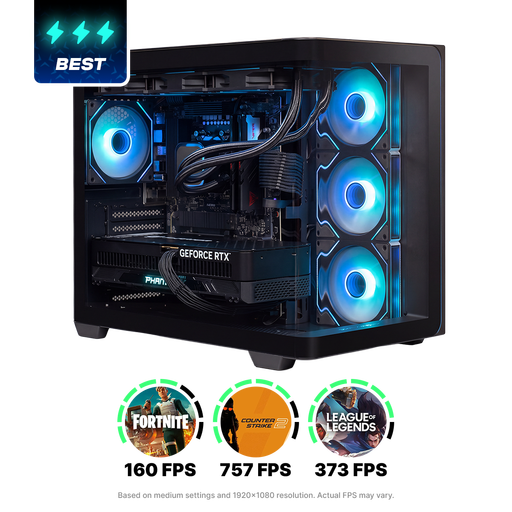 No image available
Worth comparing if you want to consider the graphics card and memory for use with a large screen, alongside your game’s system requirements.
RTX 5090; Ryzen 9; 32 GB RAM; 2 TB SSD.
 No image available
A configuration to compare if you want to take the recommended memory capacity for Europa Universalis V into account; Paradox lists 32 GB RAM.
Intel Core Ultra 7 265F; 32 GB DDR5; 1 TB SSD; NVIDIA GeForce RTX 5070 with 12 GB; Windows 11 Home.
No image available
Compare this model’s processor and memory with the requirements of the grand strategy games you play.
Intel Core Ultra 5 225F; 32 GB DDR5; 1 TB PCIe 4.0 SSD; NVIDIA GeForce RTX 5070 with 12 GB; Windows 11 Home.
 No image available
A PC to compare with your game’s requirements and your screen’s connections; check the output on the exact model for the display mode you want.
Intel Core Ultra 7; 32 GB DDR5; 1 TB PCIe 4.0 SSD; NVIDIA GeForce RTX 5070; Wi-Fi 7; Windows 11 Home.
No. The recommended Windows configurations published by Paradox Interactive vary by game. Paradox lists 16 GB RAM for Crusader Kings III and 32 GB RAM for Europa Universalis V, as well as other processor and graphics card specifications. Choose based on the most demanding game you want to play; system requirements don’t predict a specific frame rate or simulation speed.
In Windows, select the correct display and check the recommended resolution and scaling setting. HDR is only available if both the PC and screen meet the requirements; check support for each device separately.
In the Netherlands, you’re entitled to a product that meets the terms of your agreement, and the retailer is your point of contact if something is faulty, according to the Dutch Government. There is no single statutory warranty period that applies to all products. Online purchases from a business generally come with a 14-day cooling-off period, although exceptions may apply.
No. CE is not a quality mark and doesn’t indicate how well a PC performs. According to Business.gov.nl, the manufacturer uses the marking to show that the product complies with the relevant EU rules. For a specific model, check that the accompanying conformity information applies to it.