
Collision testing developers
If you regularly test colliders or physics interactions, you’ll want to find out whether CPU load or your scene settings are limiting performance. Unity recommends using the Profiler to measure CPU performance.


Start with your engine and test scene: Unity describes collision calculations as CPU work, while large Unreal Engine projects can also place demands on RAM and graphics memory. When sockets are scarce, a laptop with a built-in screen may require a different setup from a desktop with a separate monitor. However, a laptop also needs a power adapter for extended use, so assess the complete electrical setup and the exact PC configuration.
If you regularly test colliders or physics interactions, you’ll want to find out whether CPU load or your scene settings are limiting performance. Unity recommends using the Profiler to measure CPU performance.
You want to connect your computer, monitor and any other devices appropriately, without losing sight of the load on a multi-socket extension lead. Brandweer Nederland advises using approved, undamaged extension leads and warns against connecting extension leads to one another.
For larger projects, compare installed RAM and graphics memory as well as the processor. Epic recommends 32 GB RAM and at least 8 GB of graphics memory for Unreal Engine 5 development on Windows.
A good fit when: you need a computer and screen in one portable setup, and a separate monitor would require another connection.
Bear in mind: the laptop also needs a power adapter for extended use. MSI lists several screen and memory configurations in the Katana range.
A good fit when: you can keep the setup in one place and safely connect a separate monitor.
Bear in mind: the desktop does not replace the monitor’s power connection. Compare the exact CPU, RAM and GPU configuration; Acer and HP models do not all have the same specifications.
A good fit when: a fixed setup is possible and you want to factor in room for future hardware changes.
Bear in mind: room for upgrades does not prove that collision calculations will run faster, and you’ll still need a separate monitor. ASUS describes upgrade options in the ROG G700 range.
The processor is only one part of choosing a PC for collision testing. For Unreal Engine 5 on Windows, Epic recommends 32 GB RAM and at least 8 GB of graphics memory, but these are not universal requirements for every engine or scene.
| What to consider | What should you check? | Who is this important for? |
|---|---|---|
| CPU and collision testing | Note your engine, test scene and profiler results, then compare the exact processor model. Unity describes the Profiler as a tool for investigating CPU load. | If you mainly test collision behaviour, you’ll want to know whether the CPU or your scene settings are limiting your work. Around 31% of consumers put CPU load and reproducible collision tests first. |
| Connections and screen | Make a note of all your devices and their electrical specifications. Brandweer Nederland advises using approved, undamaged extension leads and not connecting extension leads to one another. | When sockets are in short supply, you’ll want to know which devices need their own power supply and how the complete setup will fit. Around 25% of consumers put safe connections first. |
| Memory and graphics requirements | Check the RAM and graphics memory for the complete model code. For Unreal Engine 5 development on Windows, Epic recommends 32 GB RAM and at least 8 GB of graphics memory. | If you work with larger Unreal scenes, you’ll want to match the configuration to your project’s features and scale. Around 25% of consumers prioritise memory and graphics hardware for their own scene. |
| Complete setup | Check which accessories are included, what equipment you already have and who the seller is for an online purchase. | If you want to put together a complete, maintainable workstation, you won’t want to overlook any missing parts. Around 19% of consumers make the complete setup and the seller their top priority. |
Acer’s Dutch product listings for the PO3-650 range show models with different processors, RAM capacities and graphics cards.
Compare the full manufacturer code and the specifications of the exact model you’re considering.
The stated power supply capacity is not the same as a measurement of the actual power consumption of your computer, monitor and peripherals together.
Assess the electrical specifications of all connected devices; don’t estimate power drawn from the socket based only on the PC power supply’s rated wattage.
A desktop setup needs a separate monitor. Acer also states that a keyboard and mouse are not included with the PO3-650 model described.
Before buying, check what you already have and what comes with the exact model.
If you don’t already have this equipment, you may need to buy it to complete your desktop setup.
The Predator Orion 3000 is a desktop range; the PO3-650 DG.BK4EH.00H is a specific model.
The OMEN 16L TG03-0600nd is an example of a compact gaming desktop.
The Katana 15 HX B14W range is a laptop option with a built-in screen; the MAG Infinite S3 is a desktop range.
The ROG G700 is a larger desktop range to compare if room for upgrades is a consideration.
The Joybuy options below are gaming desktops for a fixed setup. Remember that every desktop needs a separate monitor, and compare the listed configuration with your engine and project.
 No image available
This desktop offers a specific processor and memory configuration to compare with your own profiler results and project requirements.
Ryzen 7 7800X3D; GeForce RTX 5080; 32 GB DDR5; 1 TB NVMe SSD; Windows 11 Trial.
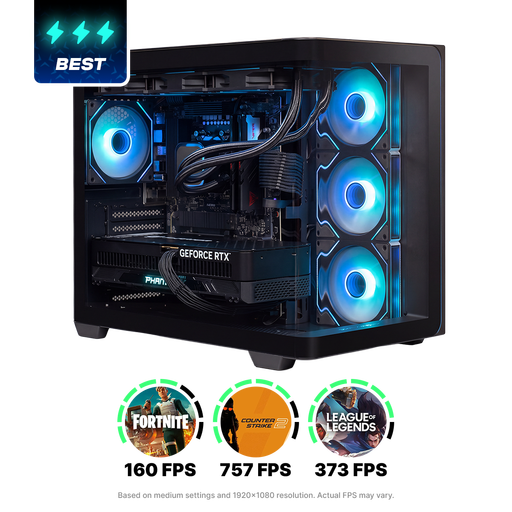 No image available
Compare the listed processor and memory capacities with the demands of your collision tests and the features of your project.
Ryzen 9 9900X3D; GeForce RTX 5090; 32 GB DDR5; 24 GB graphics memory; 2 TB SSD.
 No image available
This larger desktop is worth considering if room for upgrades matters; its configuration will determine whether it’s right for your project.
Intel Core Ultra 7 265F; NVIDIA GeForce RTX 5070 with 12 GB; 32 GB DDR5; 1 TB SSD; Windows 11 Home.
No image available
Compare the processor in this model with your own profiler results; the desktop also needs a separate monitor as part of the setup.
Intel Core Ultra 5 225F; NVIDIA GeForce RTX 5070 with 12 GB; 32 GB DDR5; 1 TB PCIe 4.0 SSD; Windows 11 Home.
 No image available
This desktop is an option for a fixed setup; check the exact processor configuration and your engine’s requirements before choosing.
Intel Core Ultra 7; NVIDIA GeForce RTX 5070; 32 GB DDR5; 1 TB PCIe 4.0 SSD; Wi-Fi 7; Windows 11 Home.
Not without measuring your project. Unity describes ways to investigate CPU load from physics simulations; Unreal Engine’s editor and rendering features can also place demands on RAM and graphics memory.
First assess the load of the complete setup, rather than relying on the number of sockets alone. Brandweer Nederland advises using approved, undamaged extension leads, warns against connecting extension leads to one another and recommends fully unwinding a cable reel when you use one. Make sure there’s also enough room for ventilation.
Make sure your computer can disperse heat and keep the area around your equipment clean. Use the Profiler to check whether your collision settings are causing unnecessary CPU load.
For most online distance purchases from a business, you have a 14-day cooling-off period; the Dutch government lists some exceptions. Check who the seller is and who is responsible for handling delivery and returns.
The applicable EU product rules must be followed; CE marking is required for product groups covered by the relevant EU rules. The Netherlands Enterprise Agency and the European Commission explain these requirements. Check which rules and conformity documents apply to the specific PC and power supply.