Who is this guide for?

Collision testing developer

If you use a game engine to investigate colliders, contact events and simulation behaviour, look at the engine settings and CPU load. Unity explains how factors such as simulation frequency and collider configuration can affect CPU usage.

Working in a quiet study

If you want to keep PC noise to a minimum during extended testing, assess the cooling of the complete configuration under load. The name or features of an individual case won’t tell you how much noise the whole PC makes.

Creating larger 3D scenes

If you’re combining physics tests with a larger or more complex project, compare your engine’s requirements with the available memory and graphics capabilities. Unity notes that the amount of RAM you need depends on the size and complexity of your project.

What should you look for?

What to consider What should you check? Who is this important for?
CPU load and collision testing Check your engine’s requirements and use the profiler to see where your own scene is slowing down. Also look at the effect of simulation frequency and collider settings. If I run repeated collision tests, I want to know whether the CPU or my simulation settings are the bottleneck. Around 31% of consumers give CPU load and repeatable testing top priority.
Noise during extended use Ask for noise measurements of the complete PC under load, and check which case, CPU cooler, graphics card and fans are included in the configuration. For a quiet workspace, I want to assess noise during my own test workload, rather than relying only on a claim about the case. Around 31% of consumers prioritise a quiet workspace.
Memory and graphics headroom Compare your engine version and project size with the RAM and graphics memory in the exact configuration. Epic Games recommends 32 GB RAM and a DirectX 12-compatible graphics card with 8 GB or more of graphics memory for Unreal Engine 5. If I create larger 3D scenes, I want enough headroom for the size and features of my project. Around 25% of consumers give memory and graphics capabilities top priority.
Maintenance and upgrades Check the upgrade options for the exact model, what’s included and who the seller is. I want to know in advance whether I can upgrade components later and which peripherals I’ll need to provide myself. Around 13% of consumers prioritise maintenance and support.

Common buying mistakes

  • Assuming a powerful graphics card will fix every slow collision test

    The slowdown may be related to CPU usage and your physics simulation settings. Unity lists simulation frequency and collider configuration among the factors that can affect performance.

    Use the profiler on your own scene to investigate the bottleneck before choosing an upgrade.

  • Assuming a quiet case means a quiet complete PC

    A case’s features don’t tell you how much noise the cooler, graphics card and fans make together.

    Where possible, compare noise measurements for complete PCs under similar workloads.

  • Confusing general series information with the configuration you’re ordering

    Specifications and included components can vary between configurations. A keyboard and mouse aren’t included with the Acer Predator Orion 7000 configuration reviewed.

    Check the manufacturer’s code, the specifications for that configuration and what’s in the box.

Brands to consider

HP

According to HP Netherlands, the OMEN 35L GT16-1686nd configuration features a Ryzen 7 9700X, 32 GB RAM, a 2 TB SSD and an RTX 5070 Ti with 16 GB of graphics memory.

  • HP lists tool-free upgrades and cooling among the features of this configuration.
  • This product information isn’t an independent noise measurement of the complete PC.

Lenovo

According to Lenovo, the Lenovo Legion Tower 5 Gen 10 configuration 90YJ002AMH combines a Ryzen 7 7700X, 16 GB RAM and an RTX 5070 with 12 GB of graphics memory.

  • The exact configuration lets you compare its specifications with your engine’s requirements.
  • Its 16 GB RAM is below Epic’s 32 GB recommendation for Unreal Engine 5; the specifications don’t confirm that it runs quietly.

Acer

According to Acer, the Predator Orion 7000 PO7-650 configuration reviewed, with manufacturer code DG.E39EH.00Y, has 32 GB RAM and an RTX 4080.

  • The manufacturer’s code helps you identify the configuration when checking its specifications and dimensions.
  • Acer warns that general series information may not apply to this configuration; a keyboard and mouse aren’t included, and there’s no noise measurement for this desktop.

MSI

MSI describes Silent Storm Cooling as a cooling design for the MAG Infinite 11th range.

  • The name may prompt you to look more closely at the cooling in a specific configuration.
  • This is an MSI claim about that product range, not an independent noise measurement or confirmation for other MSI desktops.

Gaming PCs at Joybuy

These gaming desktops offer configurations to compare for larger game engine projects. Before making your choice, also check the requirements of your own scene and assess the noise from the complete PC under load.

Gaming desktop with Ryzen 7 7800X3D and GeForce RTX 5080

Gaming desktop Ryzen 7 7800X3D, RTX 5080

A configuration to compare for a larger game engine project; the specifications alone don’t tell you how much noise it makes during extended testing.

Ryzen 7 7800X3D; GeForce RTX 5080; 32 GB DDR5; 1 TB NVMe SSD; Windows 11 Trial.

Joybuy
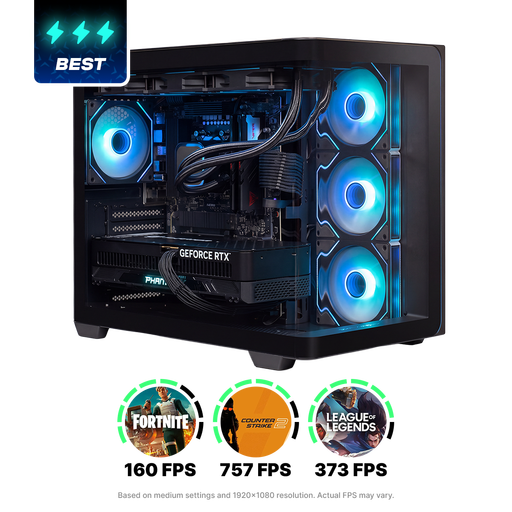
Almighty Shark R900 gaming desktop

Almighty Shark R900 gaming desktop

A configuration to compare for a larger game engine project; check the requirements of your own scene and how much noise it makes under load.

RTX 5090; Ryzen 9; 32 GB RAM; 2 TB SSD.

Joybuy

ASUS ROG G700TF-07265F666W gaming desktop

ASUS ROG G700TF-07265F666W

This configuration is worth comparing for a larger game engine project; also check whether its cooling suits your workspace during sustained workloads.

Intel Core Ultra 7 265F; 32 GB DDR5; 1 TB SSD; NVIDIA GeForce RTX 5070 with 12 GB; Windows 11 Home.

Joybuy
ASUS ROG G700TF-05225F170W gaming desktop

ASUS ROG G700TF-05225F170W

This configuration is worth comparing for larger projects; make your final choice based on your own engine requirements and the noise it makes in use.

Intel Core Ultra 5 225F; 32 GB DDR5; 1 TB PCIe 4.0 SSD; NVIDIA GeForce RTX 5070 with 12 GB; Windows 11 Home.

Joybuy

Lenovo Legion T5 30IAX10 gaming desktop

Lenovo Legion T5 30IAX10

A configuration to compare with the requirements of a larger game engine project; its specifications don’t confirm how quietly the complete desktop runs under load.

Intel Core Ultra 7; 32 GB DDR5; 1 TB PCIe 4.0 SSD; NVIDIA GeForce RTX 5070 with 12 GB; Wi-Fi 7; Windows 11 Home.

Joybuy

Frequently asked questions

Do you mainly need a faster CPU or graphics card for collision testing?

It depends on the bottleneck in your project. Unity explains that simulation frequency and colliders can affect CPU usage, so use the profiler before choosing a component. Also check your engine’s graphics requirements if your project uses demanding visuals.

How can you investigate repeated collision tests?

Note your engine version and project setup, then use that engine’s diagnostic and physics tools. Unreal Engine’s Chaos Visual Debugger can record and replay collision geometry and contact pairs, among other things, so you can investigate changes to your test settings.

What should you check for maintenance and included components?

Check the specifications and box contents for the exact configuration, as well as the model’s upgrade options. A keyboard and mouse aren’t included with the Acer Predator Orion 7000 configuration reviewed. If a product is faulty, the seller remains responsible for the statutory guarantee.

What electrical safety rules apply in the Netherlands?

Electrical and electronic devices placed on the market in the Netherlands must meet the applicable European requirements. According to Ondernemersplein, the Dutch government’s business information portal, after carrying out the required assessment the manufacturer must, among other things, affix the CE mark and draw up an EU declaration of conformity. This doesn’t confirm that an individual desktop configuration complies.

Can you return a gaming desktop bought online within 14 days?

For a standard consumer distance purchase, you generally have a cooling-off period of up to 14 days after delivery. The ACM distinguishes between computers assembled on request and products made to a consumer’s own specifications. Check which situation applies to your order.
