
Vandaag of morgen in huis

Kwaliteit gegarandeerd

Welkomstaanbiedingen ontgrendelen: GRATIS bezorging | Tot 80% korting | Gratis 30 dagen JoyPlus-proefperiode
Download de app
Buying a gaming PC may seem straightforward: choose a powerful graphics card, add RGB lighting and you’re done. In practice, it’s the combination of components, upgrade options and included software that determines whether your desktop will continue to suit you over time. A high product rating or striking case does not necessarily tell you enough.
For Dutch gamers, PC enthusiasts and creators, there are three common pitfalls:
The graphics card largely determines the image quality and resolution you can achieve. A 1080p gaming PC is suitable for Full HD monitors and competitive games. If you’re looking for a 1440p gaming PC, you’ll generally need more graphics headroom, particularly for modern games with ray tracing.
Don’t just look at the GPU name. Also check:
An RTX 5060 gaming PC is a sensible choice if you mainly play at 1080p. According to the stated product specifications, an RTX 5060 Ti gaming PC offers more graphics headroom for 1080p and certain 1440p scenarios. An RTX 5070 gaming PC is aimed at users who value higher settings, high frame rates and more demanding creative applications.
Claims about additional performance or image quality come from the manufacturer’s or seller’s product information. Treat them as an indication and always check the full configuration.
A Ryzen gaming PC and an Intel gaming PC can both be suitable. Look at the complete combination:
Also check whether free memory slots and additional drive bays are available. The MSI MAG Infinite S3 models, for example, list two memory slots and additional bays for 2.5- and 3.5-inch storage. This makes future upgrades easier to plan.
A gaming computer produces more heat during long sessions than a basic office PC. Therefore, check:
A standalone Corsair case fan can supplement an existing case. According to the product specifications, the CO-9051005-WW has a diameter of 120 mm, PWM control, a stated speed range of 480 to 2400 rpm and RGB LEDs. Check beforehand which fan positions and connections your case and motherboard support.
For more powerful configurations, a 360mm all-in-one cooler such as the MSI MAG CORELIQUID I360 may be relevant. The product information lists compatibility with AM4, AM5 and Intel sockets including 1700 and 1851. Always check the processor socket and whether your case has enough room for a radiator of this size.
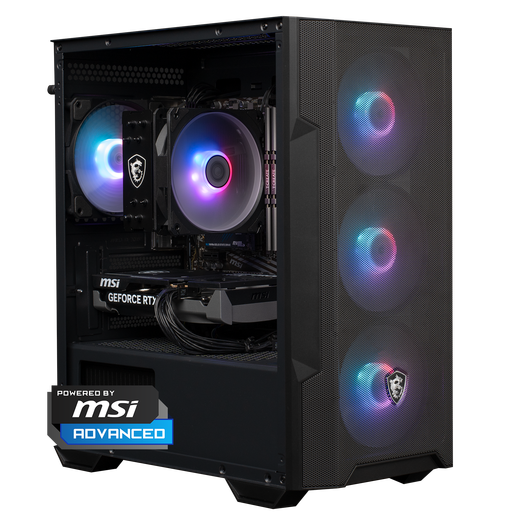
Why it suits this profile: This ready-built gaming desktop combines a Ryzen 5 5500, RTX 5060, 16 GB DDR4 and a 1 TB NVMe SSD. That makes it suitable for users who want to get started with modern games without building a PC themselves.
The 1 TB of storage avoids the limited capacity found in many entry-level models. The case lists a mesh front and ARGB fans for airflow.
RTX 5060 with 8 GB, 16 GB RAM, 1 TB NVMe and Windows 11 Home according to the product listing.
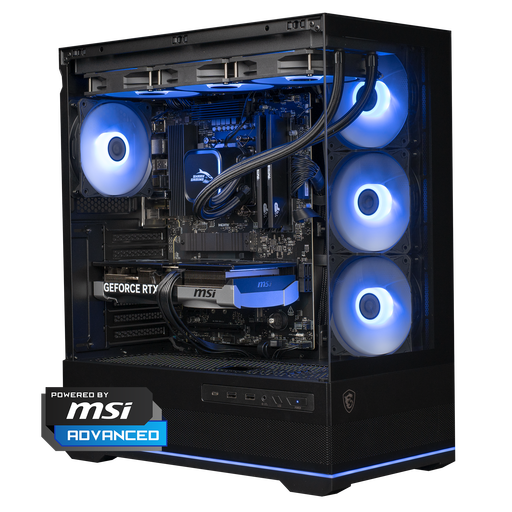
Why it suits this profile: If you value high graphics settings, 1440p gaming and demanding applications such as rendering, this configuration offers a more powerful combination of processor and GPU.
The configuration lists a 360mm liquid cooler and a 750W power supply. However, check the available space and connections before installation.
Ryzen 7 7800X3D, RTX 5070 12 GB, 16 GB DDR5, 1 TB NVMe and Windows 11 Home according to the product details.
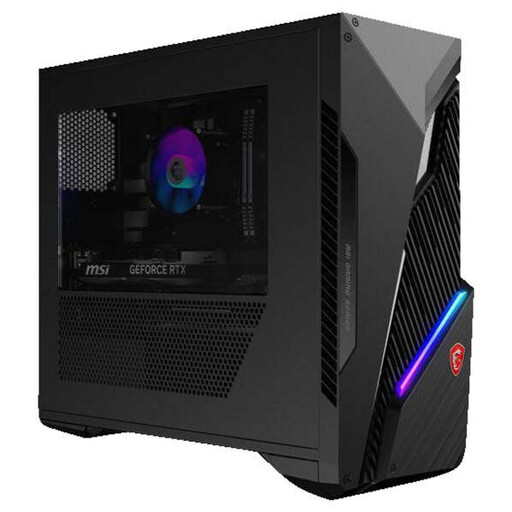
Why it suits this profile: This MSI gaming PC is well suited to users looking for a compact ready-built desktop for gaming, multitasking and everyday use.
The specifications list two free RAM slots and additional drive bays. This provides more room for upgrades than a completely sealed mini PC.
Intel Core i5-14400F, RTX 5060 Ti 8 GB, 16 GB RAM, 1 TB SSD, Wi-Fi 6E and a 500W 80 PLUS Bronze power supply.
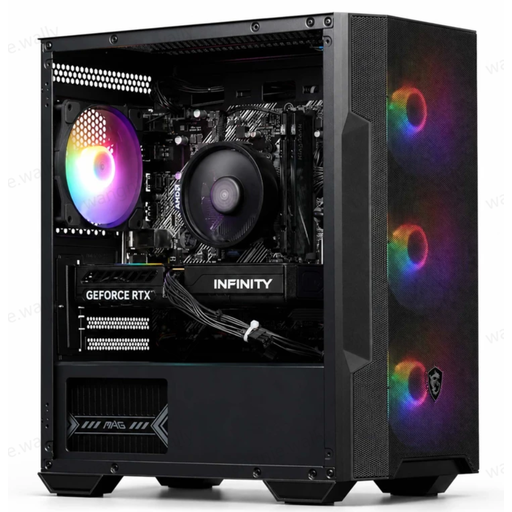
Why it suits this profile: This RGB gaming PC is aimed at players who want to combine a distinctive gaming design with Full HD gaming and a wireless network connection.
As well as RGB lighting, the configuration lists four ARGB case fans and a 550W 80+ Bronze power supply. Cooling is therefore not just about appearance.
Ryzen 5 5500, RTX 5060 with 8 GB GDDR7, 16 GB DDR4, 480 GB PCIe 4.0 SSD and USB Wi-Fi adapter.
We’ve put together a complete, up-to-date list of products that fully meet these strict selection criteria and the applicable European safety regulations.
Yes, but as well as the graphics card, look at the number of processor cores, RAM and storage. For gaming and streaming simultaneously, 16 GB is a starting point; a system with upgradeable memory may be more practical for larger projects.
Its lifespan depends on the games you play, settings, maintenance and upgrade options. A system with free RAM slots, additional storage bays and a suitable power supply can be adapted more easily as your requirements change. Keep the ventilation openings free from dust and don’t place the desktop in an enclosed cabinet.
Power consumption depends on the power supply, graphics card, processor and the number of hours you play. The wattage shown on the power supply is not its constant consumption; it is the power supply’s maximum capacity. Check the power management settings and switch off the PC when you’re not using it.
