Who is this buying guide for?

Players who spend long sessions at a desk

You want to position your monitor properly, read text clearly and change your posture and focus during quests. Arboportaal also advises people who work with screens to look away regularly, change position and take microbreaks. A monitor cannot replace these changes.

Explorers of richly detailed game worlds

You prioritise fine landscape details or contrast in dark scenes, and are weighing up QHD LCD against 4K or OLED.

Players who switch between console and PC

You want to know in advance which resolution, 120 Hz output and VRR your source device supports through the input you plan to use. Sony and LG set out specific requirements for the source, screen and connection.

What should you look for when buying?

What to consider What should you check? Who is this important for?
Comfort and positioning Check the height and tilt adjustment, how easy in-game text is to read, screen reflections and the space available on your desk. If I play for a long time, I want to adjust the screen to suit my seating position and read text easily. Around 36% of consumers prioritise comfort and positioning.
Sharpness and detail Compare QHD and 4K at your preferred screen size, and check which resolution your PC or console can output. If you want to see landscapes and interface elements clearly, weigh up resolution against what your source device can handle. Around 29% of consumers give image detail top priority.
Contrast and atmosphere Compare the panel technology and image-quality assessments for the exact model. For OLED, check the burn-in protection and warranty conditions. If dark scenes set the mood for me, I want to prioritise contrast over a high Hz figure alone. Around 21% of consumers put atmosphere and contrast first.
Connections and output Check the supported resolution, refresh rate and VRR for each input, along with the requirements of your game, source device and cable. If you switch between PC and console, you’ll want to know which display mode your setup can actually handle. Around 14% of consumers start by checking compatibility with their source device.

Things not to overlook when buying

  • Assuming the highest Hz figure guarantees gaming performance

    The monitor’s stated refresh rate doesn’t automatically tell you which mode your PC, console, game and connection can use together. LG sets out specific PC and connection requirements for 240 Hz on the 27GR83Q-B; Sony says 120 Hz output depends on support from both the screen and the game.

    Check the entire chain—from game and source device to cable, input and monitor mode—before you make a choice.

  • Assuming an HDR label guarantees convincing dark scenes

    An HDR logo alone doesn’t tell you how a game will display dark areas and bright highlights. RTINGS.com assesses image quality, black levels and bright highlights separately.

    Compare the panel technology and image-quality assessments for the exact model instead of relying on the HDR label alone.

  • Assuming OLED protection means an unconditional warranty

    Protection features and any manufacturer’s warranty vary by model. An additional warranty is separate from your statutory rights; the Dutch government says that the retailer is your point of contact if a product is faulty.

    Read the burn-in conditions for the exact model variant and check what cover the retailer and manufacturer offer.

Brands to consider

ASUS ROG

The models mentioned offer a choice between a curved QHD Fast VA option and a 27-inch 4K QD-OLED option.

  • ASUS lists 4K at 240 Hz and OLED burn-in protection features for the PG27UCDM. This mode also depends on what your PC can handle.
  • The XG27WCS and PG27UCDM differ in panel and design, so check which one suits your desk setup.

LG UltraGear

The 27GR83Q-B is an example of a flat 27-inch QHD IPS monitor with a stated refresh rate of 240 Hz.

  • LG lists G-SYNC compatibility and FreeSync Premium for this model.
  • LG specifies particular PC and port requirements for 240 Hz, so check whether your system meets them.

Dell Alienware

The AW2725D is a flat 27-inch QHD QD-OLED monitor for anyone weighing up contrast and motion performance.

  • Dell specifies 2560 × 1440 at 280 Hz for the AW2725D and describes its burn-in protection.
  • Check the burn-in cover for this exact model; conditions for other Alienware models don’t automatically apply.

MSI

The MPG 271QRX QD-OLED is an example of a QHD OLED option with a high stated refresh rate and a range of connection options.

  • MSI lists 360 Hz, HDMI 2.1 and OLED Care 2.0 for this model.
  • MSI mentions a warranty claim for OLED burn-in, but check the conditions for the Dutch model variant before buying.

Joybuy products

These monitors are options for long open-world sessions, including QHD or 4K resolution and adjustable setups. Compare the panel and connections with the output from your own PC or console.

AOC GAMING Q27G4ZDR QHD QD-OLED gaming monitor

AOC GAMING Q27G4ZDR QHD QD-OLED

A QHD QD-OLED option for anyone who values detail on a desk monitor and the ability to adjust their viewing position.

26,5 inches; 2560 × 1440; 240 Hz; 0,03 ms GtG; adjustable stand. For OLED, check the burn-in protection and conditions for the exact variant.

View at Joybuy
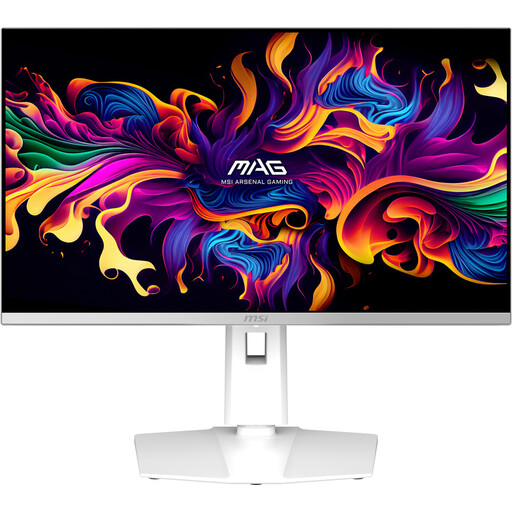
White MSI MAG 272QPW QD-OLED X28 QHD gaming monitor

MSI MAG 272QPW QD-OLED X28

A QHD QD-OLED option with an adjustable stand for a desk setup.

27 inches; 2560 × 1440; 280 Hz; white finish. For OLED, check the burn-in protection and conditions for the exact variant.

View at Joybuy

LG UltraGear 27GX704A-B.AEU OLED QHD gaming monitor

LG UltraGear 27GX704A-B.AEU

An OLED QHD option for anyone who wants to combine detail on a 27-inch screen with an adjustable stand.

27 inches; 2560 × 1440; 240 Hz; HDMI 2.1 and DisplayPort 1.4. For OLED, check the burn-in protection and conditions for the exact variant.

View at Joybuy

KTC M27P6 27-inch 4K MiniLED gaming monitor

KTC M27P6 4K MiniLED

A 4K MiniLED option with two stated resolution and refresh-rate modes, plus an adjustable stand.

27 inches; 4K 160 Hz or FHD 320 Hz; Fast IPS; USB-C 65 W and KVM. Check which mode and connection suit your source device.

View at Joybuy

Alienware AW2725Q 4K QD-OLED monitor

Alienware AW2725Q 4K QD-OLED

A 4K QD-OLED option for anyone weighing up fine detail and contrast against what their source device can handle.

26,7 inches; 3840 × 2160; 240 Hz; HDMI 2.1 and DisplayPort 1.4. For OLED, check the burn-in protection and conditions for the exact variant.

View at Joybuy

Frequently asked questions

Do you need 240 Hz for open-world quests on a PS5?

No, 240 Hz isn’t required for PS5 output. Sony describes 120 Hz output for screens and games that support it. On your PS5, check under Screen and Video to see which mode the connected screen reports.

How can you check that VRR and the right resolution are working?

On your PS5, go to Settings > Screen and Video > Video Output to see information about the connected HDMI device. Sony lists details including resolution, VRR and HDR; at 1440p, you can test the supported output modes. On a PC, also check the port and graphics card requirements for the exact monitor model.

Can a monitor with comfort features help you play without stopping?

An adjustable setup with a screen that’s easy to read can help you position it to suit your seating, but it can’t replace changing position. Arboportaal advises people using screens to look away regularly, change position and take microbreaks. Workplace rules for employees don’t automatically apply to gaming at home.

What do the energy label and a monitor’s energy use mean?

The European Commission says that EU energy labelling rules also cover computer monitors. For the exact model, compare the details on the label and in EPREL; the label also includes information about HDR energy use. An HDR label alone doesn’t tell you how much electricity a long session will use.

What are your rights in the Netherlands when buying a monitor online?

When you buy online from a business, you generally have 14 days to change your mind. You also have statutory rights if a product is faulty; according to the Dutch government, there is no fixed statutory warranty period in the Netherlands, and the retailer is your point of contact. A manufacturer’s warranty is in addition to these rights.
