For building games and working from home, an adjustable 27-inch QHD monitor is a sensible starting point if your computer can handle 2560 × 1440 pixels and the screen fits on your desk. A curved screen, OLED or Full HD model may better suit other preferences, but consider what each means for everyday text work, static images and the resolution you need. Before buying, also check the refresh rate your chosen model supports through your computer’s connection.
Who is this buying guide for?
A builder who also works from home
You want to see game menus and maps clearly, and read text comfortably during the day. A well-adjusted workstation matters too. Arboportaal highlights height adjustment and avoiding reflections as considerations for display screen workstations.
A gamer with limited desk space
You want to make sure the screen width and stand depth suit your existing desk, and check that the connections are compatible with your computer.
A gamer who puts picture quality first
You’re considering a curved screen or OLED for gaming and weighing that preference against everyday use for work. RTINGS describes the risk of burn-in with OLED when static images are displayed for long periods.
What should you look for?
Start by considering resolution, your desk and your computer’s connections. Then choose a panel type or higher refresh rate to suit how you’ll use the monitor day to day.
| What to consider |
What should you check? |
Who is this important for? |
| Clarity and screen space |
Compare the resolution with the screen size and text scaling. LG’s 27-inch QHD and Full HD models have resolutions of 2560 × 1440 and 1920 × 1080 pixels respectively. |
If I want to see game menus and work text clearly on one screen, I put clarity and screen space first. Around 36% of consumers rank this as their main buying priority. |
| Fit and adjustability |
Measure the available width and depth, including the monitor stand. Check for height adjustment and VESA mounting if you’re considering a monitor arm. |
If my desk has limited space, I want to know whether the screen and stand will fit and can be adjusted properly. Around 29% of consumers prioritise how a monitor fits their workspace. |
| Connections and refresh rate |
Compare the refresh rate for each input with the output on your computer or laptop and the cable you’re using. ASUS lists a maximum of 180 Hz via DisplayPort and 144 Hz via HDMI for the VG27AQL3A. |
If I want to be sure which resolution and connection combination my computer can support, I check the specifications of both devices. Around 21% of consumers give compatibility and smooth visuals top priority. |
| Panel and picture preferences |
Assess a curved screen from your usual seating position. With OLED, bear in mind the burn-in risk described by RTINGS when static images are displayed for long periods. |
If you value contrast or a curved picture more than other considerations, think about the impact on extended work with fixed windows. Around 14% of consumers put picture quality first. |
Common buying mistakes
-
Assuming the highest Hz rating applies to every connection
For the ASUS VG27AQL3A and Dell S2722DGM models reviewed, the stated maximum refresh rates differ by input. So the figure on the box doesn’t automatically tell you what you’ll get through the port you choose.
Check the refresh rate table for the exact model and compare it with your computer’s output and the cable you’re using.
You may need a different cable or connection to get the refresh rate you want.
-
Treating a 1 ms claim as a complete comparison of motion handling
Dell lists response times for the S2722DGM using different measurement methods and settings, including GtG and MPRT. These figures aren’t directly comparable without qualification.
Compare like-for-like measurement methods and settings. If motion handling is a deciding factor, look for information about the exact model you’re considering.
-
Choosing OLED without considering fixed work windows
RTINGS describes a risk of permanent burn-in when static elements remain on screen for long periods. Text clarity can also vary between models.
Consider how many hours you spend working with fixed windows or game interfaces, and check the text clarity and terms for the exact model.
Brands to consider
LG
The UltraGear models reviewed show why the model number matters: the LG 27GP850P-B is QHD, while the LG 27G411A-B is Full HD.
- LG lists height adjustment and 165 Hz for the 27GP850P-B, with 180 Hz available in overclock mode.
- For the 27G411A-B, LG lists 120 Hz native and 144 Hz in overclock mode. Don’t assume that features apply across the whole UltraGear range.
ASUS
The ASUS TUF Gaming VG27AQL3A is a reviewed 27-inch QHD Fast IPS monitor with an adjustable stand.
- ASUS lists height adjustment and a USB hub.
- ASUS gives maximum refresh rates of 180 Hz via DisplayPort and 144 Hz via HDMI; check which input you’ll use.
BenQ
The MOBIUZ EX2710Q is a reviewed 27-inch QHD option for anyone who wants to factor in built-in sound.
- BenQ lists speakers, 100 mm height adjustment, two HDMI inputs and DisplayPort.
- BenQ’s description of HDRi is a claim made by the brand, not an independent assessment of picture quality.
Dell
The Dell S2722DGM reviewed is a curved 27-inch QHD VA model. These features apply to this model and don’t necessarily apply to other Dell screens.
- Dell lists a 1500R curve, a stated contrast ratio of 3000:1 and height adjustment.
- Dell lists different maximum refresh rates for each input. Response times depend on the measurement method and setting.
Philips
The Philips Evnia 27M2N5500/01 is a reviewed 27-inch QHD Fast IPS gaming monitor.
- Philips lists 180 Hz and a game mode for real-time strategy.
- The stated benefits of the game mode are claims made by Philips; they don’t prove that building games play better on this model than on other screens.
Monitors for gaming and working from home
This selection of Joybuy products includes monitors in a range of sizes and resolutions for gaming and use in a home office. Compare the listed specifications with the space on your desk and what your computer can support.
 Image unavailable
MSI MAG 272QPF E20 27-inch WQHD gaming monitor
An option to compare if you’re looking for one 27-inch screen for gaming and work.
The product title lists 2K WQHD, Rapid IPS and 200 Hz.
View product at Joybuy
 Image unavailable
AOC Gaming Q27G42XNE 27-inch Quad HD monitor
An option to compare if you’re looking for a 27-inch QHD screen for game interfaces and text.
The product title lists 2560 × 1440 pixels and 180 Hz.
The title lists two HDMI 2.0 connections and one DisplayPort 1.4 connection.
View product at Joybuy
 Image unavailable
Gawfolk 34-inch curved UWQHD gaming monitor
An option to compare if you’re considering an extra-wide screen for gaming and work. Measure the available desk width first.
The product title lists UWQHD 3440 × 1440, 144 Hz and a 1500R curve.
View product at Joybuy
 Image unavailable
CRUA 49-inch curved DQHD ultrawide monitor
An option to compare if you want one wide screen for gaming and work; bear in mind the available desk width.
The product title lists DQHD 5120 × 1440, 165 Hz, 32:9 and a VA panel.
The product information gives a screen size of 49 inches; check that it will fit your setup.
View product at Joybuy
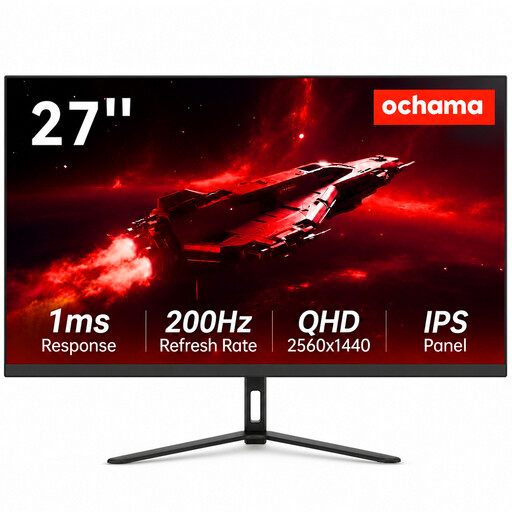 Image unavailable
Ochama 27-inch gaming and office monitor
An option to compare if you’re looking for a 27-inch screen for both gaming and office work.
The product title lists 2K resolution and a 200 Hz refresh rate.
View product at Joybuy
Frequently asked questions
Is 180 Hz automatically available with your laptop or any cable?
No. It depends on the monitor, your computer’s output, the cable and the input you choose. ASUS lists a maximum of 180 Hz via DisplayPort and 144 Hz via HDMI for the VG27AQL3A, so check the specifications for your own setup.
What should you look for if you’ll also use the monitor for paid work from home?
Check that you can position and adjust the screen properly, and avoid distracting reflections. Arboportaal describes requirements for employees’ display screen workstations, including height adjustment and a non-reflective screen. Whether these apply depends on your working arrangements, and they aren’t automatically a purchase requirement for every home gamer.
How can you compare monitors’ energy consumption?
Compare the energy labels and product specifications on a like-for-like basis. The European Commission states that electronic displays, including computer monitors, have an energy label with ratings from A to G. Your personal energy use also depends on how long and how you use the monitor.
Can you return a monitor bought online, and what about the warranty?
For online consumer purchases, you generally have a statutory 14-day cooling-off period after delivery, subject to legal exceptions, according to ACM ConsuWijzer. This is separate from your statutory guarantee: the Netherlands Authority for Consumers and Markets states that the seller is responsible if a product doesn’t meet what you can reasonably expect from it.


