
Player who prioritises readable menus
You want to keep track of notifications and menus during long sessions, without making extra screen width your top priority. Readability also depends on the game and the interface scaling setting.


Choose based on what you need during long grand strategy sessions: a 27-inch QHD screen with a 16:9 aspect ratio gives you a conventional option without extra ultrawide width, while a 34-inch ultrawide with 3440 × 1440 pixels offers more horizontal space. Check how your game scales and displays its interface, and whether the monitor and its connections suit your desk and PC. A high refresh rate isn’t automatically the deciding factor for this type of gaming.
You want to keep track of notifications and menus during long sessions, without making extra screen width your top priority. Readability also depends on the game and the interface scaling setting.
You mainly want horizontal space for the map and side panels, and have room for a wide screen. Check that your game makes good use of the extra space.
You want a screen that fits your desk and can be adjusted to suit you, rather than choosing on size or speed alone. The models reviewed vary in width and adjustability.
| What to consider | What should you check? | Who is this important for? |
|---|---|---|
| Text and interface readability | Compare the resolution and screen size with your viewing distance, and check the interface scaling in the games you play. | If I want to read notifications and menus comfortably during a long session, I also check my game’s scaling settings. Around 36% of consumers say readability is their top buying priority. |
| Space for the map and panels | Check for 21:9 support and how the game displays panels and controls at the edges of the screen. | I want to view the map and side panels side by side, and have room for a wider screen. Around 29% of consumers prioritise a wide, usable view of the map. |
| Fit and adjustability | Compare the physical width with your desk, and check the height, tilt and swivel adjustments on the exact model. | If my desk limits where I can place it, I want to position the screen comfortably for long sessions. Around 21% of consumers put fit and adjustability first. |
| PC and connections | Check your PC’s video output and the resolution and refresh rate the monitor supports through each connection. | I want to make sure my PC, connection and screen are compatible before paying for a particular specification. Around 14% of consumers make system compatibility their top consideration. |
A 34-inch ultrawide takes up more width, but it’s the game that determines how the map, panels and menus use that space.
Measure the space available and check your game’s interface and scaling settings at the aspect ratio you want to use.
ASUS lists a maximum of 165 Hz via DisplayPort and 100 Hz via HDMI for the VG34VQL1B. The connection you choose therefore affects the available setting.
Before factoring in refresh rate, check the ports on your PC and monitor, along with the specifications for that connection.
The Dutch government explains that a manufacturer’s warranty or an extended warranty purchased separately supplements your statutory right to a product that works as it should.
Compare any additional warranty terms separately. If there’s a fault, contact the seller.
The 27G610A-B is a 27-inch QHD IPS model with a 16:9 aspect ratio, for anyone who isn’t looking for an ultrawide screen.
The CU34G4 is a 34-inch 21:9 Fast VA ultrawide with 3440 × 1440 pixels and a height-adjustable stand.
The TUF Gaming VG34VQL1B is a 34-inch ultrawide with height adjustment and multiple inputs.
The Odyssey G5 LC34G55TWWPXEN is a 34-inch ultrawide with 3440 × 1440 pixels and a curvature of 1000R, as specified by Samsung.
The G2724D is a 27-inch QHD IPS model with several adjustment options, as a point of comparison for a 16:9 setup.
This selection includes QHD screens with a 16:9 aspect ratio and ultrawide models with extra horizontal space. Check how each game handles the interface at the format you choose.
 No image available
A QHD option for anyone looking for a 32-inch screen with adjustment options.
The product details list 2560 × 1440 pixels, a 16:9 aspect ratio and an IPS panel. The stand offers height, swivel, tilt and pivot adjustment.
 No image available
A 16:9 QHD option for anyone who doesn’t need ultrawide width and wants an adjustable screen.
The product details list 2560 × 1440 pixels, a 16:9 aspect ratio and a Fast IPS panel. The stand offers height, tilt, swivel and pivot adjustment.
 No image available
A 27-inch 16:9 option for anyone looking for QHD without the extra width of an ultrawide.
LG lists 2560 × 1440 pixels, an IPS panel and 200 Hz for this model. Check your game’s scaling settings before assuming the text will be comfortable to read.
 No image available
An ultrawide option for anyone looking for extra horizontal space for maps and panels.
The product details list a 21:9 aspect ratio, 3440 × 1440 pixels, a VA LCD panel and 100 Hz. The description mentions tilt adjustment; check that you have enough desk width.
 No image available
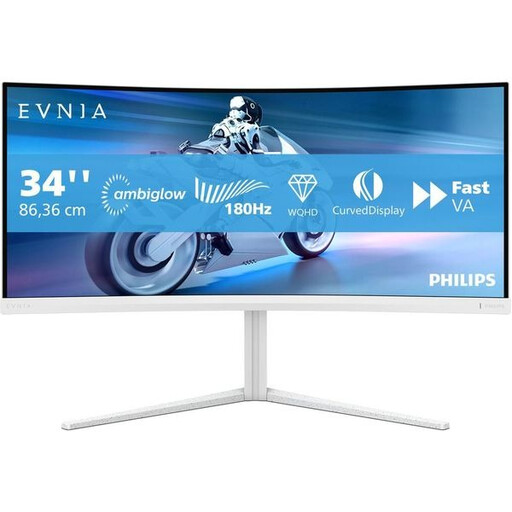
A curved ultrawide option for anyone who wants more horizontal screen space and can position it to suit their desk.
The product details list 3440 × 1440 pixels, a VA LCD panel, 180 Hz and Adaptive Sync. The stand offers height, swivel and tilt adjustment.
No, not automatically. First compare readability, screen space and the connections supported by your PC and monitor. The level of smoothness you prefer is a personal choice.
Check both its physical width and how the game displays its interface. The stated aspect ratio alone doesn’t tell you where the game will place the map, menus and side panels.
ASUS warns that displaying static, high-contrast images for long periods on an OLED screen may cause image retention or burn-in. Check the screen-protection features and warranty terms for the specific model; ASUS’s guidance doesn’t determine the terms for other models.
According to the Dutch government, when you buy online from a business, you’re entitled to a 14-day cooling-off period in many cases. Purchases from private sellers aren’t covered by the distance-selling rules described there. You’re also entitled to a product that works as it should. The Dutch government says there’s no fixed statutory warranty period in the Netherlands; if there’s a problem, contact the seller.
No. The legal duties described by Arboportaal apply to employers and employees doing screen-based work. They don’t set a mandatory gaming duration or monitor setting for personal use.