
For those who mostly play in the evening
You mainly play in the dark and want to make landscapes, shadows and light sources easy to distinguish. RTINGS explains that contrast is important for displaying blacks in a dark room.


For long building sessions in a dark room, OLED or QD-OLED suits those who prioritise deep blacks and don’t leave fixed menus on screen unchanged for extended periods. VA with Mini LED is an LCD option with local dimming, while IPS may suit you if avoiding the risk of OLED burn-in matters more than deep blacks. OLED can suffer burn-in if static images are displayed for long periods, and IPS generally has lower contrast than VA. RTINGS observed dark motion smearing and VRR flicker on the AOC Q27G3XMN they tested. So be sure to check tests, connections and supported modes for the exact model, too.
You mainly play in the dark and want to make landscapes, shadows and light sources easy to distinguish. RTINGS explains that contrast is important for displaying blacks in a dark room.
You leave building panels or other fixed interface elements on screen for long periods, so you factor in the risk of OLED burn-in. RTINGS describes this risk with static images, while MSI lists panel care features for the MPG 321URX.
You want building components and text to be easy to make out, and are looking for a resolution and refresh rate suited to your computer or console. For example, Philips lists QHD and up to 360 Hz for the Evnia 27M2N8500/00.
Ideal for: those who value deep blacks and bright details alongside dark areas.
Trade-off: static images displayed for long periods can cause burn-in; protective features don’t eliminate the risk.
Ideal for: those who want to combine local dimming with LCD for long building sessions.
Trade-off: local dimming uses zones. Check blooming, motion smearing and VRR performance on the exact model, too.
Ideal for: those who value wide viewing angles and want to avoid the risk of OLED burn-in.
Trade-off: conventional IPS generally has lower native contrast than VA, which may matter in a dark room.
| Factor to consider | What to look for | Who is this important for? |
|---|---|---|
| Black levels and contrast | Compare contrast measurements and, for LCDs, how local dimming works on the exact model. An HDR label alone doesn’t tell you enough. | If I mainly build in the dark, I want to be able to distinguish black areas and light sources clearly. Around 36% of consumers prioritise black levels. |
| Fixed menus and OLED | Factor in static interface elements displayed for long periods, and read the care instructions and warranty terms for the specific model. | During long sessions with the same building panels on screen, I want to consider the risk of burn-in when making my choice. Around 29% of consumers see this as their first consideration. |
| Sharpness and connection | Check the screen size, native resolution and supported modes for each port, as well as what your PC or console can output. | For small building components, I want a sharp image that my device can handle through the connection I’ve chosen. Around 21% of consumers prioritise detail and compatibility with their system. |
| Motion and variable frame rates | Read tests of the exact model for motion smearing and VRR flicker; also check that both your source device and monitor support VRR. | If camera movements and changing frame rates bother me, I want to know how the screen handles them. Around 14% of consumers put smooth motion first. |
For dark games, contrast and how local dimming works are relevant; an HDR label doesn’t fully describe this performance.
Compare independent contrast measurements and local dimming tests for the exact model.
Long building sessions can leave the same menus on screen. MSI describes the protection on the MPG 321URX as reducing the risk, not eliminating it.
Read the care instructions and model-specific terms for any coverage, and consider how you expect to use the monitor.
The connection can limit the mode you can use, and quoted figures alone don’t tell you what motion smearing or VRR flicker will look like.
Check the supported port mode for your source device and read motion and VRR tests for the exact model.
The Q27G3XMN/BK is a QHD VA monitor with Mini LED and local dimming.
The MPG 321URX QD-OLED is a 32-inch UHD option for those who value deep blacks and a larger screen.
The Evnia 27M2N8500/00 is a smaller QHD QD-OLED model.
The UltraGear 27GS85Q-B is a QHD IPS model for those who want to avoid OLED.
This selection includes gaming monitors for building games played in the dark, with VA, Mini LED, QD-OLED and IPS options. Compare the resolution, connections and panel trade-offs with the way you use your screen.
 No image available
A VA panel and QHD resolution may suit you if you’re considering screen space and contrast for building games.
The product information lists 2560 × 1440 resolution, 165 Hz and a 3000:1 contrast ratio.
Adaptive Sync is listed in the product title; check which mode your source device supports through your chosen connection.
 No image available
Mini LED backlighting with local dimming zones may be worth considering if you’re looking for contrast in dark scenes.
The product information lists a 27-inch IPS panel, QHD resolution and 1152 dimming zones.
The quoted refresh rate is 275 Hz; check that your system and connection support the mode you want.
 No image available
The dual-mode options may suit you if you’re weighing up detailed resolution against another supported display mode.
The product information lists 4K at 160 Hz or FHD at 320 Hz, and 1152 local dimming zones.
Check which mode your computer or console supports through your chosen connection.
 No image available
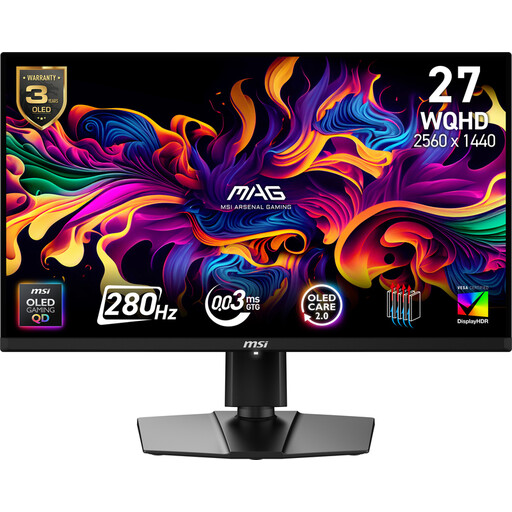
QD-OLED may suit you if you prioritise deep blacks in dark scenes and are mindful of static images displayed for long periods.
The product information lists 2560 × 1440 resolution, 280 Hz and OLED Care 2.0.
OLED Care 2.0 doesn’t eliminate the risk of burn-in; check the care instructions and terms for this model.
 No image available
IPS is an option if you want to avoid OLED. For black levels in a dark room, the contrast of the exact model is still a factor to consider.
The product name lists QHD, 200 Hz and an IPS panel. RTINGS generally describes IPS as having lower contrast than VA.
Check which refresh rate your source device can deliver through your chosen connection.
Factor in the risk of burn-in from static elements displayed for long periods. MSI describes the panel care features for the MPG 321URX as reducing the risk, not eliminating it. Check the usage and warranty terms for the model you’re considering.
First check which resolution and refresh rate combinations are supported by the monitor, connection and source device. Then select a supported mode on the connected device and in the monitor’s menu. For example, Dell lists different maximum refresh rates via DisplayPort and HDMI for the G2724D.
No. According to ACM ConsuWijzer, the statutory warranty depends on what you could reasonably expect from the product under normal use; the seller is responsible for providing a solution if the product doesn’t meet those expectations. This doesn’t automatically determine the outcome of every claim involving OLED burn-in: the circumstances and expectations matter.
For a standard online consumer purchase, ACM ConsuWijzer says you generally have a statutory cooling-off period of up to 14 days after delivery, with some exceptions. Read the terms on unpacking and trying out the monitor before using it extensively or returning it.