
Dark-scene designers
You often view spaceships against a dark background and want to distinguish bright details from black. RTINGS explains the differences between OLED black levels and the potential for halos with mini-LED.


For dark space scenes, OLED or QD-OLED is a natural choice: according to RTINGS, OLED can display black on a per-pixel basis, without halos around bright objects. If you spend long hours working with static design panels, weigh the OLED-specific risk of permanent burn-in against mini-LED LCD; also check that your computer and connection can handle your chosen resolution and refresh rate.
You often view spaceships against a dark background and want to distinguish bright details from black. RTINGS explains the differences between OLED black levels and the potential for halos with mini-LED.
You keep tool panels or timelines in the same place for long periods and want to factor in the OLED-specific risk of permanent burn-in. RTINGS describes this as a trade-off for extended use with static content.
You want enough space for design windows as well as smooth motion. RTINGS notes that gaming at a higher resolution can put more demands on your computer than a lower resolution with a higher refresh rate.
Best suited to: you, if dark scenes and deep blacks matter more to you than extended use of a static desktop.
Trade-off: fixed toolbars can make the OLED-specific risk of permanent burn-in relevant; check the terms and features of the exact model.
Best suited to: you, if you combine long design sessions with fixed interface elements and dark scenes with HDR.
Trade-off: local dimming zones can cause halos around bright objects against a dark background; results vary by model, according to RTINGS.
Best suited to: you, if QHD workspace and smooth motion matter more than the deepest blacks or pronounced HDR contrast.
Trade-off: IPS LCD does not offer OLED's per-pixel blacks; assess the specific model rather than treating a single response-time figure as a complete measure of performance.
For this combination of design work and gaming, your choice mainly depends on black levels, fixed toolbars, workspace and smooth motion.
| Consideration | What to look for when buying | Who is this important to? |
|---|---|---|
| Black levels and HDR | Compare OLED with the local dimming performance of the specific mini-LED model; don't judge HDR by peak brightness alone. | When I'm designing a bright spaceship against a dark background, I want to be able to distinguish black from bright details. Around 36% of consumers put black levels in dark scenes first when weighing up their options. |
| Toolbars that stay on screen | Consider how long the same interface remains visible, and check the care and warranty terms for the exact OLED model. | During long sessions with fixed tool panels, I factor in the OLED-specific risk of burn-in. Around 29% of consumers focus their choice mainly on extended static design work. |
| Workspace and detail | Compare screen size and resolution with your desk space and your computer's performance. | If the model, timeline and tool panels all need to fit on screen at once, I focus on workspace and detail. Around 21% of consumers make this their top buying priority. |
| Smooth motion | Check the refresh rate at your chosen resolution, the available connections and support for variable refresh rates. | If smooth motion is your main priority when gaming or navigating, you'll want to make sure your computer and connection can handle the stated refresh rate. Around 14% of consumers prioritise this need. |
Gigabyte lists 1.000 cd/m² typical for HDR at 3% screen area on the MO27Q2A, compared with 250 cd/m² typical for SDR at 100% screen area. These figures use different test conditions, so they are not a direct comparison at the same screen coverage.
Only compare brightness figures when the screen coverage and picture mode match.
OLED can be an appealing choice for dark scenes, but prolonged use with static elements brings a specific risk of permanent burn-in, according to RTINGS.
Weigh the time you spend with fixed interface elements against use with moving images, and check the care and warranty terms for the exact model.
AW2725Q and AW2725QF are different models with different panel types: Dell describes the AW2725Q as QD-OLED, while the Joybuy product listing identifies the AW2725QF as LCD.
Before buying, check the full model code and panel type on the product page.
The MO27Q2A is a 27-inch QHD QD-OLED model for gaming and dark scenes.
The PG32UCDM Gen3, model PG32UCDM3, is an approximately 32-inch 4K QD-OLED option for anyone looking for a larger screen and more pixels.
The Q27G3XMN/BK is a 27-inch QHD Fast VA mini-LED LCD model and an alternative to OLED for extended design work.
The AW2725Q is a 27-inch 4K QD-OLED model for anyone looking to combine fine detail with strong contrast in a dark room.
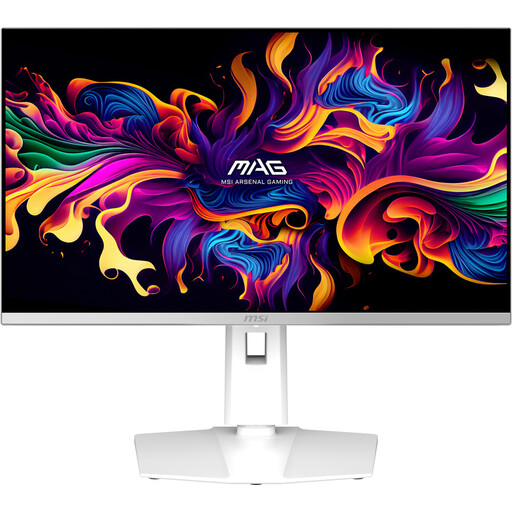
The MAG 274QRF QD E2 is a 27-inch QHD Rapid IPS option for anyone who values workspace and smooth motion.
This selection from Joybuy includes OLED and QD-OLED monitors for dark scenes, plus a mini-LED monitor as an alternative for design work with fixed interface elements.
 No image available
QD-OLED is worth comparing if black levels in dark scenes are a priority; if toolbars stay on screen for long periods, bear in mind the OLED-specific risk of permanent burn-in.
QHD (2560 × 1440); up to 280 Hz.
 No image available
The larger 4K screen may suit anyone looking for more space for design windows; with OLED, bear in mind the effect of interface elements remaining static for long periods.
OLED; 4K (3840 × 2160); 165 Hz.
 No image available
This OLED monitor is worth comparing for dark scenes; factor in the risk of permanent burn-in if the same design panels remain on screen for long periods.
QHD (2560 × 1440); 240 Hz.
 No image available
The 4K QD-OLED combination suits anyone looking for fine detail and contrast in a dark room; bear in mind the OLED trade-off with prolonged static use.
4K (3840 × 2160); 240 Hz.
 No image available
Mini-LED LCD is an alternative to consider if you use fixed interface elements for long periods. RTINGS describes the potential for halos with mini-LED in dark scenes; that doesn't tell you how visible they are on this specific model.
Fast IPS; 4K at 160 Hz or FHD at 320 Hz. The two modes therefore use different resolutions and refresh rates.
No, OLED isn't the only option. RTINGS describes advantages for OLED in black levels and halos in dark scenes, but mini-LED LCD can be an alternative if you work with fixed design panels for long periods and want to factor in the OLED-specific risk of permanent burn-in.
Check that your computer and chosen connection support your preferred resolution and refresh rate. Adaptive-Sync also requires a compatible graphics card; MSI specifies this requirement for the MAG 274QRF QD E2.
Check the care instructions for the exact model and, where possible, avoid leaving the same toolbars on screen for unnecessarily long periods. ASUS describes a feature on the PG32UCDM3 that switches to a black screen when you're away to reduce the risk of burn-in; it doesn't guarantee that burn-in won't occur.
No. ACM ConsuWijzer explains that you're entitled to a product that works for as long as you could reasonably expect it to. If a product fails to meet that expectation under the applicable terms, the seller is responsible for providing a solution; a manufacturer's guarantee doesn't replace your statutory rights.
Online purchases in the Netherlands generally come with a statutory cooling-off period that ends 14 days after delivery. ACM ConsuWijzer also explains the terms and exceptions; check these and the seller's returns information before placing your order.