
Cyclists short on screen space
You want to follow the route without taking up too much space in a shared bedroom. Measure the space available for the screen and its stand, not just the diagonal.


A compact Full HD screen is more likely to suit a cramped shared bedroom. Philips lists the 24M2N3200A/01 as having a 23.8-inch diagonal and 1920 × 1080 pixels, compared with 27 inches and 2560 × 1440 pixels for the AOC Q27G4XF. Choose a 27-inch QHD screen if you have enough space and your source device can handle the output you want: Zwift notes that your source device’s graphics performance can limit image quality and frame rate. A monitor doesn’t control the climbing resistance; that depends on having a compatible, connected bike trainer and choosing the right training mode.
You want to follow the route without taking up too much space in a shared bedroom. Measure the space available for the screen and its stand, not just the diagonal.
You look at the route and on-screen data while cycling, and want to check whether a larger QHD screen suits your viewing position and source device.
You use the same monitor for cycling workouts and PC gaming. Compare the available connections, and the maximum resolution and refresh rate supported by each input.
Best for: a cycling setup where desk and bedroom space are limited.
Trade-off: the screen offers less viewing area and fewer pixels than the 27-inch QHD options mentioned.
Best for: anyone who wants more room for the route view and data while cycling, and has space for the screen.
Trade-off: measure the space needed for the stand and check that your source device can handle the output resolution you want.
In a shared bedroom, screen size and resolution aren’t the only things to consider: your viewing position, source device connections and the impact on your room-mate can all influence your choice.
| Consideration | What should you check? | Who should pay particular attention? |
|---|---|---|
| Size and placement | Measure the available width and depth, including the stand, and check your view from the bike. | I want my bike and screen to fit in a shared bedroom without taking up unnecessary space. That’s why around 33% of consumers put available space first. |
| Readability and resolution | Philips lists the 24M2N3200A/01 as having a 23.8-inch screen and 1920 × 1080 pixels; AOC lists the Q27G4XF as having a 27-inch screen and 2560 × 1440 pixels. Assess the picture from your position on the bike. | I want to see the route and data clearly while cycling, and weigh that against the space a larger screen needs. Around 27% of consumers prioritise readability from the bike. |
| Connection and refresh rate | Compare your source device’s output with the input you’ll use. For the Alienware AW2725DM, Dell lists a maximum of 144 Hz at QHD via HDMI and 180 Hz via DisplayPort. | I want to know which resolution and refresh rate my own PC or other video source can support through the available port. Around 20% of consumers let compatibility guide their choice. |
| Shared room | Check that the screen doesn’t cause distracting reflections from your cycling position, and decide separately how to manage sound from your software and bike trainer. | I want to work out without unnecessarily disturbing my room-mate with light or sound. That’s why around 20% of consumers give the shared-room setup more weight than screen size or maximum refresh rate. |
The refresh rate you can use depends on both the input and the source device. For the AW2725DM, Dell lists a maximum of 144 Hz at QHD via HDMI and 180 Hz via DisplayPort. Zwift also notes that the computer’s graphics performance may be a limiting factor.
Compare the resolution and refresh rate you want for each input with the output of the device running your cycling software.
The monitor displays the picture. According to Zwift, route-controlled resistance depends on the bike trainer and the mode you choose; during ERG workout intervals, the road gradient doesn’t determine resistance.
Check the connection to your trainer and choose a training mode that suits your needs.
The stand and cables need space too. Height adjustment varies by model; AOC lists this feature for the Q27G4XF.
Measure the full space available for your setup and check the dimensions and adjustment options of the exact model.
The 24M2N3200A/01 is an example of a more compact Full HD gaming monitor.
The Q27G4XF is a 27-inch QHD option with an adjustable stand.
The AW2725DM is a QHD option for a setup with multiple video sources.
The G274QPF E2 is an example of a 27-inch QHD IPS monitor.
These Joybuy product options include compact monitors and 27-inch QHD screens. Compare the space you need, resolution and connections with your cycling setup and source device.
 Image unavailable
A 27-inch QHD option if your setup has room for a larger screen.
27 inches; 2560 × 1440 pixels; VA panel; 180 Hz; FreeSync Premium; 2 HDMI 2.0 inputs and 1 DisplayPort 1.4 input.
 Image unavailable
A portable 16-inch screen to consider if your setup has limited space.
Full HD; IPS; 144 Hz; 16:10 aspect ratio; FreeSync; 2 USB-C ports and Mini HDMI; built-in kickstand.
 Image unavailable
A portable 16.1-inch screen with a higher stated resolution than Full HD; check that it suits your source device and intended use.
2560 × 1600 pixels; IPS; 144 Hz; 16:10 aspect ratio; FreeSync; 2 USB-C ports and Mini HDMI; built-in kickstand and stereo speakers.
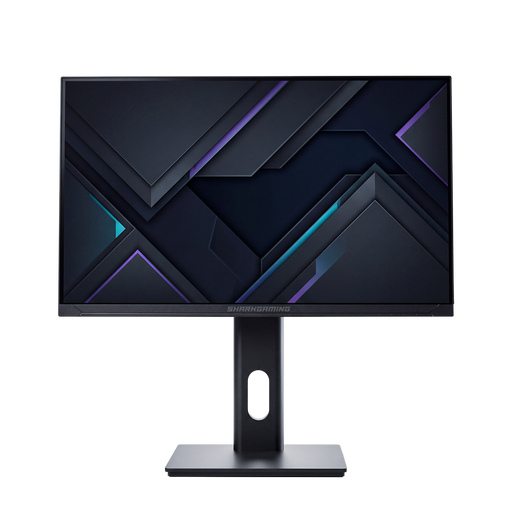 Image unavailable
A more compact screen to consider if space is a priority.
23.8 inches; 1920 × 1080 pixels; IPS; 200 Hz; 1 ms; adjustable stand and anti-glare coating.
 Image unavailable
A 27-inch QHD option if you want more screen space and have room for it.
27 inches; 2560 × 1440 pixels; IPS; 144 Hz; Adaptive Sync; DisplayPort 1.4 and HDMI 2.0.
No, the monitor only displays the picture. For route-controlled resistance, you need a compatible bike trainer connected. Zwift distinguishes between SIM, which simulates road conditions, and ERG, which targets a set power during workouts rather than responding to the road gradient.
No, 180 Hz is a monitor specification and doesn’t guarantee that Zwift will reach that frame rate. Zwift says the source device’s graphics performance can limit image quality and frame rate. Also check which refresh rate your source can output through the monitor connection you plan to use.
Check that you have a clear view from the bike, that the screen doesn’t cause distracting reflections, and that its brightness suits the ambient light. The cited Arboportaal information is about employees and isn’t directly a legal requirement for cycling in a bedroom.
In the Netherlands, when you buy a standard monitor online, you generally have up to 14 days after delivery to change your mind, according to ACM ConsuWijzer. You’re also entitled to a statutory guarantee if the product doesn’t perform as you could reasonably expect under normal use; the retailer is your point of contact.
The European Commission states that electronic displays, including computer monitors, are covered by EU ecodesign and energy labelling rules. CE marking is required only for products covered by applicable harmonised EU rules; the CE logo isn’t an independent performance test of a particular screen.