
Competitive gamer
Mostly plays fast-paced online competitions and values smooth motion that’s easy to follow. The frame rate their own PC can achieve remains a key factor.


Start with the frame rate your PC can actually deliver in the games you play; a high refresh rate alone doesn’t determine what you’ll see on screen. If you’ll also use the monitor for working from home, text clarity, screen space and connections matter too. OLED needs extra consideration if you often have static windows open for long periods.
Mostly plays fast-paced online competitions and values smooth motion that’s easy to follow. The frame rate their own PC can achieve remains a key factor.
Uses the same screen for competitions, documents and windows. That makes clarity, adjustability and connections important too.
Wants fast-moving images and contrast, but also spends long periods with static work windows on screen. It’s worth checking the panel risks and the terms for the specific model you’re considering.
First, decide how important competitive gaming is compared with clear, comfortable work and compatibility with your devices. If you’re considering OLED, also weigh up panel risks and aftercare.
| What to consider | What to check before buying | Who is this most relevant to? |
|---|---|---|
| Smooth motion | Check the frame rate in the games you usually play, the refresh rate supported by your chosen connection, and independent tests of the exact model. | If I play fast-paced competitions, I want to follow the action clearly without choosing a display mode my PC can’t make full use of. Around 40% of consumers prioritise smooth competitive gaming. |
| Clear text for work | Compare the screen size, resolution, stand adjustment and text clarity at your usual viewing distance. | If I use the same screen for documents and games, I want work windows to be comfortable to view and the monitor easy to position. Around 30% of consumers prioritise readability and using one screen for both. |
| Connections | Check the ports on your PC and laptop, the display modes supported and the charging power your laptop needs. | If I want to connect both my gaming PC and work laptop, the connections need to suit my devices and setup. Around 20% of consumers prioritise compatible connections. |
| Panel risks and aftercare | Check the warranty terms and care instructions for the exact model, and compare its energy label. | If I use lots of static work windows, I want to know in advance about any panel risks and the terms that apply to my choice. Around 10% of consumers prioritise panel risks and aftercare. |
Hz describes the monitor’s refresh rate; fps describes how many frames the PC produces per second. So a high stated refresh rate won’t necessarily be fully usable in the games you play.
Check the frame rate in the games you usually play, and compare how the exact model handles motion too.
For the MO27Q2A, Gigabyte lists video over USB-C, but Power Delivery is limited to 18 W. That may be less than your work laptop needs to charge.
Compare the monitor’s USB-C specification with your laptop’s connection and charging requirements.
You may still need a separate laptop charger or dock.
Static content displayed for long periods carries a risk of burn-in; small text may also show coloured fringing. A panel care feature doesn’t prove that this risk disappears.
Check how text looks on the exact panel and read the care and warranty terms for that model.
According to BenQ ZOWIE, the XL2546X is a compact, competition-focused Fast-TN model with a stated refresh rate of 240 Hz and DyAc 2.
According to Gigabyte, the MO27Q2A combines a 27-inch QHD QD-OLED panel, a maximum refresh rate of 280 Hz and KVM functionality for a shared gaming and work setup.
The Philips product page lists a QHD QD-OLED screen with a 360 Hz refresh rate for the 27M2N8500/00.
According to Dell Netherlands’ product description, the AW2725DF is an adjustable QHD QD-OLED model with a refresh rate of 360 Hz.
These models are aimed at online competitions and combining gaming with working from home. Check that the resolution and connections suit your PC and work devices.
 Image unavailable
An option if you want to use the same screen for fast-paced competitions and working from home.
The product name lists 32 inches, IPS and 180 Hz.
 Image unavailable
For anyone who plays competitive games and also wants to use a QHD screen for work.
The product name lists 27 inches, WQHD, 200 Hz and Rapid IPS.
 Image unavailable
Worth comparing if you’re looking for a 27-inch Quad HD screen for fast-paced competitions.
The product name lists 180 Hz, 1 ms, FreeSync Premium and HDR10.
 Image unavailable
For anyone who wants to combine gaming and working from home on one adjustable screen.
The product name lists 27 inches, 4K UHD, 180 Hz and IPS.
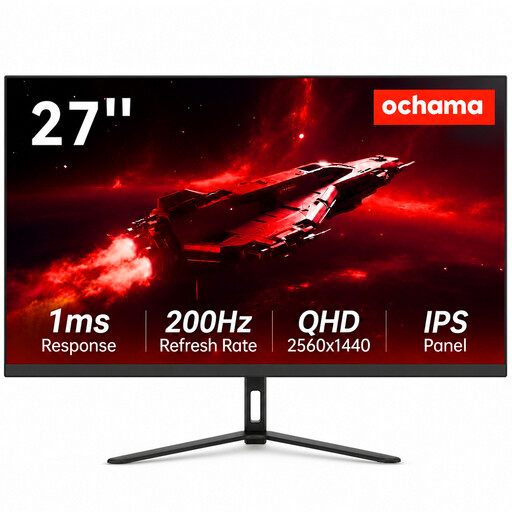 Image unavailable
The product name positions this screen for both gaming and office work.
The product name lists 27 inches, 2K and a refresh rate of 200 Hz.
The monitor can’t display more unique game frames than the PC produces. So check the frame rate in the competitions you play before paying extra for a higher maximum refresh rate.
That depends on the monitor and laptop. According to Gigabyte, the MO27Q2A supports video over USB-C DisplayPort Alternate Mode, but delivers a maximum of 18 W Power Delivery. Check how much charging power your laptop requires.
Bear in mind the risk of burn-in if static content stays on screen for long periods, and follow the care instructions for the exact model. Check separately what damage is covered by the warranty on offer; a panel care feature doesn’t demonstrably remove the risk.
When you buy a product online from a business, you generally have a statutory cooling-off period of up to 14 days after delivery, subject to applicable exceptions. ACM ConsuWijzer explains this cooling-off period; according to the Dutch government, if a product is faulty, the retailer is your point of contact for a solution.
Monitors are covered by EU energy labelling rules for electronic displays, so compare the label for the exact model. Under the Dutch old-for-new scheme, when a private customer buys a new, similar appliance, the retailer must take back the old one free of charge, including for online purchases.