
Home worker who also games
Uses the same screen for work windows and platform games. Positioning and text clarity matter alongside gaming features; Arboportaal recommends placing the top of the screen slightly below eye level.


If you use one monitor for work and platform games, start by considering readability, screen position and the connections on your PC or console. Then choose a refresh rate your equipment can actually make use of. IPS avoids the risk of OLED burn-in described by RTINGS.com, while OLED may be an option if image quality and motion matter more to you than extended use with static work windows.
Uses the same screen for work windows and platform games. Positioning and text clarity matter alongside gaming features; Arboportaal recommends placing the top of the screen slightly below eye level.
Focuses on smooth motion and the trade-off between resolution and refresh rate. Also check which refresh rate your PC can output through the connection you plan to use.
Wants to use a monitor for console games in a home office. Check that the HDMI output, resolution and refresh rate you want are compatible with your PS5 and the game.
Don’t choose based only on the highest stated Hz: the resolution, adjustability and connection need to suit both your workspace and your PC or console.
| What to consider | What to look for | Who should pay particular attention? |
|---|---|---|
| Work comfort and text | Compare the resolution and text clarity at your viewing distance; check whether the stand or mount lets you position the screen at a suitable height. | If you use work windows and games on the same screen every day, you’ll want text and screen positioning to feel comfortable. Around 36% of consumers give work comfort top priority. |
| Motion handling | Check the maximum refresh rate for each input and whether VRR is compatible with your PC; a stated response time doesn’t tell you everything about motion handling. | If smooth motion in platform games is your main priority, compare the mode your PC can actually output. Around 29% of consumers put motion handling first. |
| Console connection | Check the supported HDMI modes and test your preferred resolution, 120Hz output and VRR with your PS5 and the game. PlayStation describes a test for 1440p output, among other options. | If you play on a PS5 at your desk, you’ll want to know whether the console output you want will work. Around 21% of consumers prioritise console compatibility. |
| Panel and static images | Compare IPS and OLED for your needs; RTINGS.com describes a risk of burn-in with OLED when static images are displayed for long periods. If you’re considering OLED, also check the terms for the exact model. | If image quality matters more to you, also consider how many fixed work windows you have on screen each day. Around 14% of consumers make image quality their top priority. |
The stated signal ranges for HDMI and DisplayPort differ on the ASUS TUF Gaming VG27AQL3A. This means the connection you use may affect whether you can select the mode you want.
Check the resolution and refresh rate for the input you’ll actually use, then compare them with the output from your PC or console.
Stands vary from model to model. A screen that can’t be positioned properly in your workspace may be less suited to your everyday use.
Check the adjustability, dimensions and mounting options before deciding where to put it on your desk.
If the stand doesn’t suit your workspace, you may need a different stand or a compatible monitor arm.
Displaying the same static elements for long periods can cause burn-in on OLED screens.
Consider how often you work with fixed windows on screen, and check the care settings and terms for the specific OLED model.
The models reviewed include both a QHD Fast IPS option and a 4K QD-OLED option.
The G27U is a 27-inch 4K IPS model with separate UHD and FHD refresh modes.
The Q27G4XF is a QHD IPS model with a height-adjustable stand.
The G2725D is a QHD IPS gaming monitor with a tilting stand.
The UltraGear 27GS75Q-B is a QHD IPS model with height adjustment and swivel functionality.
These Joybuy products are aimed at using one monitor for everyday work and gaming. Check which features suit your workspace, PC or console for each model.
 No image available
An option for combining QHD images with adjustable screen positioning for work and gaming.
32-inch IPS screen; 2560 × 1440; 180 Hz; FreeSync; stand with height, swivel, tilt and pivot adjustment.
 No image available
A QHD model to consider if you want to combine work and gaming on a 27-inch screen.
27-inch QHD (2560 × 1440); 180 Hz; 1 ms GTG; FreeSync Premium; 2× HDMI 2.0 and 1× DisplayPort 1.4.
 No image available
The wide 32:9 screen is an option if you want plenty of space for work windows and games; check that your desk can accommodate its dimensions first.
49-inch; DQHD 5120 × 1440; 165 Hz; 1500R VA panel; AMD FreeSync; 2× HDMI 2.1 and 2× DisplayPort 1.4. The safety information states that the desk or VESA mount must support at least 15 kg and recommends that two people assemble it.
 No image available
A QHD screen for work and gaming; check that the curved 32-inch format suits your viewing distance and desk space.
VA panel; 2560 × 1440; 1500R curvature; 165 Hz; Adaptive Sync; HDMI and DisplayPort; VESA 100 × 100 mm.
 No image available
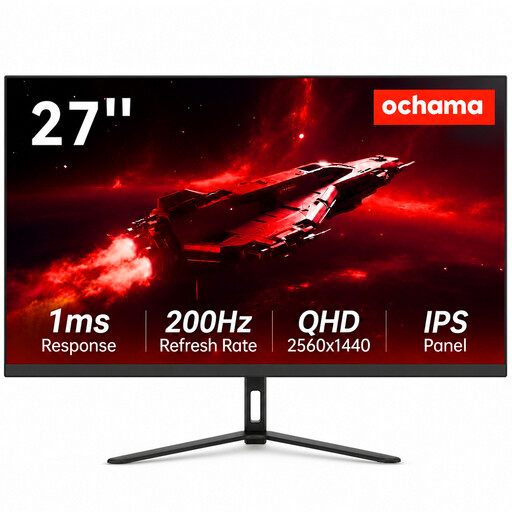
A 27-inch model described in the product information as suitable for both gaming and office work.
27-inch screen; 2K resolution; 200 Hz.
Sit the screen directly in front of you and place the top slightly below eye level, as Arboportaal recommends. Check that the stand or a suitable mount lets you achieve this position in your workspace.
Check the information about the connected HDMI device and use the 1440p output test in the PS5 settings. Also check your preferred 60Hz or 120Hz output and VRR; the available combination depends partly on the screen and the game.
Yes. OLED screens can be at risk of burn-in when the same static elements are displayed for long periods. Check the care settings and terms for your chosen model rather than assuming they’re the same across all brands.
Compare the energy labels for the specific models. The European Commission lists a scale from A to G for electronic displays; the label may also include information about energy use in HDR mode.
For a standard online consumer purchase, you’ll generally have up to 14 days after delivery to change your mind; ACM ConsuWijzer notes that exceptions may apply. You’re also covered by the legal guarantee if, under normal use, the product doesn’t do what you could reasonably expect. There isn’t one fixed guarantee period for every monitor.