Start by measuring the available width and depth, including the stand, cables and your viewing position. A compact Full HD monitor of around 24 inches is more likely to fit on a cramped desk; a 27-inch QHD screen gives you more pixels for routes and training data, if your desk and PC can accommodate it. A higher refresh rate won’t, by itself, control the resistance on a climb.
Who is this relevant to?
Cyclists short on desk space
If you share a desk with your training set-up, you’ll want the monitor stand and cables to take up as little work surface as possible. The screen diagonal alone doesn’t tell you how much desk space a monitor needs; Lenovo’s guide also highlights the importance of desk depth and stand design.
Cyclists who want to read climb data
If you want to view routes and training data clearly, you could consider a larger screen, but you’ll also need to take the available space and your viewing position into account. AOC lists the Q27G4XF as having a resolution of 2560 × 1440 pixels.
Cyclists with an existing PC
If you’re using an existing PC or another video source, check that its connections match the monitor and that it supports your preferred resolution. Zwift Support notes that graphics performance also depends on the GPU.
What should you consider when choosing?
Compact Full HD screen
Choose this option: if desk space is your priority and Full HD suits your video source.
Bear in mind: you’ll get a smaller screen area and fewer pixels than with a 27-inch QHD screen. A maximum refresh rate of 180 Hz doesn’t guarantee that your cycling app will display the same number of frames per second.
27-inch QHD screen
Choose this option: if your desk and viewing distance leave enough room, and your video source can output QHD.
Bear in mind: the larger screen needs to fit your space, and the higher resolution places greater demands on the device rendering the image.
| What to consider |
What should you look for? |
Who is this most important to? |
| Desk space |
Measure the width and depth with the stand in place. According to ASUS, the VG249Q3A is 54,10 cm wide and 17,40 cm deep with its stand; check the dimensions of the exact variant. |
If I also use my desk for my training set-up, I want to know how much work space the stand takes up. This is the main concern for around 36% of consumers. |
| Viewing routes and data |
Assess the viewing distance and readability in your own set-up. AOC lists the 24G4X as 23,8 inches with 1920 × 1080 pixels, and the Q27G4XF as 27 inches with 2560 × 1440 pixels. |
If you want to see routes and training data clearly, you can weigh a larger screen against the space available. Around 29% of consumers say having a clear overview is their main concern. |
| Connection and PC performance |
Check the outputs on your video source, the monitor’s inputs, and the resolution and refresh rate supported by the combination. Zwift Support notes that the GPU affects graphics performance. |
If I’m using an existing PC, I first want to know which display settings it can actually handle. Around 21% of consumers prioritise connections and PC performance. |
| Display and climbing resistance |
Treat monitor refresh rate and trainer resistance as separate functions. Zwift Support describes a connected smart trainer as the equipment that can control resistance, including on climbs. |
I don’t want to expect a monitor to control the physical resistance during a climb. Around 14% of consumers prioritise cost and realistic expectations. |
Common buying mistakes
-
Measuring only the screen diagonal
The stand affects how much desk depth you’ll have left. Stand dimensions vary by model; for example, ASUS lists the VG249Q3A as 17,40 cm deep.
Measure the available space and compare it with the monitor’s dimensions, including the stand. If you’re considering a monitor arm, check the VESA size and make sure the arm and desk clamp suit your set-up.
An arm can be an alternative if the supplied stand takes up too much space, but you’ll need a suitable mount and a suitable place to attach it to your desk.
-
Assuming the maximum Hz rating guarantees the app’s frame rate
Refresh rate is a monitor specification. On its own, it doesn’t tell you how many frames your PC or cycling app will actually display; Zwift Support points to the GPU’s influence.
Before choosing a monitor based on its maximum refresh rate, check what your video source can handle and which resolution you want to use.
-
Confusing screen refresh with the feel of climbing resistance
A monitor displays the image, but doesn’t control the resistance of a bike trainer. Zwift Support describes a separate connection to a controllable smart trainer for this.
Consider the monitor and any training equipment as separate purchases, and check that your equipment works with the cycling app you use.
Brands to compare
AOC
AOC’s product range includes a compact Full HD option and a 27-inch QHD option.
- According to AOC, the 24G4X and Q27G4XF have a maximum refresh rate of 180 Hz. AOC also lists an adjustable-height stand for the Q27G4XF.
- Check the stand dimensions, connections and exact variant for your set-up; the maximum refresh rate doesn’t tell you what your PC can achieve in a cycling app.
ASUS
The Dutch specifications for the TUF Gaming VG249Q3A include dimensions, ports and VESA information for a compact Full HD monitor.
- ASUS lists the VG249Q3A as 54,10 cm wide and 17,40 cm deep with its stand, and with VESA 100 × 100 mm.
- According to ASUS, the stand tilts but isn’t height-adjustable. Check that it suits your viewing position.
Philips
The Evnia models mentioned include a 23,8-inch Full HD variant and a 27-inch QHD variant.
- Philips lists a maximum refresh rate of 180 Hz for both variants mentioned.
- Check the exact model variant, stand dimensions and ports. A marketing description isn’t an independent measurement of gaming performance.
MSI
According to MSI, the G244F E2 is a 23,8-inch Full HD model with HDMI and DisplayPort inputs.
- MSI lists a stand depth of 231,9 mm and VESA 75 × 75 mm for this model.
- These model dimensions don’t prove that the stand will fit every small desk. MSI notes that specifications and availability can vary by country.
Joybuy products
This selection includes compact Full HD monitors and larger 27-inch QHD monitors for virtual cycling training. Measure the available space and check that your video source supports your chosen connection and resolution.
 Image unavailable
KTC H24B9S 24-inch Full HD gaming monitor
A compact screen option if you’re weighing the available desk space against screen size.
24 inches, Full HD, IPS panel and 144 Hz. HDMI and DisplayPort are listed; the stand tilts.
View at Joybuy
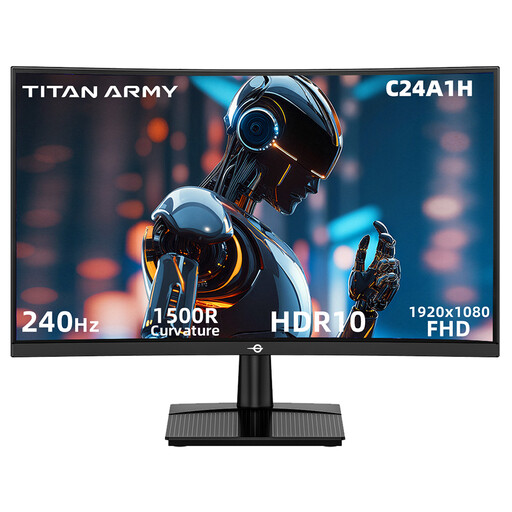 Image unavailable
TITAN ARMY C24A1H 23,6-inch FHD gaming monitor
A compact FHD option for a desk with limited space; compare the stand dimensions with the room available.
23,6 inches, FHD, VA panel and 240 Hz. The listed dimensions with the stand are 537,9 × 196,9 × 409,2 mm. HDMI and DisplayPort are listed; VESA 100 × 100 mm.
View at Joybuy
 Image unavailable
AOC Q27G42XNE 27-inch QHD gaming monitor
A larger screen for routes and data if your desk and viewing position have enough space.
27 inches, 2560 × 1440 pixels and 180 Hz. The title lists FreeSync Premium, two HDMI 2.0 inputs and one DisplayPort 1.4 input.
Check that the monitor fits your desk and viewing position.
View at Joybuy
 Image unavailable
Philips Evnia 27M2N3500NF 27-inch QHD gaming monitor
A larger QHD option if you have room for a 27-inch screen and can adjust your viewing distance.
27 inches, QHD, IPS panel and 144 Hz. HDMI 2.0 and DisplayPort 1.4 are listed.
Check the available desk space and the connections on your video source.
View at Joybuy
 Image unavailable
Alienware AW2725DM 27-inch QHD monitor
A 27-inch QHD option if a larger screen suits your desk and viewing position.
The product description lists 2560 × 1440 pixels, 180 Hz, HDMI and DisplayPort inputs, and an adjustable stand.
Check the dimensions of the exact model and whether your video source can handle your preferred resolution.
View at Joybuy
Frequently asked questions
Does a gaming monitor make a virtual climb feel physically harder?
No, a monitor doesn’t control climbing resistance. Zwift Support describes a separate RESISTANCE connection to a smart trainer for this; check that your trainer and cycling app support the feature.
How can I avoid expecting a higher frame rate than my PC can handle?
Compare the outputs on your video source with the inputs on the exact monitor model, and check which resolution and refresh rate the connection supports. Zwift Support notes that the GPU affects graphics performance, so a monitor with a maximum refresh rate of 180 Hz doesn’t guarantee that the app will display 180 frames per second.
What should I measure to fit a monitor on a small desk?
Measure the available width and depth, then compare them with the monitor’s dimensions, including the stand. Allow for cables and your viewing position too. If you’re using a monitor arm, check the model’s VESA size and make sure the arm and desk clamp are suitable.
If I buy online in the Netherlands, do I have a cooling-off period and a legal guarantee?
ACM ConsuWijzer explains that online purchases generally come with a statutory cooling-off period of up to 14 days after delivery, and notes that exceptions apply. The ACM also says you’re entitled to a product that meets what you could reasonably expect; this doesn’t automatically mean a fixed two-year guarantee. If there’s a problem, contact the seller.


