
Long-distance rider
Wants to read ride data from the bike and adjust the screen position. Arboportaal outlines employers’ requirements for display screen work; these don’t automatically apply as a legal requirement to a private setup.


For long virtual climbing rides, a screen you can read easily from your bike and position to suit your setup matters more than a high refresh rate alone. Then choose between a compact 27-inch QHD screen and a wider 34-inch 21:9 screen, based on your space and preferred view. Also check that your computer and connection can handle your chosen resolution and refresh rate. A monitor displays the climb, but it doesn’t control your trainer’s resistance.
Wants to read ride data from the bike and adjust the screen position. Arboportaal outlines employers’ requirements for display screen work; these don’t automatically apply as a legal requirement to a private setup.
Weighs a wider view of the virtual world against the space the screen needs and the extra graphics processing required by a higher resolution. Zwift Support notes that the GPU is one of the factors affecting image quality and frame rate.
Wants to avoid choosing a resolution or refresh rate that isn’t supported by their computer or other video source. Zwift Support identifies the GPU as an important factor in visual performance.
| What to consider | What should you check? | Who is this important for? |
|---|---|---|
| Readability and positioning | Check the ride data from your position on the bike. Look at adjustability, reflections and the space available. | If I want to read data during a long ride, I need to assess the screen position from my bike. Around 33% of consumers put readability and positioning first. |
| Width of the route view | Compare a 27-inch QHD screen with a 34-inch 21:9 screen where you plan to set it up. Don’t judge by product images alone. | If a wider view of the virtual world matters to you, weigh it against the space the screen takes up. Around 27% of consumers give the route view top priority. |
| Video source and connection | Check which resolution and refresh rate your device can output through the connection you plan to use. Check the port limits for the exact model. | If I want to keep using my current computer, I need to know which screen settings it can handle. Around 20% of consumers put this compatibility first. |
| Features that suit your needs | Choose features that fit your setup and how you use it. Check that the model’s specifications suit your other games. | If you’re mainly looking for a screen for virtual cycling, you don’t automatically need to aim for the highest specifications. Around 20% of consumers prioritise features that suit their needs. |
A higher resolution or refresh rate won’t, on its own, guarantee better gaming performance: Zwift Support says the GPU has a significant effect on image quality and frame rate. What you see on the monitor is also separate from the trainer settings and the resistance the trainer can provide.
The monitor’s refresh rate doesn’t tell you how many frames your computer can actually generate and output. Zwift Support emphasises that the GPU plays a major role in image quality and frame rate.
Check your device’s graphics performance and the capabilities of its chosen video output before selecting a monitor setting.
A monitor displays the virtual world; resistance depends on the trainer and its settings. Zwift Support describes the limitations of smart trainers separately from what appears on screen.
Consider your screen choice and how your trainer works as two separate things.
The manufacturers’ information for the Philips 27M2N3500NF/00 and LG 34G600A-B lists model-specific limitations for their MBR modes, including an effect on brightness. Philips also warns that this model may flicker.
Check which display modes can be used at the same time on the exact model, and review the settings before starting a long session.
The Philips Evnia 27M2N3500NF/00 is a 27-inch QHD option for those who don’t want a 34-inch ultrawide.
The Dell Plus S3425DW is an example of a 34-inch 21:9 screen with height adjustment.
The LG UltraGear 34GX900A-B is a 34-inch OLED ultrawide for those who want to use their monitor for other games too.
The BenQ EX3210U is a 32-inch 4K example with a 16:9 aspect ratio, rather than an ultrawide screen.
This selection of Joybuy products includes compact QHD monitors, larger screens and a 34-inch ultrawide option. Before choosing, check that the connections and display settings suit your computer and bike setup.
 No image available
An option if you’re looking for a larger screen and flexible positioning; check that the size suits your bike setup.
32 inches and QHD. The product description mentions height, swivel and tilt adjustment. The title lists an IPS panel and 180 Hz; the description mentions HDMI 2.0 and DisplayPort 1.2.
 No image available
A compact QHD option if you’re looking for a 27-inch gaming screen; set it up to match what your computer can output.
27 inches and 2560 × 1440 pixels. The title lists Rapid IPS and 200 Hz.
 No image available
A 27-inch QHD option to compare if you’re looking for a more compact screen setup. Check that your chosen settings suit your video source.
2560 × 1440 pixels and 180 Hz. The title lists FreeSync Premium, HDR10, two HDMI 2.0 ports and one DisplayPort 1.4 port.
 No image available
An option if you want a wider 21:9 view and have room for a 34-inch screen.
34 inches, WQHD and 21:9. The description lists a VA panel, 120 Hz and a curved design with an 1800R curvature.
 No image available
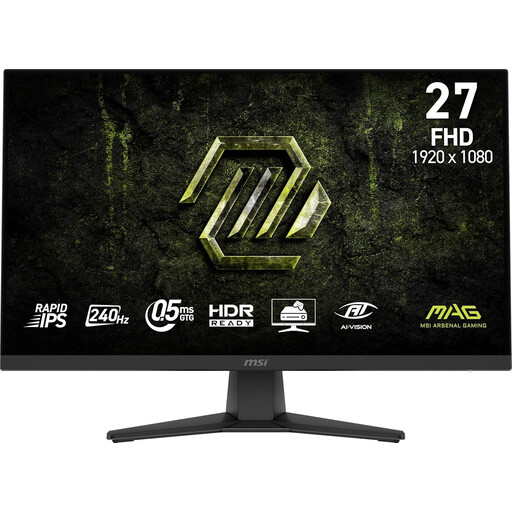
A 27-inch gaming monitor to consider if FHD suits your device and the viewing experience you’re after.
1920 × 1080 pixels and 240 Hz. The product information lists IPS, AMD Adaptive Sync, HDMI, VGA, VESA mounting and tilt adjustment.
No, a monitor doesn’t change the resistance. Zwift Support explains that the trainer settings and capabilities of a connected smart trainer determine the simulated gradient; a trainer may reach its limit on steep climbs.
Check the display from your position on the bike and see whether reflections or ambient light make it harder to read. Arboportaal lists small symbols, contrast, reflections and lighting as factors affecting readability for display screen work; this isn’t specific health advice for cycling at home.
First, check which resolution and refresh rate your computer can output through the connection you plan to use. Zwift Support highlights the effect of the GPU on image quality and frame rate; Philips also advises checking that the graphics card can handle the maximum screen setting for the 27M2N3500NF/00.
Follow the instructions for your exact model. The Philips 27M2N3500NF product description on Joybuy recommends a soft, dry microfibre cloth and warns against applying too much pressure to the panel; don’t treat this as universal advice for all monitors.
For a standard online consumer purchase, you generally have a statutory cooling-off period of up to 14 days after delivery, subject to exceptions outlined by ACM ConsuWijzer. The seller is also responsible for the statutory guarantee if a product is faulty; this isn’t the same as a fixed guarantee period that applies to every monitor.