
PC pilot looking for a wider view
You want a wider horizontal view during trading runs and have space for a wide screen. Check whether your game supports 21:9.


If you game on a PC and your game supports 21:9, an ultrawide monitor could give you the wider view you want during trading runs. First, check game support, the space on your desk and what your PC can handle. If your cockpit HUD stays on screen for long periods, compare LCD with OLED, as static elements that remain visible over time are still a consideration with OLED.
You want a wider horizontal view during trading runs and have space for a wide screen. Check whether your game supports 21:9.
Your interface often stays on screen for long periods, so you’ll want to weigh your display preferences against the risk of static elements on OLED.
You’ll benefit more from a screen size and aspect ratio that suit your available space and gaming platform than from maximum width on paper.
| What to consider | What to look for | Who is this important for? |
|---|---|---|
| Width and game support | Check whether your PC game displays in 21:9 and measure the available desk width. | If you want a wider cockpit view during a trading run, first check whether your game supports it. Around 33% of consumers put this concern first. |
| OLED and fixed HUD elements | Compare OLED with LCD, and check the care guidance and terms for the exact model. | If you play long sessions with the same cockpit interface, weigh the benefits of dark imagery against the presence of static elements over time. Around 27% of consumers put this consideration first. |
| Refresh rate and PC performance | Check the resolution, connection and frame rate your PC can achieve. Also compare how response times are measured. | If smooth motion matters to you, your monitor, connection and PC need to work well together. Around 20% of consumers prioritise this compatibility. |
| Size, source and power consumption | Check the screen dimensions and source compatibility, and compare the energy labels of specific models. | If your console, desk space and long hours of use all need to fit together, choosing the right size matters more than width alone. Around 20% of consumers prioritise this practical fit. |
A wide panel doesn’t guarantee that a game will display in a wide format. RTINGS points out that consoles don’t support ultrawide aspect ratios.
Before buying, check the aspect ratio supported by your specific game and the output of your PC or console.
Protection features don’t eliminate the risk of static elements staying on screen for long periods. RTINGS describes cumulative exposure to these elements as an ongoing risk with OLED.
Take into account how long you play with the same HUD, and read the usage and warranty terms for the exact model.
Manufacturers can measure response times in different ways; MPRT, for example, isn’t directly equivalent to GtG. A stated maximum refresh rate also doesn’t tell you how many frames your game will actually deliver.
Check how the figures are measured and whether your PC and connection can handle your preferred resolution and refresh rate.
The ROG Swift PG34WCDN and TUF Gaming VG27AQ3A represent a 34-inch ultrawide QD-OLED option and a 27-inch QHD IPS option respectively.
The UltraGear 34GS95QE-B is a curved 34-inch OLED monitor with a 21:9 aspect ratio.
The AW3426DW is a 34-inch QD-OLED ultrawide option.
The G34WQC is an example of a curved 34-inch VA LCD monitor for ultrawide PC gaming.
The Odyssey OLED G8 G85SD is a 34-inch Ultra WQHD OLED monitor.
These Joybuy products offer a range of options for comparing ultrawide LCD and OLED with a 16:9 QHD monitor for your gaming setup.
 No image available
A 21:9 LCD option to compare if your PC game supports ultrawide and you’re weighing up OLED for use with a fixed HUD.
3440 × 1440; VA; 120 Hz; 1800R curve.
 No image available
A 16:9 LCD option to compare if you’re not looking for an ultrawide format or want a screen that suits your gaming platform.
2560 × 1440; IPS; 144 Hz; Adaptive Sync.
The product description also mentions VESA mounting and tilt adjustment.
 No image available
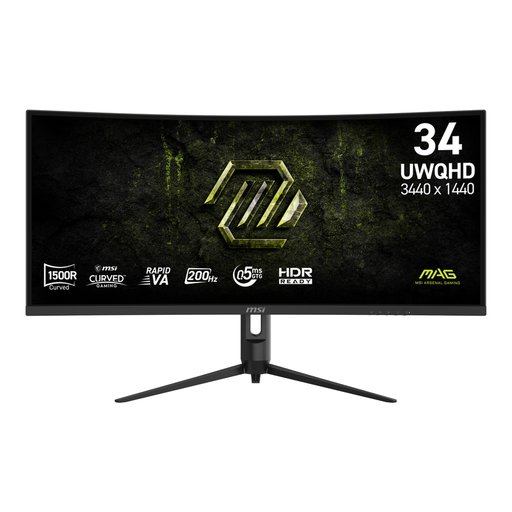
A 21:9 LCD option to compare for a compatible PC game, including if you’re weighing up LCD against OLED for a fixed HUD.
3440 × 1440; VA; 200 Hz; 1500R curve; Adaptive Sync.
The product description mentions a height-adjustable stand with tilt, swivel and pivot adjustment.
 No image available
An extra-wide LCD format to consider if your game supports the aspect ratio and you have enough desk space.
5120 × 1440; VA; 165 Hz; 1500R curve; FreeSync.
The product description recommends a desk or VESA mount that can support at least 15 kg, and installation by two people.
 No image available
An ultrawide OLED option to compare if your game supports 21:9 and you vary how you use the screen. Bear in mind the risk of OLED burn-in described by RTINGS if static HUD elements stay on screen for long periods.
3440 × 1440; 21:9; OLED; 240 Hz; 800R curve.
No. First check whether your game and gaming platform support the aspect ratio. RTINGS points out that consoles don’t support ultrawide aspect ratios; support varies from game to game on PC.
It’s something to weigh up: prolonged exposure to the same static elements remains a consideration with OLED. RTINGS describes cumulative exposure as a risk; panel protection doesn’t guarantee that burn-in won’t occur.
Compare the energy labels for the exact models. The European Commission lists consumption in kWh per 1,000 hours. Use your typical hours of use to calculate consumption, then multiply it by your own electricity tariff.
The seller is responsible for the statutory guarantee if a product is faulty, as ACM ConsuWijzer explains. For a standard online purchase, you’ll usually also have a cooling-off period; ACM ConsuWijzer states that this ends 14 days after delivery. Check the terms and any exceptions that apply to your purchase.
No. The maximum refresh rate is a monitor specification and doesn’t guarantee that your PC will achieve that frame rate in a game. Check what your PC and connection can handle at your chosen resolution.