
Player with limited desk space
You want to know whether the screen and stand will fit without taking up space for your mouse.


Start by considering the space available on your desk and your viewing distance. A screen of around 24 inches is a sensible first option when space is limited, while 27 inches gives you more screen space if the stand and viewing distance work too. RTINGS describes 24–25-inch screens as an option for smaller desk setups. For dialogue and fine details, compare resolution and text clarity as well, rather than choosing on refresh rate alone.
You want to know whether the screen and stand will fit without taking up space for your mouse.
You often look at text or fine details, and weigh up screen size and resolution against your viewing distance.
You also use the same space for other computer tasks, so you pay attention to positioning, adjustability and connections.
Best for: limited desk width or depth. RTINGS describes the 24–25-inch class as an option for smaller setups.
Trade-off: you get less screen space than with a larger monitor. Check the stand’s footprint and adjustability too.
Best for: a compact setup where you want extra pixel space, provided your game and computer support the resolution.
Trade-off: a higher resolution is no substitute for suitable text scaling or viewing distance. Assess text clarity from the distance you’ll be using the screen.
Best for: when you have enough room for the screen and stand, and extra screen space matters more than the smallest possible setup.
Trade-off: measure the overall dimensions first. Philips specifies a 27-inch QHD panel for the 27M2N3500NF/00; that model specification doesn’t tell you whether it will fit on your desk.
| What to consider | What should you check? | Who should pay particular attention? |
|---|---|---|
| Space and positioning | Measure the available width and depth; compare the dimensions including the stand, and check adjustability or VESA mounting. | I want the screen and stand to fit without giving up space for my mouse; around 36% of consumers put physical fit first. |
| Readability | Compare resolution and screen size, and assess text clarity from your intended viewing distance. | I want to be able to read dialogue and small clues clearly from where I usually sit; around 29% of consumers give readability top priority. |
| Scenes and features | Factor in refresh rate if you also play fast-paced games; don’t treat it as proof of better text or scene clarity. | I mainly play more relaxed adventures and want to prioritise scenes and readability over competitive gaming features; around 21% of consumers prioritise this trade-off. |
| Connections and shared use | Compare the ports and included cables with your computer or console; check the stand or monitor arm separately. | I also use the same space for other tasks and want my equipment and setup to work together; around 14% of consumers choose mainly on connectivity and versatility. |
A screen may seem to fit based on its diagonal measurement, while the stand takes up too much desk depth.
Before buying, check the dimensions including the stand, its adjustability and any VESA mounting options.
If the stand supplied doesn’t work with your setup, a suitable monitor arm could be an extra accessory to consider.
Refresh rate and text sharpness describe different properties. A high figure on its own says nothing about how easy dialogue is to read.
Compare size, resolution and text clarity first. Give a high refresh rate more weight if you also play fast-paced games.
A commercial manufacturer’s warranty doesn’t replace your statutory rights. ACM ConsuWijzer explains that if a product develops a fault too soon under normal use, you can ask the retailer for an appropriate solution.
Keep your proof of purchase and contact the retailer about your statutory rights if the product develops a fault.
The features mentioned apply to the specific models and product lines below, not necessarily to every monitor made by each brand.
The SE2422H is an example of a 23.8-inch Full HD monitor for anyone comparing straightforward, compact options.
The Evnia product line includes examples of both a compact Full HD monitor and a 27-inch QHD model.
According to AOC, the 24G4X is a 23.8-inch Full HD Fast IPS gaming monitor.
According to BenQ ZOWIE, the XQ2566X is an esports-focused monitor with a 24.1-inch QHD TN panel.
This selection includes compact monitors around 24 inches in Full HD, as well as a compact QHD option, so you can weigh up desk space against resolution and adjustability.
 No image available
A compact Full HD option if you’re looking for a gaming monitor around 24 inches for a desk with limited space.
The product description lists a 23.8-inch Full HD IPS screen, HDMI and DisplayPort, built-in speakers and VESA 100 × 100 mm.
The stand is described as adjustable for height, tilt, swivel and pivot.
 No image available
A compact Full HD monitor if you want to play on a screen around 24 inches and adjust its position.
The product description lists a 23.8-inch screen, 1920 × 1080 Full HD resolution, an IPS panel, HDMI, DisplayPort and a headphone output.
The stand is described as height- and tilt-adjustable; VESA 100 × 100 mm is also listed.
 No image available
A monitor around 24 inches to compare if you’re looking for a compact Full HD setup.
The product name lists 144 Hz; the product description mentions a Full HD IPS screen, HDMI, DisplayPort and Adaptive Sync.
The stand is described as tilt-adjustable.
 No image available
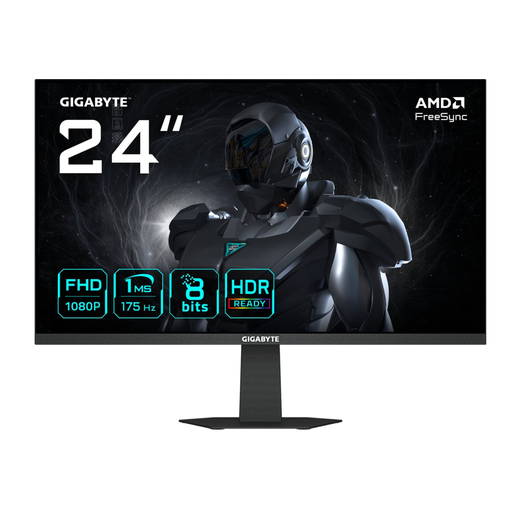
A compact Full HD option to compare when weighing up screen dimensions and positioning on your desk.
The product description lists a 23.8-inch Full HD IPS panel, 175 Hz, FreeSync and HDMI 2.0.
Tilt adjustment and VESA 100 × 100 mm are listed.
 No image available
A compact QHD option if you want extra pixel space on a desk with limited room and your computer supports the resolution.
The product description lists a 23.8-inch screen with 2560 × 1440 pixels, plus USB-C, HDMI and DisplayPort.
The stand is described as adjustable for height, tilt, swivel and pivot.
Not necessarily. Measure the available width and depth, including the stand and space for your mouse, and take your viewing distance into account. A screen around 24 inches is a sensible first option to compare when space is limited.
No, not for this type of gaming alone. RTINGS discusses high refresh rates mainly as a gaming and competitive feature; make sure you also consider readability, size and positioning when choosing.
It can, provided the monitor and arm are compatible and your desk can support the arm. Dell lists VESA 100 × 100 mm for the SE2422H; check compatibility separately for every other model.
Not automatically. Consider resolution alongside screen size, text scaling and viewing distance. RTINGS notes that text clarity is partly subjective, so two people may judge the same screen differently.
For a standard online purchase, you generally have a 14-day cooling-off period after delivery, subject to statutory exceptions. ACM ConsuWijzer distinguishes this from your statutory guarantee rights: if a product doesn’t meet reasonable expectations under normal use, you can ask the retailer for an appropriate solution.