
Racer with a narrow setup
Wants to know first whether the screen and stand will fit alongside the wheel and other equipment. Measure the available width and depth, then compare them with the monitor’s dimensions, including the stand.


For a compact racing setup, a single 27-inch 16:9 monitor is often the more practical choice. Consider a 34-inch 21:9 ultrawide only if it fits and your racing simulator and PC support its resolution. An ultrawide can give you more horizontal screen space without side monitors, but it needs more room and graphics processing power. Three monitors also require extra space and configuration. Measure from your usual racing position and adjust the field of view accordingly, as a larger screen doesn’t guarantee a better view of the corners.
Wants to know first whether the screen and stand will fit alongside the wheel and other equipment. Measure the available width and depth, then compare them with the monitor’s dimensions, including the stand.
Wants to see more of the track alongside the car when turning in, but doesn’t have room for three screens. Check whether your simulator supports 21:9 and take your viewing distance into account; iRacing uses this distance and the screen width when setting the field of view.
Wants a monitor that matches the video output and refresh rate their device can deliver. Check your device’s settings and output before paying for specifications you can’t use.
First measure the space and viewing distance from your usual racing position. Then weigh up track visibility, achievable smoothness and connectivity.
| What to consider | What to check | Who may value this more |
|---|---|---|
| Space for the complete setup | Measure the available width and depth, then compare them with the monitor’s dimensions, including the stand. Check the viewing distance too. | When my wheel, seat and screen are close together, I want to know whether the stand will fit. Around 36% of consumers put physical fit first. |
| Horizontal view of the track | Check whether your simulator supports the aspect ratio, then adjust the field of view to suit the screen width and viewing distance. | If you want a better view of corners and the track alongside the car, compare an ultrawide with the space you have and your game settings. Around 29% of consumers prioritise a useful horizontal view. |
| Image smoothness and resolution | Compare the resolution and supported refresh rate for each connection with what your PC can deliver in the simulator. | If I want smooth racing without putting unnecessary strain on my PC, I look at the balance between resolution and achievable refresh rate. Around 21% of consumers prioritise this balance. |
| Connection to your device | Check your device’s video output, cable, supported resolution and refresh rate, as well as the input you’ll use on the monitor. | If you want to keep using an existing PC or console, make sure the settings you choose are available through the connection you’ll be using. Around 14% of consumers prioritise compatibility. |
The width and depth of the monitor with its stand also determine whether it will fit alongside your wheel and seat.
Measure the available space and compare it with the model’s full dimensions before choosing.
If the stand doesn’t fit, you may need a different stand or a suitable mount.
An ultrawide is one wide screen; a three-screen setup needs separate side monitors and configuration for viewing distance and angles.
Choose based on the space you actually have and check which field of view your simulator supports.
A monitor’s stated maximum refresh rate isn’t automatically available with every combination of device, connection, cable and game.
For the exact model, check which resolution and refresh rate can be used together through the input you plan to use.
The UltraGear 27GS75Q-B is an example of a 27-inch 16:9 QHD gaming monitor for a more compact setup.
The CU34G2XP/BK is an example of a single 34-inch 21:9 screen as an alternative to a setup with side monitors.
The Dutch Odyssey G5 G55C is a 32-inch 16:9 QHD option between a 27-inch screen and a 34-inch ultrawide.
The MOBIUZ EX271Q is a 27-inch option to compare for adjustability and desk connections.
The Dutch 346E2CUAE/00 is a 34-inch 21:9 option for anyone who also uses the same space as a workstation.
This selection features 27-inch gaming monitors for a more compact racing setup. For each model, check that the connection and resolution are right for your PC or console.
 Image unavailable
The 27-inch size is worth comparing if you’re short on space.
The product name lists WQHD, 200 Hz and Rapid IPS.
 Image unavailable
The 27-inch size may suit a setup with limited available width.
The product name lists 2560 × 1440, 180 Hz, FreeSync Premium and HDR10. Connections listed: 2× HDMI 2.0 and 1× DisplayPort 1.4.
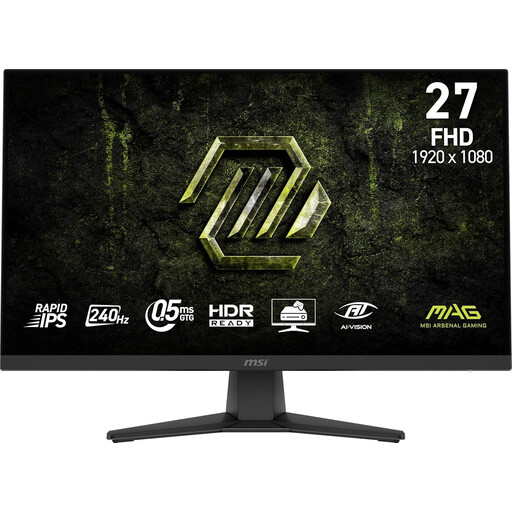 Image unavailable
This 27-inch option is worth comparing if Full HD suits your system’s output.
The product name lists 1920 × 1080, 240 Hz, AMD Adaptive Sync, HDMI and VGA.
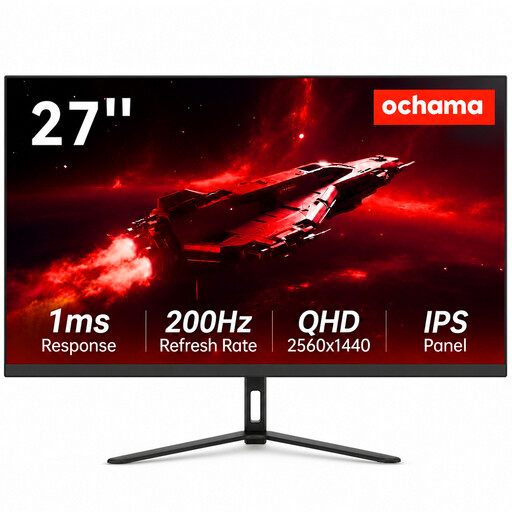 Image unavailable
The 27-inch size is a compact option to compare with the dimensions of your racing setup.
The product name lists a 200 Hz refresh rate and a 2K screen.
 Image unavailable
This 27-inch model is worth comparing if space for your screen is limited.
The product name lists QHD (2560 × 1440), 240 Hz and HDMI 2.1.
In iRacing, measure the distance from your eyes to the screen and the screen width from your usual racing position; the simulator uses this information to calculate the field of view. For other games, check their own display and field-of-view settings.
It may be an option if the monitor has a compatible VESA mount and the arm is suitable for both the screen and the mounting surface. The LG 27GS75Q-B and BenQ EX271Q list VESA 100 × 100 mm; also check the arm’s weight limit and whether your desk can support the mount.
Once connected, check which resolution and refresh rate are actually set in your operating system and game. A particular screen’s maximum specification isn’t automatically available with every combination of device, port and cable.
Compare the energy label for the exact monitor version; the European Commission includes computer monitors in its energy labelling rules for electronic displays. According to the Dutch government, there is no fixed statutory warranty period in the Netherlands, but the seller must supply a product that is fit for purpose and help resolve any problems. For distance purchases, you generally have 14 days to change your mind; check the terms that apply to your purchase.