For story-driven puzzle games in a shared bedroom, choose a monitor that fits on your desk, displays dark scenes comfortably and offers an audio option that suits the room. IPS is worth considering if you play with ambient light or have static images on screen for long periods. OLED can be appealing for dark scenes, but you’ll need to consider the risk of burn-in and prolonged exposure to static images.
Who is this guide for?
Quiet evening gamer
You share a bedroom and want to follow the story and dialogue without relying on your monitor’s speakers. Check for a headphone socket and consider how much room the screen and stand will take up. ASUS ROG, LG and BenQ list audio connections or speakers for the models mentioned.
Atmospheric gamer who plays in the dark
You mainly play dark, story-driven games and care about black levels. If you’re considering OLED, bear in mind the risk of burn-in when static elements remain on screen for long periods; RTINGS highlights this as a consideration with OLED screens.
Gamer sharing a desk
You use the same screen for other tasks or devices. In that case, size, adjustability and connections may matter more than the highest possible refresh rate. ASUS ROG and BenQ provide details including stand adjustability for the models mentioned.
What should you look for when choosing?
Start with the space available on your desk and the picture you want. Then decide how you’ll listen in a shared room, and check that your gaming device supports the picture mode you’ve chosen.
| What to consider |
What to check before buying |
Who should prioritise this? |
| Quiet listening |
Check whether the monitor has speakers or a headphone socket, and whether your PC or console can send audio to that connection. ASUS ROG lists no speakers for the XG27ACS, while BenQ lists a speaker system for the EX2710Q. |
If I want to hear the story and dialogue without sending sound around the bedroom, I look for a private listening option; around 33% of consumers in this situation prioritise quiet listening. |
| Dark scenes |
Compare IPS and OLED in the lighting conditions you play in. RTINGS describes OLED as offering deeper blacks and IPS as having advantages in bright rooms; with OLED, also consider prolonged exposure to static images. |
If I mainly play in the dark and atmospheric dark scenes matter to me, black levels are a key consideration; around 27% of consumers in this situation prioritise dark scenes. |
| Desk space |
Measure the available width and depth, then compare them with the monitor’s dimensions including the stand. Check the adjustability of the exact model too; ASUS and BenQ publish this information for the models mentioned. |
If I share a desk with someone else, I want to know whether the screen and stand will fit and can be positioned comfortably; around 20% of consumers in this situation give desk layout top priority. |
| Connection and picture mode |
Check the port on your PC or console, and the resolution and refresh rate available through it. ASUS lists a maximum of 180 Hz via DisplayPort or USB-C and 144 Hz via HDMI for the XG27ACS. |
If I want to use a particular picture mode, I check that my gaming device supports it through the connection I’ve chosen; around 20% of consumers in this situation prioritise platform compatibility. |
Pitfalls to avoid
-
Assuming HDR10 means convincing HDR picture quality
HDR signal support alone doesn’t tell you how dark scenes or HDR images will look on screen.
Alongside the exact model’s specifications, check independent reviews of its black levels and HDR performance.
-
Assuming a gaming monitor plays sound by itself
Speakers are included on some models but not others. According to ASUS, the ASUS ROG XG27ACS has no built-in speakers, while BenQ lists speakers for the EX2710Q.
Decide in advance whether you want to listen privately or share the sound, and check the speakers, headphone socket and source device separately.
You may need a separate pair of headphones or another audio solution for private listening.
-
Treating similar model names as the same product
The Alienware AW2725DM and AW2725D are different monitors. Dell specifies the AW2725D as a QD-OLED model, while the Joybuy product listing for the AW2725DM names an IPS panel.
Check the full model code and panel technology before matching product specifications or reviews to a listing.
Brands to compare
ASUS ROG
The XG27ACS and PG27UCDM suit different priorities around room lighting and picture quality.
- ASUS lists adjustability and multiple video connections for the XG27ACS.
- ASUS lists no built-in speakers for the XG27ACS and gives different maximum refresh rates for each connection. The PG27UCDM’s OLED care features don’t automatically eliminate the burn-in risk described by RTINGS.
LG UltraGear
The Dutch specifications for the 27GS75Q-B make it an IPS model to compare for a bright room or mixed use.
- LG lists QHD, an adjustable stand and a headphone output for the 27GS75Q-B.
- LG lists no speakers or USB-C for this model; these features aren’t automatically available on other models in the UltraGear range.
BenQ MOBIUZ
The EX2710Q is worth considering if you want to compare built-in monitor audio with private listening through headphones.
- BenQ lists both a headphone socket and a 2.1-channel speaker system for the EX2710Q.
- The listed availability and power ratings come from the manufacturer and don’t prove what the sound quality will be like in your bedroom.
Alienware
The AW2725D is a QHD QD-OLED model for anyone factoring dark scenes into their choice of panel.
- Dell lists a resolution of 2560 × 1440 and a refresh rate of 280 Hz for the AW2725D.
- Consider whether that refresh rate is relevant to your gaming device and how you use it. The AW2725DM is a different model with an IPS panel, so don’t treat it as the same monitor.
Joybuy monitors for this setup
These Joybuy products include IPS and OLED gaming monitors for story-driven puzzle games in a shared bedroom. Check each model for the audio option you want, its connections and the space available.
 No image available
MSI MAG 272QPF E20 27-inch QHD 200Hz Rapid IPS gaming monitor
An IPS model to consider if you’re looking for a 27-inch QHD gaming monitor.
The product information lists QHD, Rapid IPS and 200 Hz.
Joybuy
 No image available
Philips Evnia 27M2N3500NF 27-inch QHD IPS gaming monitor
An IPS model to compare if QHD gaming and private listening through headphones matter to you.
The product information lists 144 Hz, Adaptive Sync, HDMI 2.0, DisplayPort 1.4 and a headphone output.
Joybuy
 No image available
LG UltraGear 27GX704A-B.AEU 27-inch QHD OLED gaming monitor
An OLED model to consider if dark scenes are a priority. Bear in mind the risk of burn-in when static elements remain on screen for long periods, as RTINGS describes for OLED screens.
The product name lists QHD, 240 Hz, DisplayHDR 400 True Black, G-SYNC Compatible, FreeSync Premium Pro, 2× HDMI 2.1 and 1× DisplayPort 1.4.
Joybuy
 No image available
KTC H27D9 27-inch QHD IPS monitor
An IPS model to compare if you’re looking for a 27-inch QHD screen for gaming and other tasks.
The product name lists 2560 × 1440, 120 Hz, Adaptive Sync, HDMI, DisplayPort and VESA mounting compatibility.
Joybuy
 No image available
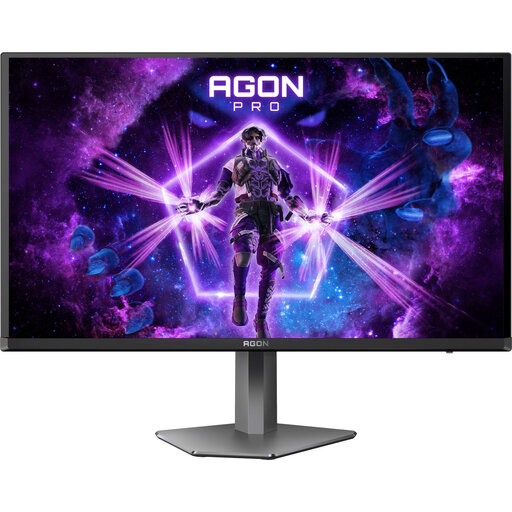
AOC AGON PRO AG276QZD2 27-inch QHD QD-OLED gaming monitor
This OLED model may suit you if you’re also considering built-in speakers. Bear in mind the risk of burn-in when static elements remain on screen for long periods, as RTINGS describes for OLED screens.
The product information lists QHD, built-in speakers, an adjustable stand and 240 Hz via DisplayPort compared with 144 Hz via HDMI.
Joybuy
Frequently asked questions
Should I choose the highest refresh rate for story-driven puzzle games?
No. Start with screen size, picture quality and connections. Then check which resolution and refresh rate your PC or console can use through the port you’ve chosen; a monitor’s maximum doesn’t necessarily apply to every connection.
How can I listen quietly when someone else is in the room?
Check whether you can connect headphones to the monitor or directly to your gaming device. ASUS lists a headphone socket but no built-in speakers for the XG27ACS; BenQ lists both on the EX2710Q.
What should I consider when using an OLED monitor for long periods?
Bear in mind the risk of burn-in if the same static elements remain on screen for long periods, as RTINGS describes for OLED. Read the care and warranty terms for the exact model too; protective features don’t prove that the risk has disappeared.
What should I expect regarding returns and warranties after an online purchase in the Netherlands?
For eligible online consumer purchases, you generally have a 14-day cooling-off period, subject to exceptions explained by the Dutch government. If a product is faulty, the seller must provide a solution. The Netherlands has no fixed statutory warranty period of exactly two years.
Which Dutch or European rules are relevant to a monitor?
Electrical appliances placed on the Dutch market must meet the applicable European safety requirements and CE obligations for businesses, as explained by Ondernemersplein. The European Commission also describes energy labels for electronic displays. These labels help you compare energy classes, but don’t in themselves show whether a specific listing complies with all the rules.


