
Gamers with limited desk space
You want to know whether the screen, stand and cables will fit. So compare the dimensions of the complete set-up, not just the diagonal measurement.


First, measure the space for the screen, stand and cables; the screen size in inches alone won’t tell you whether a monitor will fit on your desk. Then choose between a more compact screen and greater QHD detail, and weigh up an OLED panel against how you’ll use it and the terms for the specific model. Finally, check that your PC or console supports your preferred resolution and refresh rate through the connection you’ve chosen.
You want to know whether the screen, stand and cables will fit. So compare the dimensions of the complete set-up, not just the diagonal measurement.
You prioritise detail, colour or dark scenes, as long as a larger screen will fit your set-up.
You want to check that your device and chosen connection support the resolution and refresh rate you’re aiming for.
First, measure the space available for the complete monitor set-up. Then compare the screen size and panel type with your source device’s capabilities and the monitor’s connections.
| What to consider | What should you check? | Who is this important for? |
|---|---|---|
| Desk space | Measure the available width and depth, then compare them with the dimensions including the stand. Leave room for cables. | If your desk has little free space, you’ll want to make sure the complete set-up will fit. That’s why around 36% of consumers prioritise the space required. |
| RPG detail and picture quality | Compare the resolution and dimensions of the exact model; consider colour and HDR claims separately. | If detail and atmosphere in RPGs matter more to you than compactness, focus on the screen’s picture capabilities. Around 29% of consumers prioritise RPG detail. |
| Connection and output | Check the limits of the monitor port, cable and output from your PC or console. | If you want to avoid a connection limiting your preferred picture settings, check the whole set-up. Around 21% of consumers prioritise connection and output. |
| Contrast and panel type | Read the care instructions and warranty terms for the specific OLED model, especially if menus or HUD elements will remain on screen for long periods. | If contrast matters to you, weigh it against the conditions of use for the panel you choose. Around 14% of consumers prioritise contrast and panel type. |
The screen size won’t confirm whether the stand and cables will fit on your desk.
Measure the available width and depth, then compare them with the dimensions of the exact model, including the stand.
A stand that’s too deep may mean you need to position the monitor differently.
The maximum setting can vary by connection. Your source device and game also need to support the output you want.
Check the specifications for the specific input and match them to your device, game and cable.
A setting you can’t use through your chosen connection may not benefit your set-up.
According to ACM ConsuWijzer, the seller remains responsible if a product doesn’t meet what you could reasonably expect from it when used normally.
Read the terms of any commercial warranty separately and compare them with your statutory rights before choosing additional cover.
An optional warranty may have terms that differ from your statutory protection.
The AOC 24G4X is a compact-screen option to consider if desk space is a priority.
The LG UltraGear 27GS85Q-B is a 27-inch QHD IPS option for desks with enough space.
Dell offers two different examples here: the G2725D’s QHD IPS option and the Alienware AW2725D’s QHD QD-OLED option.
These products are suited to a compact gaming set-up. For each model, check that the dimensions and connections work with your desk and source device.
 No image available
A portable option to consider if you have limited desk space; check that the connections work with your PC or console.
The product name lists a 16-inch FHD IPS display, 144 Hz, 16:10, two USB-C connections and Mini HDMI.
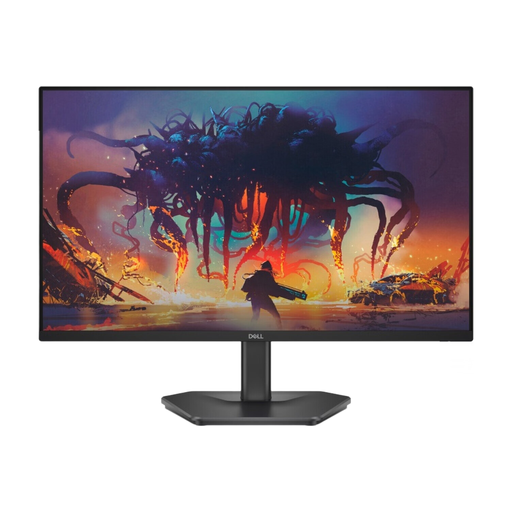 No image available
A 24-inch model to include in your comparison if you’re looking for a more compact screen; measure the space needed for the complete set-up.
The product name lists model SE2425HG and 200 Hz.
 No image available
This 24-inch option may suit a compact set-up; check that the connections match your source device.
The product name lists FHD, IPS, 144 Hz, Adaptive Sync, HDMI and DisplayPort.
 No image available
A portable size to consider if desk space is the deciding factor; check the connection on your source device.
The product name lists a 15.6-inch Full HD display and speakers.
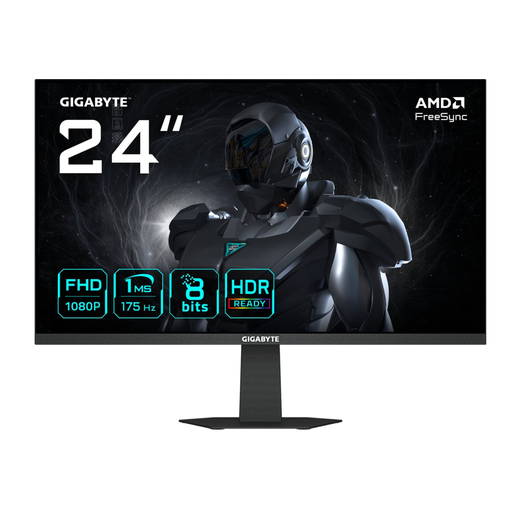 No image available
A model to compare for a compact gaming set-up; check the full dimensions and connections of the version on offer.
The product name lists model GS24F14A and a screen size of 60.4 cm.
Measure the available width and depth, then compare them with the dimensions of the exact model, including the stand. Allow space for cables too, and don’t rely on the screen size in inches alone to estimate the depth you’ll need.
The limit can vary by input. Dell lists up to QHD at 180 Hz via DisplayPort and 144 Hz via HDMI for the G2725D; also check the output supported by your own device and game.
Read the care instructions and warranty terms for the model you choose, especially if fixed RPG menus or HUD elements remain on screen for long periods. The terms for another OLED model won’t necessarily apply to this version.
According to ACM ConsuWijzer, online purchases usually come with a statutory 14-day cancellation period from the day after delivery; check the applicable exceptions and return instructions. Your statutory guarantee rights are separate from the manufacturer’s warranty: if a product doesn’t meet what you could reasonably expect from it when used normally, the seller is responsible for providing an appropriate solution.
According to the European Commission, electronic displays are covered by EU energy labelling rules. The seller must show the label information at the point of sale; compare the label and product information sheet for the specific model.