
Shadow-detail analyst
Wants to assess dark areas and details in scenes without losing sight of motion. RTINGS notes that VA panels generally offer more contrast than IPS; also check the black uniformity of the specific model.


Choose OLED if you want to assess both black detail and fast scene changes in dark scenes, and are prepared to consider the risk of interface elements remaining static for long periods. A VA or IPS LCD may be a better fit if menus will be visible for extended periods; for every model, compare black uniformity and measured motion handling too, as a high Hz rating or low ms figure doesn’t tell the whole story.
Wants to assess dark areas and details in scenes without losing sight of motion. RTINGS notes that VA panels generally offer more contrast than IPS; also check the black uniformity of the specific model.
Replays fast-paced action repeatedly and wants to track movement clearly. As well as the stated refresh rate, look for independent measurements of motion handling and pixel transitions.
Keeps timelines, scoreboards or analysis menus on screen for long periods, so also takes into account the risks of static elements, panel protection and warranty terms.
Start with what you want to assess in the replay: dark details, fast motion, a menu that stays visible for a long time or small elements in the analysis view. Then check that your replay source supports the required resolution and refresh rate through the connection you plan to use.
| What to consider | What to look for when buying | Who is this important for? |
|---|---|---|
| Black detail and uniformity | Compare the contrast and black uniformity of the exact model, including with dark images that contain bright objects. | If I want to see small differences in dark scenes, I prioritise black performance over the other factors. Around 33% of consumers prioritise black detail. |
| Tracking motion | Check motion and pixel-transition measurements at relevant refresh rates; a GtG figure alone isn’t a complete motion measurement. | If I watch fast-paced action repeatedly, I want to track movement without dark transitions making the image look blurred. Around 27% of consumers prioritise motion clarity. |
| Menus visible for long periods | With OLED, take into account the risk of static elements remaining on screen for long periods, panel protection and the warranty terms for the exact model. | If my timeline or scoreboard stays in the same place for a long time, suitability for displaying static images is a major consideration. Around 20% of consumers say this is their main concern. |
| Analysis view and connection | Check the screen size, resolution and supported resolution and Hz for each input on your PC or console. | If I want to assess small on-screen elements, my source must be able to output the chosen resolution and refresh rate. Around 20% of consumers prioritise screen space and connectivity. |
These figures don’t fully show how dark, moving objects appear on the specific screen. Your replay source and connection also matter.
Look at independent motion tests at speeds that match your usage, and check which resolution and refresh rate your source supports through the input you plan to use.
A setting that improves visibility in dark scenes changes how the image is displayed, but it doesn’t make the black performance of a TN or IPS panel equivalent to OLED.
Assess the settings separately from the model’s measured contrast and black uniformity.
Keeping the same interface elements on screen for long periods carries a risk of burn-in with OLED. Protective features don’t eliminate that risk, and terms vary by model.
Read the cover that applies to the exact model and use the recommended panel protection. Keep the manufacturer’s warranty separate from your statutory rights.
A panel issue that isn’t covered may have to be paid for out of your own pocket; what applies depends on the terms for the model.
According to ASUS ROG Netherlands, the ROG Swift OLED PG32UCDM Gen3 (PG32UCDM3) combines a 31.5-inch 4K QD-OLED screen with a refresh rate of up to 240 Hz.
According to MSI, the MPG 271QRX QD-OLED is a 27-inch QHD model with a stated refresh rate of up to 360 Hz.
According to BenQ, the XL2566X+ is a Fast-TN esports monitor with 400 Hz, DyAc 2 and Black eQualizer.
According to AOC, the Q27G4X is a 27-inch QHD Fast IPS model with 180 Hz; the AGON PRO AG326UD is a separate 31.5-inch 4K QD-OLED option with 165 Hz.
These models offer VA LCD and OLED options for assessing dark scenes, motion and replay elements that remain visible for long periods.
 No image available
The Rapid VA version is a good fit if you’re considering a VA LCD for dark scenes without the specific OLED trade-off around static images remaining on screen for long periods.
WQHD (2560 × 1440), 240 Hz and 0.5 ms are listed in the product name. For dark moving scenes, compare measurements for the model too.
 No image available
OLED is a good fit if you want to assess dark scenes; if your replay interface includes elements that stay visible for long periods, bear the risk of burn-in in mind.
QHD (2560 × 1440), 240 Hz and a 0.03 ms response time are listed for this model. The title mentions HDMI 2.1 and DisplayPort 1.4.
 No image available
This QD-OLED option is a good fit if black detail and fast replay footage matter to you; static images displayed for long periods remain a consideration.
WQHD, 240 Hz, 0.03 ms and 400 cd/m² are listed in the product name. 2× HDMI, DisplayPort and USB Type-C are also mentioned.
 No image available
The QD-OLED version is a good fit if you want to assess dark scenes and the extra resolution detail offered by 4K. Bear in mind the risk of interface elements remaining static for long periods.
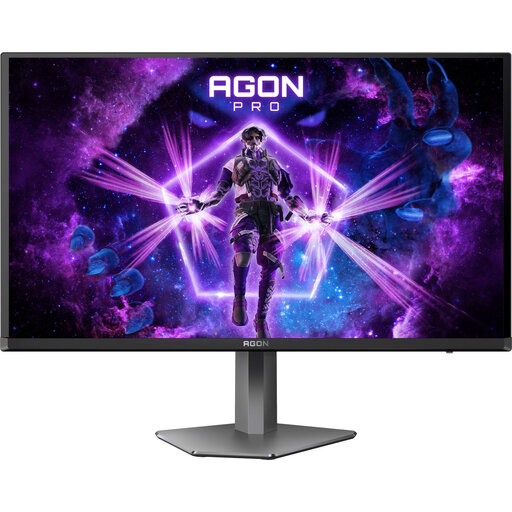
The product specifications list 3840 × 2160 pixels, 240 Hz and a 0.03 ms response time.
 No image available
The QD-OLED version is an option if you want to assess dark scenes; if replay elements will stay visible for long periods, factor the risk of OLED burn-in into your decision.
QHD (2560 × 1440) and 240 Hz via DisplayPort are listed. Via HDMI, 144 Hz is stated; the product name also mentions 2× HDMI, 2× DisplayPort and adjustable height, rotation, swivel and tilt.
No, 400 Hz alone doesn’t determine how useful motion will be in a replay. That also depends on the source and measured pixel transitions; check which resolution and refresh rate your connection supports.
Use the panel protection recommended for your model and avoid leaving a static image on screen for longer than necessary. ASUS, for example, recommends keeping the OLED Care features enabled; also check your model’s terms and warranty.
Compare the EU energy labels of screens that suit your preferred size and resolution, and check the HDR information provided too. The European Commission explains what information is shown on the label for electronic displays; the label class alone doesn’t calculate your costs.
If there’s a problem, contact the seller about your statutory rights. According to the Dutch government, the Netherlands has no fixed statutory warranty period; what you can expect from a product depends, among other things, on the product and normal use. Any manufacturer’s warranty is separate.
Computer monitors are covered by the European energy-labelling rules. The European Commission explains the labelling and information requirements for businesses placing products on the market; as a private buyer, you don’t need to register anything.