
Puzzle player who wants to see every detail
You’re comparing resolution and screen space so you can clearly see text, clues and details in the surroundings. Tweakers discusses 27-inch QHD gaming monitors, among other models.


A compact Full HD screen may be a better fit for a small desk, while 27-inch QHD gives you more pixels for fine details if your desk and gaming device can accommodate it. Philips lists Full HD for the 23.8-inch 24M2N3200A/01, while Tweakers discusses 27-inch QHD models. OLED is worth considering if contrast is a priority, but bear in mind possible limitations with text, ambient light and long periods of static images.
You’re comparing resolution and screen space so you can clearly see text, clues and details in the surroundings. Tweakers discusses 27-inch QHD gaming monitors, among other models.
You want to play without disturbing your room-mate with sound. Check the audio output on the exact monitor model and the connection options on your PC or console; built-in speakers are not the same as a headphone socket.
Start by comparing the dimensions of the screen and stand, then consider Full HD or QHD. Philips lists a 23.8-inch diagonal and Full HD resolution for the 24M2N3200A/01.
First, work out how much space you have and which resolution your PC or console can handle. Then check the audio connections, before considering refresh rate or panel type in light of how you’ll use the monitor.
| What to consider | What should you check? | Who should give this more weight? |
|---|---|---|
| Readability and detail | Compare 23.8-inch Full HD with 27-inch QHD at your viewing distance, and check which resolution your gaming device supports. | I want to see small clues and in-game text clearly; around 36% of consumers prioritise readability and image detail. |
| Sound in a shared room | Check whether the exact model has a headphone socket and how your PC or console sends audio to the monitor. | I want to play without disturbing my room-mate with sound; around 29% of consumers prioritise an audio setup that works in a shared room. |
| Desk space | Measure the available width and depth, then compare them with the dimensions of the screen, including the stand. | I need to fit the screen on a small desk; around 21% of consumers give the available desk space the greatest weight. |
| Device and usage | Check the supported resolution and refresh rate for each connection; with OLED, also consider static images and warranty terms. | I want to choose features that suit my PC or console and how I use it; around 14% of consumers prioritise device compatibility and cost. |
A high refresh rate alone doesn’t tell you whether clues and small details will be easy to read. Tweakers covers gaming models with high refresh rates, but that feature isn’t necessarily a deciding factor for slower-paced puzzle games.
First decide on your preferred size, resolution and what your PC or console can handle. Then compare refresh rates.
Speakers and a headphone socket are different features. BenQ lists both for the EX2710Q, but check the connections on every other model individually.
Also check how audio is sent from your PC or console to the monitor.
Tweakers notes the risk of burn-in with OLED and highlights limitations with text and black levels in ambient light on the Gigabyte MO27Q2A.
Weigh the contrast against your use of static interfaces, the amount of ambient light in the room and the warranty terms for the exact model.
The 24M2N3200A/01 is a compact Full HD option for a small desk.
The EX2710Q is a 27-inch QHD model for which BenQ specifies audio features and adjustability.
The Q27G4ZR is a 27-inch QHD IPS model that Tweakers discusses as an alternative in its selection of gaming monitors.
The MO27Q2A is a 27-inch QHD QD-OLED option.
The 27GX704A-B is a specific example of a 27-inch QHD OLED monitor.
This selection features gaming monitors around 27 inches with QHD or 2K resolution. Check the dimensions, connections and supported signals to make sure they suit your desk and PC or console.
 Image unavailable
Worth comparing if you’re looking for QHD on a 27-inch screen to see small in-game details.
Listed features: 2K WQHD, 200 Hz and Rapid IPS.
 Image unavailable
A good fit for your comparison if you’re looking for a 27-inch Quad HD gaming monitor; measure the space for the screen and stand first.
Listed features: 180 Hz, 1 ms, FreeSync Prem., HDR10, 2560 × 1440, 2× HDMI 2.0 and 1× DisplayPort 1.4.
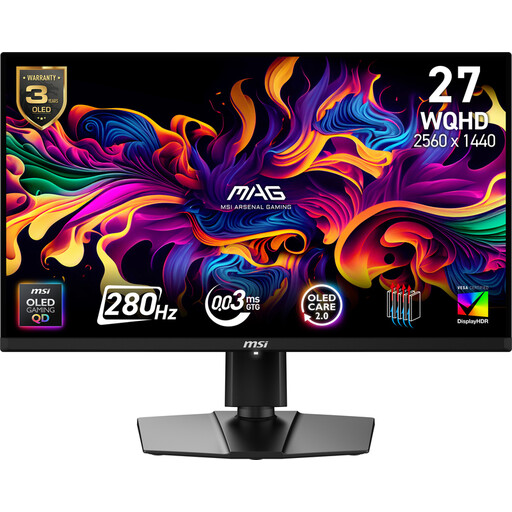 Image unavailable
An OLED option to consider if contrast matters to you; bear in mind prolonged use of static game interfaces and the warranty terms.
Listed features: WQHD, 280 Hz and OLED. Tweakers notes the risk of burn-in with OLED screens.
 Image unavailable
Worth including in your comparison if you’re looking for QHD at 27 inches; check that the audio connections suit playing in a shared room.
Listed features: IPS, 144 Hz, 0.5 ms, HDR10, DisplayPort 1.4 and HDMI 2.0.
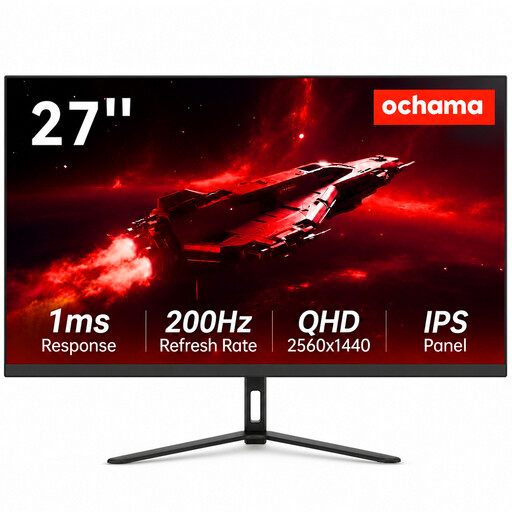 Image unavailable
A 27-inch option to compare if you’re looking for a gaming monitor for your desk; measure the available space before making your choice.
Listed features: 2K Ultra HD and a 200 Hz refresh rate.
Compare the available width and depth with the stated dimensions, including the stand. BenQ lists a stand depth of 252.5 mm and 100 mm of height adjustment for the EX2710Q; these measurements apply to that model only.
It depends on the model. BenQ lists a headphone socket for the EX2710Q. Also check whether your PC or console sends audio to the monitor through the connection you’re using; built-in speakers don’t automatically mean there’s a headphone socket.
No, it’s not a general requirement for puzzle adventures. Tweakers discusses these refresh rates for specific gaming models; first compare the resolution and screen size with what your own gaming device can handle.
Weigh the contrast you want against prolonged static images, ambient light and the warranty terms for the exact model. Tweakers notes the risk of burn-in with OLED, as well as limitations with text and picture quality in ambient light on the Gigabyte MO27Q2A.
For a consumer purchase, the seller must offer a solution under Dutch government guidance if a product is faulty; there is no fixed statutory warranty period in the Netherlands. For online purchases from a business, a 14-day cooling-off period applies in many cases. Check the applicable terms and exceptions.