
Map and menu reader
You play information-rich simulations and want to follow maps and menus on a large screen without the text becoming uncomfortably small.


Start by checking how easy maps and menus are to read from your usual viewing distance, then compare how much extra detail or horizontal space you want. A large QHD screen, a 4K screen and an ultrawide monitor each involve different trade-offs. Also check that your PC can handle the resolution you want and how your game displays its interface.
You play information-rich simulations and want to follow maps and menus on a large screen without the text becoming uncomfortably small.
You want to compare finer map and text detail, and are happy to check the scaling settings in your game and operating system.
You’re looking for extra horizontal screen space and want to check whether ultrawide suits your simulation, desk and viewing distance.
Choose this if: you mainly want a physically large map and menu display, and 4K detail isn’t your priority.
Trade-off: check how easy the text is to read from your viewing distance; 165 Hz doesn’t tell you how many frames your PC will deliver in a game.
Choose this if: finer map detail and text are important, and your PC can handle the resolution you want.
Trade-off: check whether interface elements remain comfortable to read if you need to adjust the scaling.
Choose this if: you want more horizontal space for your map and interface, and your game displays well in a wider format.
Trade-off: factor in the space on your desk and check how the games you play look on the screen.
| What to consider | What to check before buying | Who is this important for? |
|---|---|---|
| Map and menu readability | Compare screen size and resolution together. LG lists the 32GR75Q-B as 31,5 inch with 2560 × 1440 pixels. Also check the scaling settings in your game and, if you use Windows, in Windows. | If your main priority is keeping maps and menus readable from your viewing distance, make that your starting point. Around 36% of consumers say readability is their top buying priority. |
| Extra detail on a large screen | Compare the exact resolution and screen size. Dell lists the S3225QS as 31,5 inch with 3840 × 2160 pixels. Check how the interface looks in your own game and, if needed, adjust the Windows scaling setting. | If finer map detail matters more to you than the other trade-offs, see how the interface looks at a high resolution. Around 29% of consumers prioritise extra detail. |
| Horizontal space | Check the resolution, the space available on your desk and how ultrawide looks in the games you play. Philips describes the 34M2C3500L/00 as a curved 34-inch model with 3440 × 1440 pixels. | If you want more side-by-side space for your map and interface, check that your game makes use of the extra width and that your desk can accommodate the monitor. Around 21% of consumers prioritise horizontal space. |
| Refresh rate for a mix of games | Compare the maximum Hz rating of the exact model with what your PC can support. LG lists up to 165 Hz for the 32GR75Q-B and Dell up to 120 Hz for the S3225QS; these figures alone don’t determine a game’s frame rate. | If you play other games as well as simulations and smoothness is important to you, compare the stated refresh rate with your PC’s capabilities. Around 14% of consumers prioritise smoothness across different types of games. |
A screen of around 32 inch could have QHD or 4K resolution. The diagonal measurement alone won’t tell you how many pixels you get or how large the interface will appear.
Compare screen size and resolution together, then check how easy the text is to read from your usual viewing distance.
An ultrawide monitor has a different shape and resolution from a large 16:9 screen. How the extra width is displayed depends on the game.
Check how your own games display on the screen and measure the available space on your desk beforehand.
A wider monitor also needs more desk space.
According to ACM ConsuWijzer, your statutory rights exist alongside any warranty from the retailer or manufacturer.
Keep your purchase and product information, and if something goes wrong, remember your statutory rights with the retailer too.
The LG UltraGear 32GR75Q-B is an example of a large QHD gaming screen. LG lists this model as having a 31,5-inch IPS panel with 2560 × 1440 pixels and a maximum refresh rate of 165 Hz.
According to Dell, the Dell 32 Plus S3225QS is a 31,5-inch 4K alternative with a maximum refresh rate of 120 Hz.
The Philips Evnia 34M2C3500L/00 is an example of an ultrawide monitor, with a curved 34-inch Fast VA panel, 3440 × 1440 pixels and, according to Philips, a 180 Hz refresh rate.
These Joybuy products are options to compare when looking at large 4K screens and ultrawide formats for political simulations.
 No image available
A large 16:9 screen for comparing 4K detail with how easy maps and text are to read from your viewing distance.
The product name lists QD-OLED, up to 165 Hz, 0.03ms and USB-C.
 No image available
An ultrawide option for checking whether extra horizontal space works with the way your game is displayed and the space on your desk.
The product name lists an 86.4 cm (34-inch) LCD screen with 3440 x 1440 pixels.
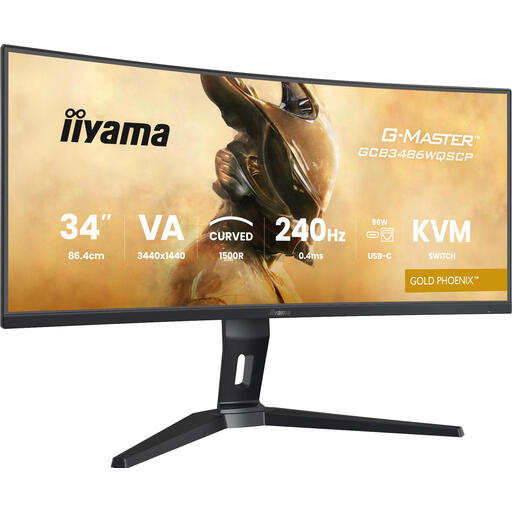 No image available
A curved gaming monitor to compare if you’re looking for a wide view. Check how your games display the interface and whether the screen will fit on your desk.
The product name lists a 240 Hz refresh rate.
 No image available
An ultrawide option to compare if you want extra horizontal space; how useful it is depends on the game display and the space on your desk.
The product name lists 3440 x 1440 pixels.
 No image available
An extra-wide format to consider if horizontal space is your priority; check how your games display and how the monitor will fit on your desk.
The product name lists 32:9, DQHD 5120 x 1440, 165 Hz, a 1500R curvature and a VA panel.
No. Compare both the screen size and resolution, and check whether maps and menus are easy to read from your viewing distance. A 31,5-inch QHD screen and a 31,5-inch 4K screen have different pixel counts. In Windows, you can adjust the scaling of text and apps if needed.
First, select the correct display and check the resolution and scaling under Display settings. Then check in your game that the text and interface look the way you want.
Compare the energy label and product information for the exact monitor model. According to the European Commission, the EU energy label for electronic displays uses a scale from A to G. If you buy as a consumer in the Netherlands, you also have statutory rights if a product doesn’t do what you could reasonably expect under normal use; a voluntary manufacturer’s warranty doesn’t replace those rights.
For online consumer purchases in the Netherlands, you generally have a statutory cooling-off period of up to 14 days after delivery. ACM ConsuWijzer explains this period; check the applicable terms and exceptions before ordering.