
Map explorer
Wants to read routes, markers and small details without losing sight of the balance between sharpness and an achievable frame rate. RTINGS discusses this trade-off between resolution and the demands placed on the graphics card.


If you want to learn map details during long multiplayer sessions, a 27-inch QHD monitor can offer a good balance, provided your PC can achieve the frame rate you want. Also compare independent motion tests, the resolution and refresh rate available through each connection, and the stand’s adjustability. OLED may be a good choice if contrast and fast pixel transitions are priorities, but bear image retention in mind if you often use a fixed HUD.
Wants to read routes, markers and small details without losing sight of the balance between sharpness and an achievable frame rate. RTINGS discusses this trade-off between resolution and the demands placed on the graphics card.
Wants to keep track of the surroundings during fast camera movements, so looks beyond the refresh rate alone. RTINGS also discusses the importance of motion clarity.
Wants to adjust the screen position and readability to suit their setup, and change posture during extended use. The Arboportaal advises alternating your posture and regularly looking away when working at a screen.
Start with what matters most when learning maps: distinguishing details, following movement or creating a comfortable screen setup. Then check whether your PC and connection can handle the display settings you want.
| What to consider | What to check before buying | Best suited to |
|---|---|---|
| Map detail and readability | Check the native resolution, screen size and your PC’s performance in the game. Assess how easy text and symbols are to read from your usual viewing distance. | If I want to distinguish routes and small map markers clearly, I look at how readable they are from my usual position. Map detail is the top priority for around 28% of consumers with this purchase in mind. |
| Motion clarity | Compare independent motion tests at the frame rates you use, as well as the stated refresh rate. | When I want to keep the surroundings clear during fast camera turns, I look beyond the refresh rate alone. Motion clarity comes first for around 22% of consumers. |
| Adjustability for long sessions | Check the height and tilt adjustments, desk space, reflections and readability. Also change your posture and take short breaks. | If I play for long periods, I want to adjust the monitor to suit my desk and sitting position. Screen adjustment is the top purchase priority for around 22% of consumers. |
| Connections and frame rate | For your PC or console, check the resolution and refresh rate supported by each port, the cable used and whether variable refresh rate is supported. | I want to use the display setting I’ve chosen with my own device, rather than relying on the product name alone. Connecting to a device is the top priority for around 17% of consumers. |
| Panel use and energy information | For OLED, check the usage and warranty conditions for the exact model. Compare the official energy label and product information. | If I often play the same game for long periods with a fixed HUD, I take that into account and check the energy information too. Long-term panel use is the main consideration for around 11% of consumers. |
Response time, refresh rate and the display settings available for each input describe different features. A stated GtG figure is no substitute for an independent motion test.
Compare motion tests where available, and check the input specifications for the exact model.
Image retention remains a consideration if you use the same static on-screen elements for long periods. The stress tests on TVs cited by RTINGS do not predict the lifespan of a specific monitor.
Consider your usage pattern and read the terms and care instructions for the exact OLED model.
For the MSI MAG 272QPF E20, MSI lists QHD at up to 200 Hz via DisplayPort and up to 144 Hz via HDMI. The Joybuy listing for this model also includes different resolution and refresh-rate figures.
Before choosing a model, compare the full model code, panel details, resolution and port specifications with the manufacturer’s information.
The Q27G3XMN/BK is an example of a 27-inch QHD monitor with VA and Mini-LED, for those who also want to compare contrast and HDR.
The ROG Strix XG27ACS is a QHD IPS model for weighing up map detail and motion together.
The AW2725QF offers a dual-mode option for those who want to switch between resolution and refresh rate.
The MAG 272QPF E20 is an example of a 27-inch QHD IPS monitor with a high stated refresh rate.
The tested Odyssey OLED G6/G60SD S27DG60 is an example of the QHD OLED option for fast-paced games.
This selection brings together QHD gaming monitors for map detail and fast multiplayer action. The models differ in panel technology, screen size and adjustability, among other features.
 No image available
A good fit if you want to combine QHD map detail with a high stated refresh rate.
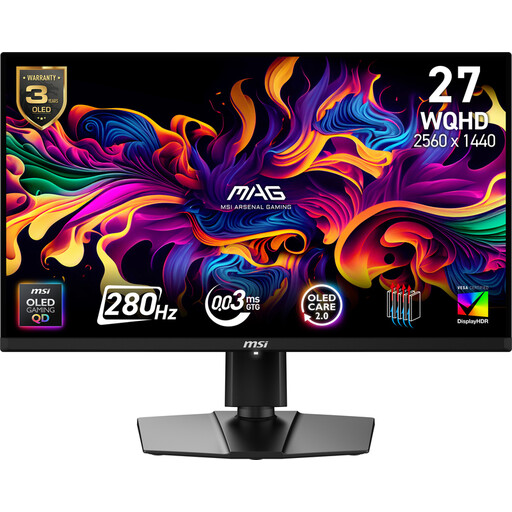
26.5-inch QD-OLED panel; 2560 × 1440; 280 Hz; height, tilt, swivel and pivot adjustment. OLED burn-in is a consideration if you use the same fixed game HUD intensively for long periods; available sources do not predict the lifespan of this specific model.
 No image available
A good fit if you’re looking for a QHD screen for map detail and fast multiplayer action.
27 inches; 2560 × 1440; 240 Hz standard and up to 260 Hz overclocked; height, tilt, pivot and swivel adjustment.
 No image available
A good fit if you’re looking for QHD map detail and a high stated refresh rate in a QD-OLED model.
26.5 inches; 2560 × 1440; 240 Hz; 0.03 ms GtG; 130 mm height adjustment, plus tilt, swivel and pivot adjustment. OLED burn-in is a consideration if you use the same fixed game HUD intensively for long periods; available sources do not predict the lifespan of this specific model.
 No image available
A good fit if you’re looking for QHD map detail and fast motion in a QD-OLED monitor.
27 inches; 2560 × 1440; 280 Hz; height, tilt, swivel and pivot adjustment. OLED burn-in is a consideration if you use the same fixed game HUD intensively for long periods; available sources do not predict the lifespan of this specific model.
 No image available
A good fit if you want a larger curved screen for viewing map detail and motion.
32 inches; VA panel; 1500R curvature; 2560 × 1440; 165 Hz; FreeSync; tilt adjustment and 100 × 100 mm VESA mounting.
Adjust the screen and furniture to suit your body, reduce reflections and make sure symbols are easy to read. The Arboportaal also advises changing your posture, looking away regularly and taking microbreaks when using a screen. Workplace rules for employers do not automatically apply as legal requirements for gaming at home.
The available display setting depends on the model, input and connected device. MSI specifies QHD at up to 144 Hz via HDMI and QHD at up to 200 Hz via DisplayPort for the MAG 272QPF E20. Check the specifications for the exact model and set your preferred option on your device.
For online purchases from a business, a 14-day cooling-off period applies in many cases, according to the Rijksoverheid; check which terms apply to your purchase. Products must also meet the terms of the agreement under normal use. According to ACM ConsuWijzer, the seller is responsible for providing a suitable solution if they do not; the statutory guarantee period has no fixed duration.
The EU energy label provides information to help you compare electronic displays, including computer monitors. The European Commission describes a scale from A to G; the label alone does not show whether a specific retailer listing is complete.